An Afternoon in Coppell

You do what you have to do to get where you want to be.

I start the three and a half hour drive to Coppell at eight-thirty. I don’t need to be there until one-fifteen or so, but delays can happen on the road and after going to the trouble to write and practice this speech, I don’t want to let Adrienne, the organizer of this event, or myself, down.

I’m on my way to read a few chapters from both my books and then to share my experience of taking a book from the first sentence to publication. Apparently hearing authors read their own work is a treat for the readers, though I’ve never been happy with the way I talk so fast or my silly accent. It’s surreal that there are people fond enough of my books to want to hear me read from them.

On my mind as I cover the miles is the novelty of my own ambition. For a quarter of a century I told David that my dream was for someone to like one of my books well enough to publish it. Just one. In my fantasy I was humble. And how embarrassing it was to tell people I was a writer but I had no publisher to stand behind my work. 

And now two novels have been published and it’s not enough. I want an entire library shelf loaded with books that bear my name. How bizarre it is that at sixty-one I’ve become consumed by aspiration. I’m just beginning when others are winding down. I’ve completed three installments of my mystery series and I want someone to love it as much as I do. 

Meet my main character:

I’m Fran Furlow and I work in a dermatologist’s office. Thankfully I have no part in handling the oozing sores and flakey moles that walk through the door. That’s for Dr. Hamm and his nurse, Hazel, to do. I’m the receptionist, a job that carries very little responsibility and leaves me free to attend my support groups and take care of my friends. 

Don’t you love her already? She’s out in the world now, getting looked over by others who will make decisions about what happens to her. And the reason I’m obsessing over her is because when I get to the end of this drive I’m expected to stand in front of many people and give a talk. And I don’t want to think about that. Nevertheless—

I use my family for inspiration. Curtis deposes witnesses and argues in court. Sam lectures at universities, sits on panels, and interacts with Chinese people on Chinese TV in what is evidently fluent Mandarin. Where did this self-assurance come from? And David, also, was always giving technical presentations to strangers. 

Aloud, I tell myself, “If the boys I raised and the man I’m married to can do it, so can I.”

I’m met at the Cozby Library in Coppell by Adrienne, Frank, and Steve, who represent the Friends of the Library. They’ve all read Old Buildings in North Texas, the book I’m here to publicize. (Honestly, I feel like I’ve been publicizing it forever. This is what happens when books get released twice—once in the UK and now in the states. Why Stuff Matters will be out here in June and then it’ll be another round of here we go again.)

The three of them tell me how much they enjoyed the book, which makes me grateful that they gave it a chance. People telling me that they like my books is a huge thrill. On the other hand, I’m a quiet person, not used to being the center of attention. As their guest author, I must temporarily put aside my reticent ways. 

I’m introduced to the audience, about thirty people, a respectable number. As OBiNT was discussed at their library’s book group this month, most are familiar with it. 

The reading goes well, with laughter in the appropriate places and only a few tongue stumbles. The prepared talk—well, I get through it. I make plenty of eye contact and have interesting stories to tell. And what is unusual is that as I’m speaking my mind divides into two halves; and one of these halves is really nervous and the other says slow down, stay calm, you’re doing fine. I believe this is the first time I’ve ever experienced this two-headed phenomenon. Thank you, the nervous half of my brain says to the encouraging half. 

The Q & A is the fun part because the book is funny, so the audience assumes that I am also funny, which I am. One woman asks me to expound on the experience of working with an editor and another gives me kudos for leading her to enjoy a self-centered and devious protagonist. The pleasure these people found in the novel is one big stroke for my ego. 

Never in a million years did I see myself doing what I’m doing right now. I have another one of these talk-and-reads in April and I think it will be easier and I’ll do better. Like I said, you do what you have to do to get where you want to be.
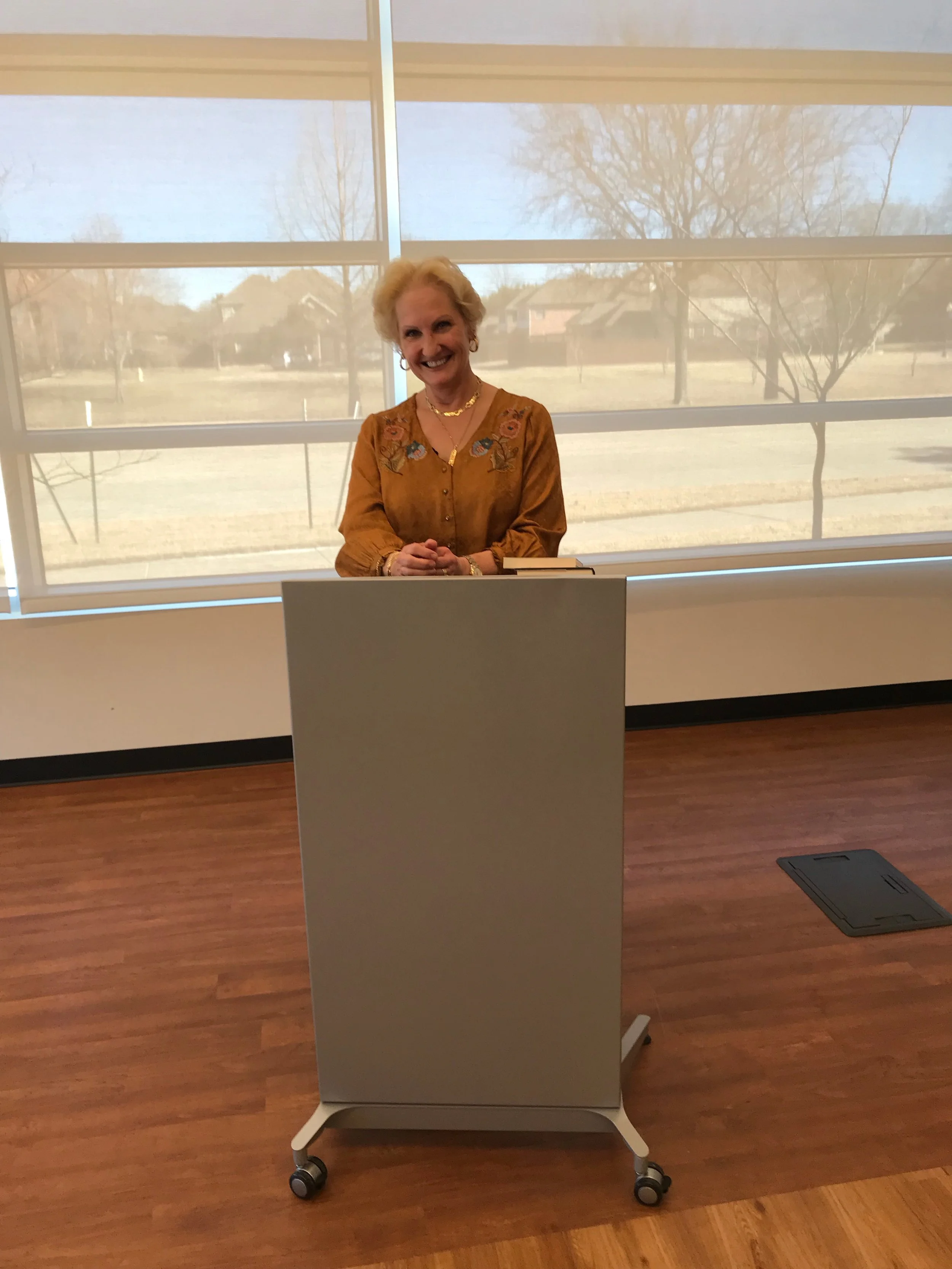
How professional I look!
How professional I look!

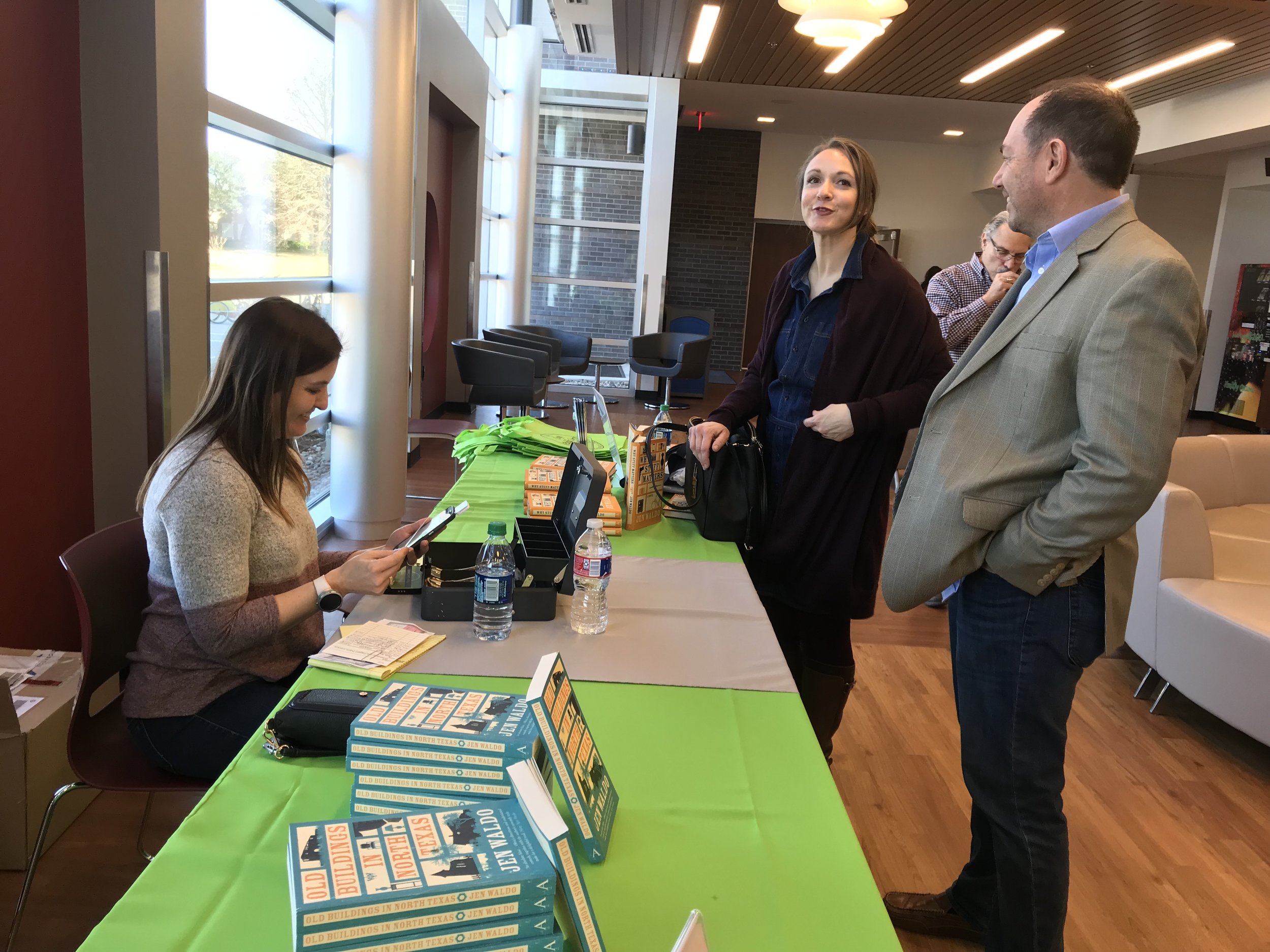
The Friends of the Library set up my books and sold quite a few. The woman standing up is Adrienne. I’m grateful that she organized this event to help publicize my novels. I was at a table over in the corner signing the purchased copies.

The Friends of the Library set up my books and sold quite a few. The woman standing up is Adrienne. I’m grateful that she organized this event to help publicize my novels. I was at a table over in the corner signing the purchased copies.

Coppell was a lovely suburb north of Dallas. Their library is a lovely facility. It’s shameful that it’s been several years since I’ve been in a library. Usually I order and download from Amazon.

Coppell was a lovely suburb north of Dallas. Their library is a lovely facility. It’s shameful that it’s been several years since I’ve been in a library. Usually I order and download from Amazon.

Paul Waldo 1958-2018

Husband, father, brother, friend. 

Everyone’s favorite.

Died of a heart attack on Sunday morning. Sixty years old. Unexpected and devastating.  

The first characteristic that comes to mind when I consider Paul is that he was charming; in a good way, not a calculating way. Everyday he told his wife, Betty, that he loved her and that she was beautiful and desirable. It sounds corny, but he made it work. 

Also, he was mannerly towards women. He held doors and watched his language, gestures that might be considered old-fashioned, but I always appreciated them. If he saw me carrying something, even if it was a little thing like a cake or a shopping bag, he’d rush forward with a “Here Jenny, let me get that.”

He had an uncanny knack for discerning and complimenting the one thing that a person valued most or had put the most effort into. Once when he, David, and I were grabbing Chinese in Houston, he gazed thoughtfully at me across the table and told me that he’d never seen teeth as perfect as mine. Another time when I was wearing one of my favorite sweaters, he told me that the color looked great on me. How was he able to so accurately pinpoint the source of my vanities? And he was this insightful with everyone, not just me. He could meet a person for the first time and immediately perceive what she or he held most dear. 

I’m not sure how accurate it would be to call him the last of the wildcatters, but that’s the way I thought of him. I know he loved his work and, as he was materially successful and so very personable, I’m certain he was highly respected and will be missed by his peers.

Once, at one of our many Waldo gatherings, David complained that people came to business meetings with their minds closed, which led to arguments, shouting matches, and hurt feelings; and Paul offered this advice: 

“I have a trick for when a meeting gets noisy. I cross my arms over my chest, lean away from the discord, and keep my mouth shut until someone asks for my opinion. Then all eyes turn to me. The quiet man wins every time.”

“But that’s manipulation,” I said, indignant because a person should be authentic. 

“If crucial information isn’t being heard because people are acting like baboons, the reasonable response is to create a calm environment where communication can take place.”

So in this way Paul taught me that, though handling people and manipulating people carry essentially the same meaning, they’re not the same thing at all. Being able to handle someone is an admirable gift while manipulating someone implies a selfish or even dishonest agenda. He was indeed a wise man. 

He never made an enemy and he never lost a friend. I never heard him insult anyone. He was never cruel or impatient. He didn’t judge harshly and generously took family members into his home when they were down on their luck. 

He and David talked on the phone at least once a week. He was more than a brother; he was a cherished friend. 

He was one of the best of us and we are heartbroken. 

Rest in Peace Brother Paul

Rest in Peace Brother Paul

Waldo's Christmas Letter 2018

“When are you going to get started on the Christmas letter?” David asks. 

It’s a simple and reasonable question, asked for the first time, so it’s not like he’s nagging. So why do I feel like I’m being hounded? I’ve been feeling grumpy for a few days now and I’m not sure why.

“And say what?” I want to know. “We used to have such exciting adventures. But for the last few years there’s been no new news.”

“We took that trip to the northeast in the fall.”

“And I blogged the crap out of it. The people who would read a holiday letter would’ve also read the blog.”

“We got to see Sam while we were in Boston.”

“His situation’s as stagnant as ours is, so why write about it?”

“But now his company’s SamCentric.”

SamCentric is a word I came up with when Sam told us that in an effort to move Mantra forward he’s going to become more visible. Does this SamCentric approach mean that Sam is going to become a celebrity in China? It sounds like he already is. His last video received three million views and pulled in ten thousand comments; and he’s got fifty thousand followers. 

“If Sam moved back to the states,” I say, “that’d be something I’d put in a letter.”

“You can’t be irritated with Sam for living in Beijing when we were out of the country for nearly thirty years.”

“It was different. Our parents didn’t miss us at all.” 

This is true. A divorce reshapes a family and my parents kind of wrote me off when they split up. And David’s mother had children and grandchildren galore. Demands were coming at her from all sides, so she was fine with us being elsewhere.   

“You can write about Curtis and Anna.”

“And say what? That they work a lot and take vacations every once in a while?”

“One of your books was released in the states; that’s a big deal. And you had that blog tour.”

“Big whoop.Old Buildings has twelve reviews on Amazon. Beartown has two thousand, three hundred, and thirty-two.”

Old Buildings is hardly Beartown.”

“That’s true, but Norah Roberts’ last book got over a thousand reviews. She’s been writing bestsellers for so long that at this point her work is no more than hackneyed regurgitation. Yet still she gets the readers and the reviews.”

“Playing the comparison game is never a good idea.”

“The absolute only thing that’s changed this year is we got a new dog.”

“So write about that.”

So, here’s the Christmas letter: 

We’re fine and the boys are fine. The only change has been the arrival of Dilly. So here’s a little about Dilly:

I got her from the local no-kill SPCA shelter. She’s a total mutt, but people seem to find comfort in labeling. 

“She’s half poodle and half shitzu,” one neighbor says. 

“She’s also very skinny,” another says. “I think she’s poodle, shitzu, and whippet.”

It’s true that she has the haughty snout of a poodle and the protruding lower teeth of a shitzu, but she also has the long feet of a rabbit. She’s white with a tinge of cinnamon along her back, and, as with most white dogs, the distinctive copper tearstains. Like I said, a mutt. 

At first she was scared of everything. She would crouch into submissive position every time she heard a loud noise. Once, trembling with fear, she went prone in front of an oncoming car! She flinched when the wind blew strong. Also, she cringed when I held out a hand to stroke her head, a sure indication that her last owner hit her, which upsets my heart. She sounds like a wimp, which isn’t such a bad thing. Her timidity made me believe that she’d never stray and that she would forever rest her faith in my ability to keep her safe. 

That was two months ago, when I naively thought that, because she was so fearful, she wouldn’t go far. But she’s grown more confident by the day and more territorial in the cul-de-sac. Now she takes off after other dogs, wanting them to be her friend; when she hears our neighbor’s voice she runs to his house and jumps into his arms; and she follows our guests to their cars, begging them for a ride to anywhere. 

The shy princess has become an insecure teenager with daddy issues, needing everybody to love her and seeking affection from strangers. 

My belief was that the advantage of having a small dog is that if she doesn’t do what I want her to, I can easily pick her up. But I can’t pick her up if she’s not there. She runs away fast and doesn’t respond when I call. I have no control, which, come to think of it, is probably why I’ve been so grouchy lately. I tend toward discontented introspection when disorder invades. 

I know how to train a dog. I was just being lazy, hoping she’d figure out my expectations and then train herself. How stupid is that? So now Dilly and I are spending two sessions a day with her on the leash as she learns how to heel, sit, and come when I call. She’s catching on quickly, but I don’t fool myself. Once she’s off that leash she’s gone, which is a dangerous way for a little dog to be.  

And here’s the part that makes this a Christmas letter— 

We wish our friends and family, and their friends and family, the most Merry Christmas ever and a safe and serene 2019. 

The Waldos

Merry Christmas!

Merry Christmas!

Doesn’t she have the sweetest face?

Doesn’t she have the sweetest face?

I trained her to yawn. See the poking-out lower teeth?

I trained her to yawn. See the poking-out lower teeth?

Travertine it is! I thought it was funny that everyone I’ve ever known weighed in on the tile issue, and nobody responded to my sentimental homage to my thesaurus. Practicality conquers whimsy. This picture doesn’t do the travertine justice. But bel…

Travertine it is! I thought it was funny that everyone I’ve ever known weighed in on the tile issue, and nobody responded to my sentimental homage to my thesaurus. Practicality conquers whimsy. This picture doesn’t do the travertine justice. But believe me, it looks a lot better than our old kitchen tile, and it’ll look so much better than carpet in the other areas.

Tile!

We’re replacing the carpet in the bedrooms and the back living area with tile. Also, the tile in the kitchen and bathrooms is dated, so it’s going away, too. The floors in the rest of the house are dark hardwood. This project is quite an undertaking but the carpet is years old and stained. It’s time. We’re dreading the mess. 

We go to a tile place in Bee Cave. We’ve come here before and were waited on by a knowledgeable personable salesperson and we’d like to work with her. But sadly, we’re told she’s unavailable because she’s recovering from brain surgery. So we tell the sloppy man behind the counter what our plans are and, though he seems reluctant to leave his chair, he heaves his backside up and circles around, leading us toward a corner where there are several rows of tile racks.  

His nose is red and every inhalation is accompanied by a wet sniff. He wipes his dripping nose with the back of his hand and rubs it down the leg of his pants. 

“Do you have a cold?” I ask with clear disdain.

“Allergies,” the sad sack tells me.

Huh. That’s what they all say. I pull hand sanitizer from my purse, use it, pass it to David. 

We pull out a few pieces of tile that we like and the guy says we can take them home and bring them back when we’ve decided. We load three heavy tiles into the trunk. 

“Brain surgery, hah,” I tell David as I drive from the lot. “I think she went to lunch and he was poaching her clients.”

“If so, he wasn’t very good at it.” David has no respect for salespeople who aren’t energetic, good-natured, and helpful.

On the way from Bee Cave we spot another tile store. We drop in and a lively woman named Mariah says she’ll be happy to come look at the house, bring samples, and guide us through the decision-making process. The next day she brings several tiles based on what we described, none of which we’re crazy about. 

“Well, now that I’ve seen your home I have a better idea of what you’re looking for.”

She comes the next day with more tiles. She explains color variance, which is the flow of different shades through the whole tile lot. A high variance will give the floor a sense of drama and movement. David and I prefer the high, but we can’t discern the authentic range of color from only a single tile. We’re mired in indecision. 

“I’ll leave them with you,” she says merrily. “You can return them when you’ve made up your mind.”

Now we have six tiles laid out across the carpet, bordering the dark wood floor, the wall, and the stone base of the bar so we can see what goes with what. Unfortunately nothing matches anything, nor does anything complement anything. And they all have too much gray, which, I’ve been told, is the new neutral. 

The next day on the way to the Costco on William Cannon in Austin, we see another tile place and decide to check it out. 

“Will we still be going from store to store a year from now?” David wants to know. 

“So far I’m not inspired by any of it.”

“Isn’t inspiration a lot to ask of tile?”

This store is different. It sells only to contractors. We’re supposed to choose our tile and then tell the contractor which one we want. The store gives the contractor a discount, which he or she either will or won’t pass on to us. If we want to take tiles home we must pay eighteen dollars per tile and will be fully refunded when they’re returned. We choose three that we kind of like; but they aren’t inspiring. We’re given a list of store-sanctioned contractors. 

I carry all the samples we’ve collected around the house, looking at them in different light, holding them up to the wall—clash, match, or blend? We take off our socks and walk on them. The no-slip one is sandpaper beneath our feet, so that’s a no-go.

In our possession we have nine tiles. 

“There must be hundreds of tile stores in Austin,” I say. “We could go to them all and do the entire house with the samples.”

“That’d definitely give us a high variance.” 

“Do you know which of these belong to which store?”  

“I’m keeping track.” 

Sure he is. 

One thing we’ve learned is that pictures never show the true color. Our floor is much darker than this and we concluded that the tile is too dark, but that’s not discernible at all in this picture.

One thing we’ve learned is that pictures never show the true color. Our floor is much darker than this and we concluded that the tile is too dark, but that’s not discernible at all in this picture.

High variance, but too dark with way too much gray.

High variance, but too dark with way too much gray.

See, this is what i’m talking about. In this picture the paint has a gold tinge, when in reality, it’s a pale shade of taupe.

See, this is what i’m talking about. In this picture the paint has a gold tinge, when in reality, it’s a pale shade of taupe.