The Death of Roget

I’m fortunate to have an activity that consumes me. Some people don’t require an immersing passion and are content to pass their days tending to interests that float by or difficulties that pop up. But when I write a sentence that makes me laugh or use a word in a particularly clever way, my joy is set for the whole day. And when a plot seems weak or inauthentic I descend into a state of upheaval. 

This morning I’m stumbling over the use of the word “virago.” It scans well and the meaning fits, though I want to make sure it’s not just a good word, but the perfect word. 

Here is the sentence:

“Caught between the two viragoes, I make no attempt to intervene, but instead take a deep breath, focus on my hands in my lap, and go to a serene place in my head.”         

It feels right. But my fear is that use of the archaic vocabulary will distract from the story. Perhaps a more current word would be better. So I turn to my most outstanding helper, Peter Mark Roget, who created a system of ordering words by nuance as well as meaning. There is no greater resource when it comes to synonyms and extended connotations. For instance, in the index there are seven entries for “wobble,” an indication that the word is subject to seven subtle distinctions; and each entry gives at least thirty words that are near in meaning or connected to wobble in some way. The progeny of words doesn’t get much better than that. 

But to my disappointment, there is no virago between viper (two entries) and virgin (twelve entries). For the first time, Roget has let me down. 

Flummoxed, I rush down the hall to discuss it with David, who’s in the bedroom getting dressed for the day’s work on the Habitat house. The house the crew is currently working on will belong to Pastor Perry. It’s going up next door to the last one they built. To further enlighten, the recently completed house caused grumbles and discord within the local chapter of Habitat when the young owner/recipient requested yellow paint and lavender trim. Because of this nontraditional choice, arguments ensued and feelings were hurt. In the end, freedom of expression won and she now lives in a house that looks like an Easter egg, which I find charming while others term it an eyesore.  

“There is no entry for virago in my Thesaurus,” I tell David, waving it about.

“Internet,” he says. 

So to the internet I go. I’m disheartened when I see how many entries there are. I scroll through three pages of thesauruses that include virago without coming across Roget.

Oh Roget, Roget, incomplete and obsolete. Superfluous. A redundant tome. Inferior. Worn and Torn. 

Virago has two opposing meanings. 

The first: a domineering, violent, or bad-tempered woman.

This accurately describes my two characters. 

The second: a woman with exemplary or heroic qualities. 

Well, there’s nothing exemplary or heroic to be found in my bickerers. 

But then I come across a couple of other synonyms: shrew and termagant. Also from a long-ago century. I look ’em up. Shrew: famously and obviously Shakespeare; Termagant: well, it’s all over ancient literature from Song of Roland to Chaucer’s Canterbury Tales to Shakespeare’s Hamlet. And many others, but these are the only ones I’m familiar with. 

I decide to leave virago where it is for now. And look, I’ve squandered thirty minutes having fun with alternative words for bitch. 

David has gone his way and I have half an hour before I need to leave for yoga; plenty of time to wallow in sentimentality. I take a picture of my old Thesaurus and consider how much it’s helped me over the years. When I moved from country to country I carefully packed it in my luggage rather than putting it in the shipment to follow later. When I required subtext—humorous, snide, imperious, or otherwise, it offered endless choice. It was indispensible and beloved. 

And now look at it. A yellowed corpse. Symbolic of my growth yet with no purpose at all. Rendered pointless by the mighty www. 

I tie on my hiking boots. In the garage I locate a trowel. Hugging the volume to my breast, I trek across the crunchy damp grass to the back of our property, the section that’s easy to dig in because it’s been churned up by feral hogs. With David’s trusty gardening tool I dig a hole. I make it deep so the hogs and armadillos can’t sniff it out. I lay my old friend down, slap cold mud over it, and tamp it. 

Good-bye, Roget. 

Seen better days.

Seen better days.

Peter Mark Roget, 1779-1869

Peter Mark Roget, 1779-1869

Dilly in the house! A bonus for those who stuck it out until the last picture. It’s been a while since Trip died and I was ready for a new dog. So look who I found at the local SPCA. She’s adorable, and even better, she adores me. It breaks my heart…

Dilly in the house! A bonus for those who stuck it out until the last picture. It’s been a while since Trip died and I was ready for a new dog. So look who I found at the local SPCA. She’s adorable, and even better, she adores me. It breaks my heart that when I reach out to pet her she cringes. She’s been hit in the face at some point. She’ll get over that. She’s a total mutt, I think mostly poodle but she’s got the protruding lower teeth of a shitzu. She’s tiny and frail, only six pounds. Dilly’s going to be very happy with us.

Texas Book Festival

David suggests that we attend the Texas Book Festival so that I’ll get a feel for who participates and what its goals are. At first I’m reluctant because Old Buildings in North Texas isn’t going to be there and it should be. My novel belongs front and center with the other Texas novels. Stupid people in charge. Stupid unwieldy organization. Stupid other writers who’ve been called in while I’ve been left out. But even in my bitter state, I’m able to recognize the folly of holding a grudge against a festival. 

The festival office sent me an apologetic rejection letter, from which I gathered that the book hadn’t even been read because, for one thing, it was submitted too late, and for the other, there were several thousand entries and not enough reviewers. My book fell through the cracks, as I feared it would. 

Next year’s submission period opens in January. Woefully, Why Stuff Matters will not be released in the US until March. Once again, too late. I will have to figure out a way around it. 

The UK publicist came up with the idea that when I submit Why Stuff Matters I should also arrange and offer a panel discussion. This, she said, would make the organizers look favorably upon me, for I will have filled a slot in their schedule. 

I’m intrigued. A writer can go on about writing forever. There are so many facets to be explored—the publishing experience; grammatical license; editing; writers’ groups and whether or not they’re helpful; the creative process, organic or methodic; innovative vocabulary . . . these are just a few. And within each topic are endless subtopics.  

So I’m putting this out to my writing friends—IF YOU’RE INTERESTED IN JOINING MY PANEL, IF YOU HAVE A BOOK COMING OUT EITHER THIS FALL OR IN THE FIRST FEW MONTHS OF THE NEW YEAR, AND IF YOU’RE ABLE TO GET TO AUSTIN TOWARD THE END OF OCTOBER, CONTACT ME AND WE’LL HASH OUT TOPICS AND DETAILS.  

Moving on. David’s suggestion is a wise one. I need to see what, who, and how. 

It’s a fresh sunny day in Austin and the festival is being held on the capital grounds, which, after the recent rains, are lovely, clean, and lush.

We take seats and observe a panel rendered cohesive by their genre; in this case, fantasy. The three authors are introduced, they each summarize their books for the audience, and then they take questions. I could do this. I’d be great at it! My conclusion, however, is that these authors did not, as the publicist implied, offer themselves as a prearranged panel in order to be included in the festival. This grouping was organized by the Festival planners. Though this doesn’t mean that her counsel missed the mark. There are multiple ways to get things done. 

We wander through the maze of tents. There are tents for book signings and posted schedules telling when the authors will be available. There are tents for purchasing books and tents for purchasing random things, such as T-shirts and gardening boots. There is a tent for publishers of every ilk—vanity, boutique, university affiliated, and highly reputable. 

The theme of the entire event is a noble one—literacy, a cause I will forever feel passionate about. To this end, children’s authors are a dominant presence. In one of the panel discussions a seven-year-old boy sits next to me with his nose buried in a thick book. It brings on a wave of nostalgia. My boys were avid readers from kindergarten on. 

Another theme is diversity. Latino writers are heavily represented and we stop to listen to a discussion of how it feels to be an undocumented resident in the US. Also, in an attempt to make the mostly white audiences comprehend a cultural view other than their own, African Americans, Muslims, Jews, and Asians discuss their issues and hold up their books. 

Sadly, this event seems to have no place for a blond woman who has a strong narrative voice and tells unique and humorous stories. Though there are few solid novelists, most guest authors, fiction and nonfiction, brandish a cause or an agenda. Angst about violence, oppression, or prejudice; the treatment of the addicted and the disenfranchisement of the mentally ill; the difficulties of the middle class; even voter suppression—all are topics of books and subjects of discussion. 

We stop in front of the booth representing the Writers’ League of Texas. 

“What is this organization and why would I want to join it?” I ask the garrulous man who steps forth to greet me. 

“Mainly, we’re all about networking. We meet once a month at By the Book.” By the Book is a popular store in Austin.  

An introvert, my reaction is one of horrified cynicism. Very few times have I met with other authors where there has been no competition, no one-upmanship. A writer’s ego is humongous and fragile. Also, what do writers have to discuss with one another? It’s a solitary occupation and we each have our own opinions, style, and genre. 

“What did you find out about it?” David asks as we walk away. A proponent of joining, he’s wondering why I didn’t sign and pay. 

“Overall, this has been a humbling experience.” I’m despondent. “This book fair is massive, there are too many authors in the world, and I have no socially deep and insightful foundation propping up my writing. How do I get from the outside to the inside?”

Yet I hold to my dream: maybe next year. We stop in Bee Cave for barbecue on the way home. 

Yep, I was there. Also these are the sunglasses Sam manufactures. Mantra Eyewear.

Yep, I was there. Also these are the sunglasses Sam manufactures. Mantra Eyewear.

This is what a panel looks like. I so belong up there!

This is what a panel looks like. I so belong up there!

Rows and rows of tents on the Capital Grounds in Austin.

Rows and rows of tents on the Capital Grounds in Austin.

New Haven, the Pit

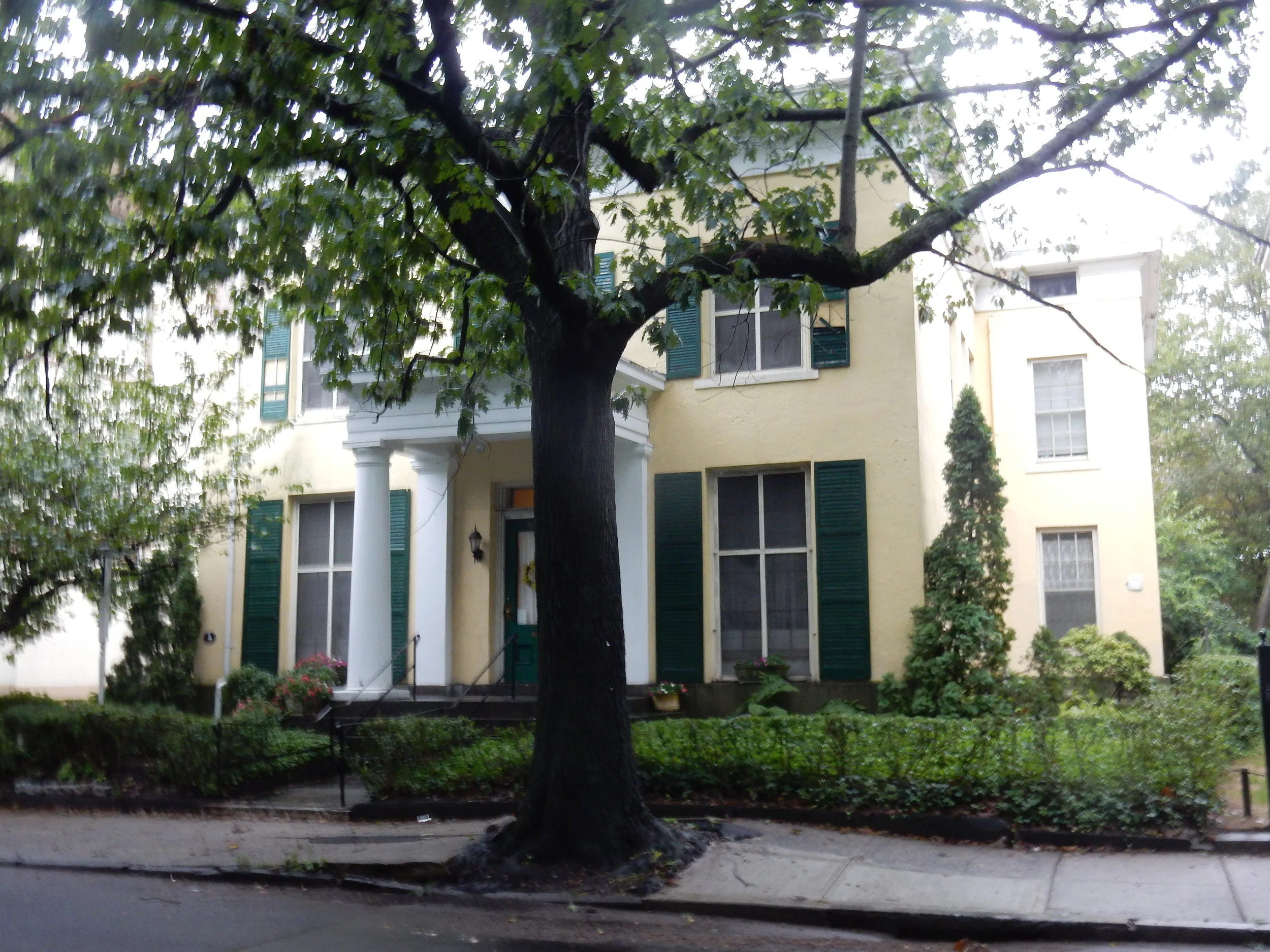
Yale is all there is worth seeing in New Haven. Step off the elegant campus and you’re surrounded by worn buildings and derelict homes—in short, a ghetto. Signs are posted on every corner euphemistically identifying the area as The Historic District, but I don’t know why New Haven bothered; these few fusty blocks are nothing to be proud of. The houses loom over the streets with stairs leading from the cracked sidewalk to broad porches with high-reaching columns. I’m certain that at one time these homes were impressive, but these days the wood rot around the roofs, windows, and eaves is clearly visible and the smell of old carpets is so prevalent that the moldy odor drifts heavily out into the narrow street. 

David and I have elected to stay in one of these historic mansions, a yellow edifice built in the 1850’s. We look up and down the street, observing all the other decaying buildings. Dubiously, we approach the porch of the house where we’ll be sleeping for the next two nights. 

“I estimate it would take a half million to restore one of these homes to its past glory,” I tell David.

“That’s probably about right.”

He rings the bell and the door is answered by a petite man, approximate age, eighty. As a host in a house of historic significance, he invites us in and starts giving us a tour as soon as we’re through the door. 

He speaks with an accent, Greek we think. We follow him down a tight hallway and turn left into the common area. Ancient crown molding in the lofty ceiling; dull brass chandelier hanging crookedly; furniture rickety, old but not valuable; watery light, dirty windows. 

“The importance of this house,” he tells us, taking a central position, “is that the man who built it was a co-founder of the Baldwin piano company, very famous. You know of it? And because the factory burned down he invented and installed the first in-home sprinkling system, which you see there.”

And he points behind us. Dutifully, we turn and look. Yes, heavy pipes cross the ceiling. There isn’t a surface in this room that hasn’t been claimed by dolls. And there isn’t an inch of wall free of paintings or framed dried flower arrangements. Also, paintings are stacked ten-deep and lean against walls and in doorways. The paintings are all about duets of color, splotches of green next to blue, or red streaks lined in purple. I’m no artist and I certainly know nothing about painting, but is it art if you do the same thing again and again? 

“What’s with the dolls and paintings?” I ask, not too concerned about whether he catches my disdain. All these old art projects smell bad, as though they haven’t been shifted in twenty years. 

“My wife is an artist. She carves the dolls from wax.”

“She makes the clothes?” The clothes are lovely. 

“Oh yes. Everything. And the paintings are hers, too. And see her three dimensional art?”

Oh. I didn’t see it before, but some of the paintings have faces or body parts emerging from them, as though the colorful canvases are giving birth. 

He leads us to our room. As we make our way back through the cramped hallway to the stairs, I notice a couple of opened Arm and Hammer boxes tucked between dolls and behind stacks of pictures. Pointless. He would have to bury this house in baking soda to make any difference at all.

We chose this place off the internet because we thought it sounded interesting—a house with a past. We stayed in Duke’s Mansion in Charlotte a couple of years ago, and it was a lovely experience. But, as with most of the places on this tour, the description online simply isn’t true. We’re promised a room on the ground floor, a refrigerator, a television with cable, and two queen beds. But what good is a television if you can only get one channel? And we’re on the second floor; there’s no refrigerator; and there’s only one bed and it’s a double. At least there’s a small desk where I can write. 

The landlord acts proud of this tight cell as he points to the undersized bed, tells us of the fresh towels (I should hope!) in the bathroom, and explains how the paintings in here are also the work of his wife. He leaves us and that’s the last we see of him. 

“I think his wife’s dead and he’s got her remains preserved somewhere on the premises,” I say.

“Ordinarily I’d call poppycock, but in this case I fear you you’re right.” (I use a writer’s license; David never says poppycock.)

We settle into the room, then walk around the corner to New Haven’s Little Italy—more dank frontages, Italian flags drooping. Our planned destination is Pepe’s, which has been ranked as the number one pizza place in the country. I’m very strict about what goes in my mouth and in the last dozen years I’ve allowed myself exactly two slices of pizza. Discouragement brought on by finding myself in this pit called New Haven weakens my will, causing me to eat three slices of Pepe’s pizza, which is as delicious as is claimed.  

I come awake at two a.m. with a picture of our creepy host in my mind. Withered and hunched, he’d barely been able to make it up the stairs to show us to our room. I hate to think how long it’s been since this comforter has been laundered. As far as I can tell, the man’s on his own in this fetid mansion; and he’s certainly in no condition to go the extra mile when it comes to changing bedding. I begin to itch. There is no more sleep to be had. I kick back the covers and spend the rest of the night composing this posting. 

Historical dolls.

Historical dolls.

See how many? Dolls are everywhere. She must be obsessed!

See how many? Dolls are everywhere. She must be obsessed!

Ah. The boy doll is proposing to the girl doll.

Ah. The boy doll is proposing to the girl doll.

The mansion. It looks better in this picture than it really is.

The mansion. It looks better in this picture than it really is.

In Newport, a wonderful place to visit. Brahmin. Their flagship is my mothership!

In Newport, a wonderful place to visit. Brahmin. Their flagship is my mothership!

On the last day of our trip we meet up with Sam in Boston. As it’s been two years since we’ve seen him, it’s good to have an opportunity to catch up. He’s in town to give a presentation at Forbes’s Thirty under Thirty conference. Proud of you Sam!

On the last day of our trip we meet up with Sam in Boston. As it’s been two years since we’ve seen him, it’s good to have an opportunity to catch up. He’s in town to give a presentation at Forbes’s Thirty under Thirty conference. Proud of you Sam!

The Trip That's Lasting Forever

Happily saying good-bye to our mouse-infested abode in New Hampshire, we drive through the White Mountains to Burlington, Vermont. We have no idea what to expect from this small city on Lake Champlain, but I like it immediately. The well-maintained buildings are the kind of old that is picturesque and stately, an indication of past wealth and current prosperity. The University of Vermont is here, along with three other colleges, which means the population is young and energetic. 

Our travel information tells us that Burlington has two points of interest to offer tourists—the Church Street Market and the Farmers’ Market. So first, the Church Street Market. Parking isn’t easy. When we finally find a place on a side street, the meter demands a quarter per fifteen minutes. 

The icy wind coming off the lake makes my nose red and my pace brisk. The Church Street Market is three blocks of walking, no cars allowed. The stores aren’t unusual—The Gap, Banana Republic, Black & White—yet every shop I go into is pretentious and overpriced. There seems to be an inexplicable underlying arrogance. The walkway is clean. A couple of violinists huddle in the doorway of a closed pub; their lines of harmony soar briefly, then are carried away by the biting gusts. I enter a store that sells only jeans and the girl who works there asks how she can help. 

“I don’t like skinny jeans or jeans with rips,” I tell her. “And I won’t pay more than a hundred dollars.”

“Oh, well, these are designer jeans,” she says, disappointed that I’m so demanding and opinionated. 

“Jeans are jeans,” I tell her, glancing at a price tag of three hundred dollars. “These look exactly like the jeans they have at Macys for seventy-five dollars.”

“Sorry,” she says. 

Having irritated her, I leave the shop and join David who, when I’m on a mission, entertains himself with his iPad. We only had three quarters, so time’s running out on the parking. Returning to the car, we go in hunt of where we’ll be staying, the Starlight Inn, which is a Hollywood-themed hotel in the tiny town of Colchester. Hollywood themed: what were we thinking? The woman in the phone guides us there.

The establishment looks new. The units open to small well-kept lawns and a parking lot. The man who owns and manages the place is in his forties and eccentric. He rides around the property on what he calls his “Li’l Nellie,” which is like a three-wheeled Segway. And not only does he own the hotel, but he also owns the three-screened drive-in theatre next door and, beyond that, the Starlight Laundromat. I bet he owns more of Colchester than anyone. 

We’re in the Marilyn Monroe Room. The Tom Cruise room is next door. No mice and it’s spacious. We’ll be happy here for a couple of nights. There’s a life-sized cutout of Marilyn on one wall and her most famous photos on the others. Most disconcerting, in the bathroom there’s a poster of Marilyn in off-the-shoulder black lace accompanied by a quote: I don’t mind living in a man’s world as long as I can be a woman in it.This sentiment is so opposed to women’s views today that I can’t help but wonder what to make of it. How would Marilyn fit into our present? Is she no longer relevant? Or is she supremely relevant?

The next morning, after a great night’s sleep, we visit the Farmers’ Market, which turns out to be the best and most extensive I’ve ever seen. The vegetables are inspiring—massive shiny bell peppers, piles of carrots and greens, tomatoes of every size and hue. My sorrow is that I’m traveling and I can’t buy. There are baked goods, too; also pottery, jewelry, and home-brewed ales. We come across a Master Gardeners’ booth and I take David’s picture with his Vermont gardening sisters.  

We leave there and make our way downhill to Lake Champlain, where there’s a nice bike/walking path. After an hour’s walk, we return to the market for lunch. I have falafel and David has a chicken curry wrap. We eat as we walk. 

Burlington is a good place to hang out and absorb the lively atmosphere. If you’re in the vicinity, I highly recommend a couple of days there. But now we’re off to Manchester, Vermont, which turns out to be one of the loveliest small towns I’ve ever seen. Genteel homes, rolling green lawns, colorful flowers, ancient oaks. It’s the home of Orvis so, just as we did with LL Bean in Maine, a trip to the flagship store is a must. I have no interest in either of these brands. Why can’t clothing be both practical and attractive? But muddy colors, bulky cuts, and clunky boots are for lumberjacks, not for me. Also, plaid flannel—yikes!

In Manchester we have reserved a room in a B&B, and we once again find ourselves at the mercy of a retired person who does everything on the cheap—a bread-only breakfast, thin toilet paper, Wal-Mart pillows, no movie channels. The little woman hovers behind the drinks counter at breakfast, counting how many sugars we put in our coffee and tea, huffing discontentedly when David pours himself a second juice. I’m so over B&B’s.

There’s not much to do in Manchester except walk around and ooh and ah over its beauty. The next morning, before we leave the area, we drive to the summit of Mount Equinox, where there is a spectacular view and a spiritual meditation center that’s maintained by the Carthusian monks who are secluded in their nearby monastery. A history of these monks and an explanation of their austere lifestyle is framed and posted at the entry—and it’s quite touching to think that these men who live in almost total silence and have no possessions spend their days praying for all of us who must confront the evil world on a daily basis. Thanks guys, it means a lot. 

Booth after booth of beautiful produce at the Burlington Farmers’ Market

Booth after booth of beautiful produce at the Burlington Farmers’ Market

On the wall of our hotel room. It confuses me to think about Marilyn these days.

On the wall of our hotel room. It confuses me to think about Marilyn these days.

This gives a pretty good idea of the place. The rooms are in the background.

This gives a pretty good idea of the place. The rooms are in the background.

David and his new Master Gardener friends from Vermont.

David and his new Master Gardener friends from Vermont.