The Last Lodge

We catch the boat in Seward, a small town at the head of Resurrection Bay.  We’ve been looking forward to this portion of the trip where we’ll follow the dramatic fjords and perhaps catch sight of whales.  A boat this size disappeared about a year ago, and there was speculation, bordering on certainty, that it was taken out by a whale.  So, as I am understandably fearful, I share the story with my travel mates, who are unimpressed; they’re more concerned about throwing up than whale danger.  

This is the roughest sea I’ve ever traveled.  Up, up, up to the crest; then Slam! into the valley of the wave.  Repeat a billion times.  I don’t tend toward seasickness, so I sadistically enjoy every up and down of it while every one around me moans and turns green.  It is, however, disappointing that the heavy fog hinders fjord viewing. 

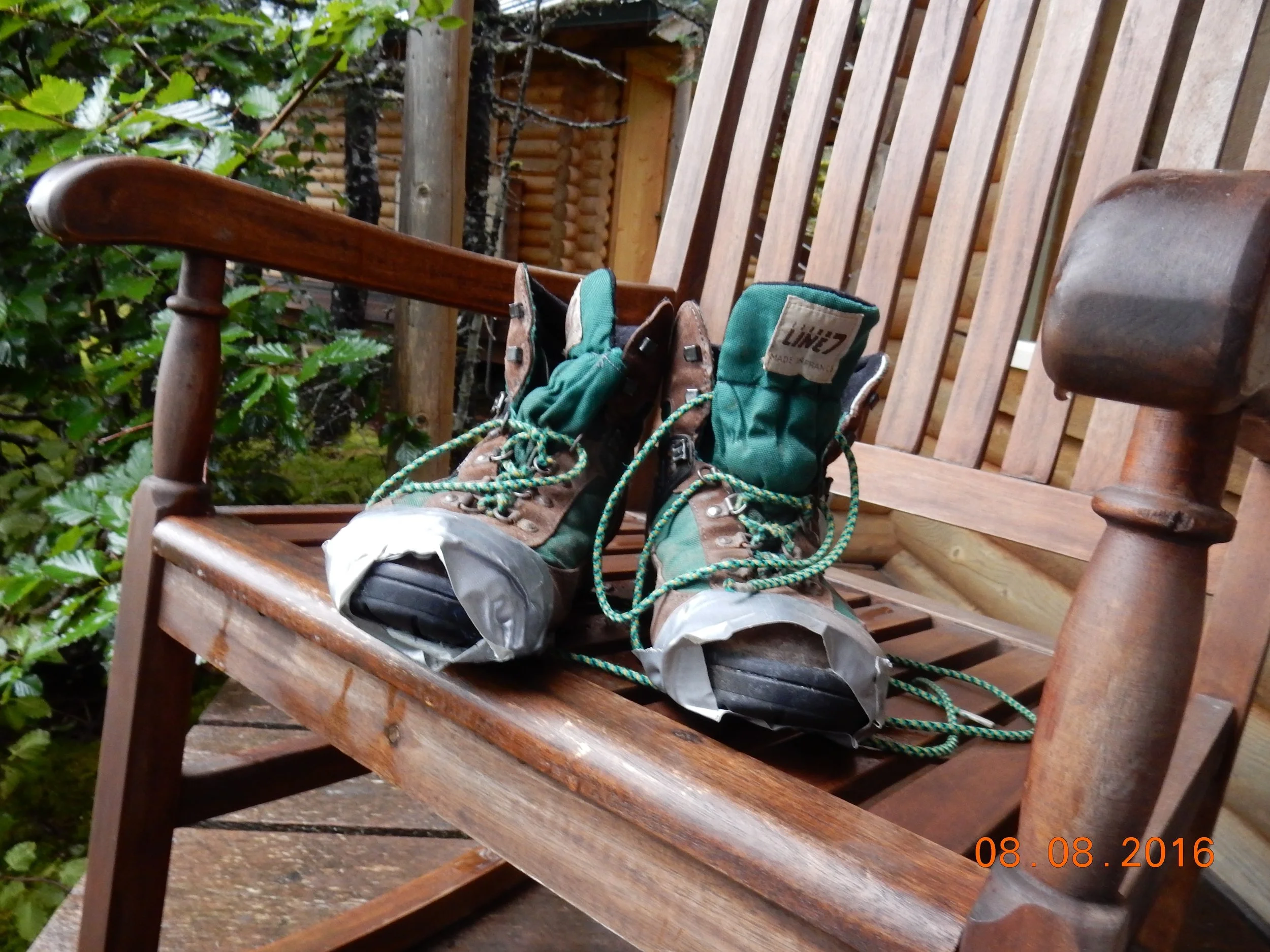
We arrive on a beach and are told that it’s an easy mile-long hike to the Kenai Fjords Glacier Lodge.  It’s on this short walk that disaster catches up with David—his hiking boot falls apart!  The sole, barely attached at the heel, flops all over the place.  Toes are exposed.  This couldn’t be more suitably timed, as, when we were packing, David informed me, in a rather pompous tone, that he’s had those boots longer than he’s known me.  Thirty-three years.  (Well, gee, David, we were going to Alaska.  Maybe you should have invested in a new pair.)  But all was not lost.  A woman gave him a tiny bungee string to hold the shoe together until we got to the lodge; and Dennis, a member of our tour group, offered the extra pair that he’d brought along, just in case they were needed.  Whew.  Misfortune overcome.  This is the sort of thing that seems inconsequential when it happens to someone else, but it’s a big deal when it happens to you.  Mortified that his gear fell apart, and sorrowful over the demise of one of his oldest belongings, David mourned the loss for a whole hour.  Then he perked up and got on with things, wearing someone else’s shoes. 

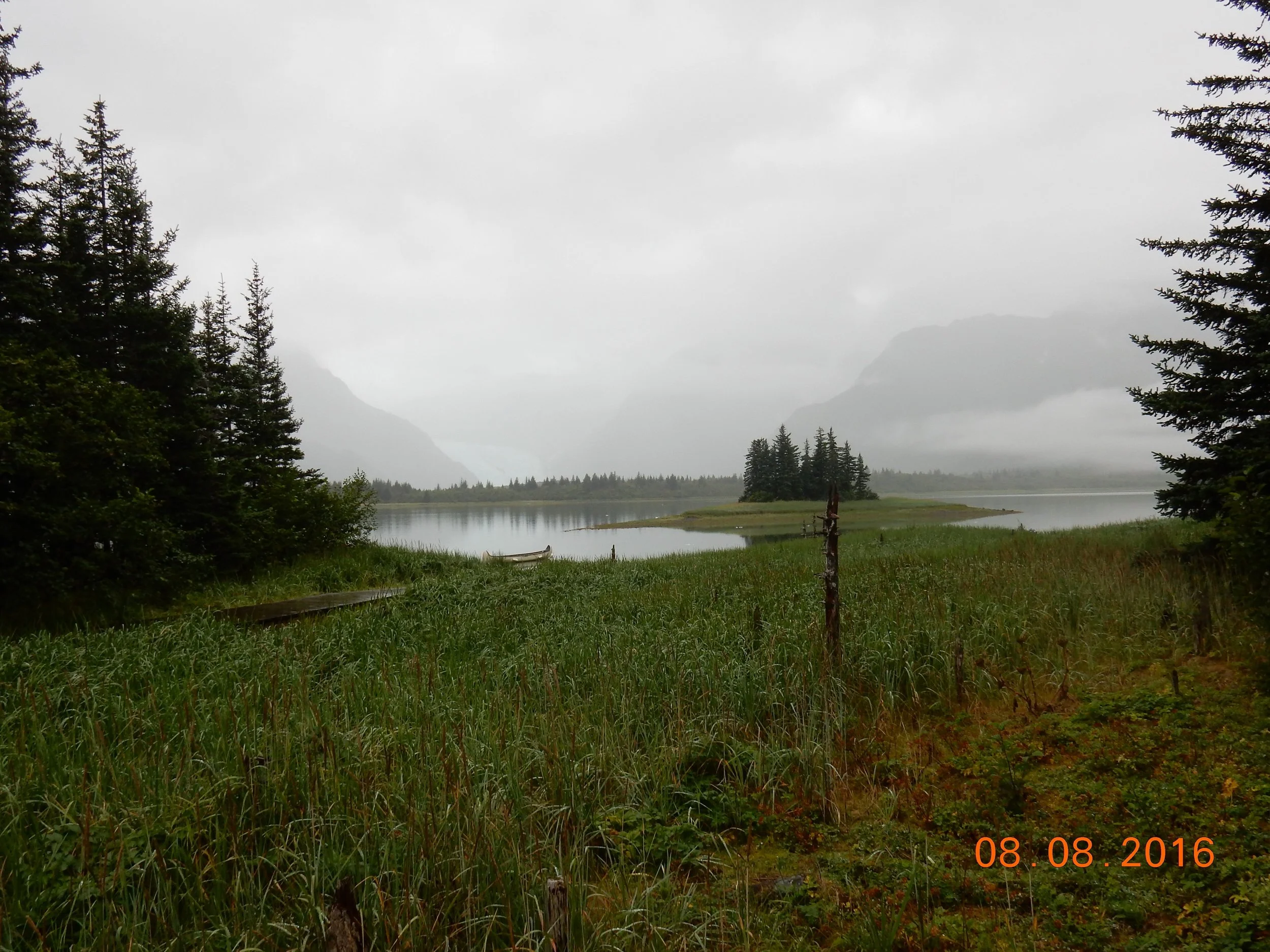
The lodge is stunning.  Nestled in a tidal lagoon, it overlooks Pederson Glacier.  The bay is a mirror dotted with floating mounds of white.  Otters are everywhere, cute with their playful eyes.  Right in front of the dock, a seal’s round head pops up, twinkling eyes visible, then disappears again.  It thinks it’s being sneaky.  We see you, seal. 

Of the three places we’ve stayed, this is the nicest.  The cabins are large and, thankfully, have bathrooms.  Most importantly, this lodge has a designated drying room, made arid by the hot wind from the generator.  As were the other lodges, the location is remote.  There is no garbage pick-up.  They produce their own power and process their own waste.  Every aspect is designed to leave only the tiniest footprint. 

Delicious food, charming guides, a nice wine bar, a surplus of equipment in excellent condition—these things are appreciated, but all fade when compared to the breathtaking scenery.  I’m sure there are other lodges like this in Alaska, where tourism thrives and the isolated pristine wilderness is the attraction; but in all my travels I have never seen a place as beautiful as this—the jagged gray mountains patched with glaciers that from a distance look insignificant, but grow to massive proportions upon proximate approach.  The water, ocean and glacier, the bluest blue.  Air so pure that it makes me dizzy.  Every once in a while, a great Boom!  A part of a glacier has broken off.  Echoes for miles.  Calving. 

We’re kayaking to the Aialik Glacier.  We don comical gear—rubber boots, rubber overalls, two rain jackets; and an oddly flared skirt over it all.  Plus lifejackets.  And then we tromp the mile to the shore, uncomfortable and looking ridiculous in the absurd skirts.  During our travels, we’ve combined and split away from other tour groups, and this activity is open to all who are staying at the lodge, but the only guests who’ve elected to come along are the people we started out with, the ones we’ve become quite close to.  One by one we squat into our places in the kayaks, encouraging one another and enjoying ourselves.  The skirt edge fits tightly over the rim of the seat; and this, we’re told, will keep us dry.  By this time, I know better.  To be in Alaska is to be wet. 

David and I aren’t experienced kayakers.  He sits in back, working the rudder as he rows, attempting to control where we go.  I’m in front, rowing hard, putting my shoulders into it.  But for some reason David can’t keep the bow going straight.  We go one way, then the other.  This body of water is still; no current, no waves.  Maybe the rudder’s broken.  As a group, we’re aiming toward a distant island, and the glacier beyond.  I’m putting all this effort into gliding forward, yet we’re zigzagging.  It’s a waste of energy.  So I decide that when we’re not heading where we should be, I’ll stop rowing. 

“You can’t keep a beat,” David complains, as though he’s doing everything right back there. 

“So says the scientist to the music major,” I tell him.  “I’m a human metronome.”

“We’re supposed to row in sync.”

“If you want me to row then keep this thing true.  It’s stupid to row in the wrong direction.” 

Out of sorts with one another, we continue our efforts in sulky silence.  For about three glorious minutes on the outgoing trip, we get it right—flawless, coordinated, advancing quickly in the right direction. 

And during this brief spell, I hear Dawn, in a neighboring kayak, say to her son—“Look at David and Jenny.  Cooperating, going forward smoothly.  Only when you’ve been married for years can you achieve that kind of harmony.”

Harmony.  Ha.  Sometimes something can look one way when it’s really not that way at all. 

We arrive at the base of the massive glacier.  With icebergs floating around us, everything is eerily still, silent, enchanted; time stops.  We cease rowing and talking, and simply gaze at the magnificence for fifteen minutes or so.  Then we complete the circle around the island and zigzag back to our starting point on the shore. 
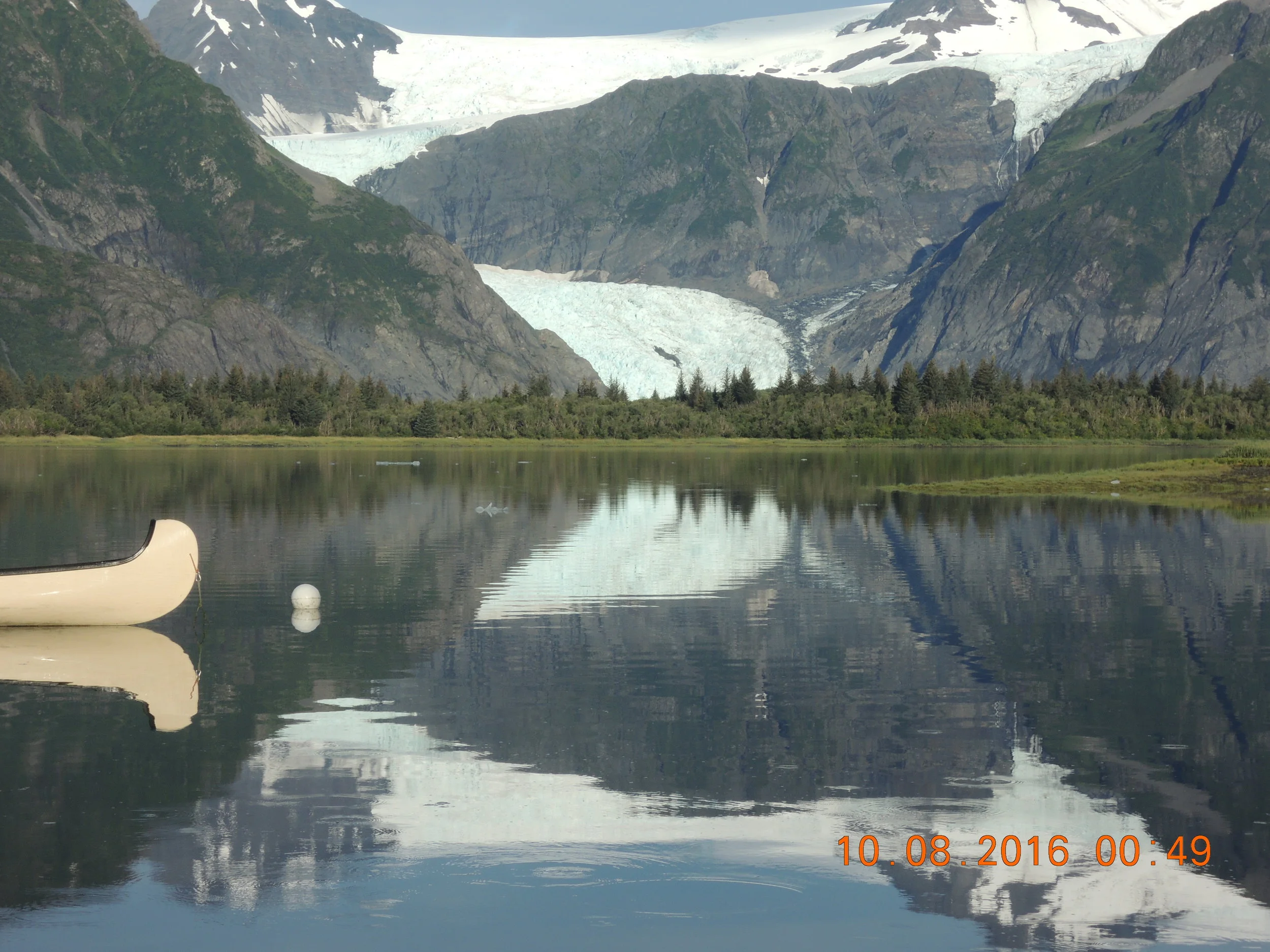
A view of the glacier from the kayak.
A view of the glacier from the kayak.

Even the best hiking boots don't last forever.  
Even the best hiking boots don't last forever.  

The view from the lodge.  Because of the fog, the glacier is barely visible.

The view from the lodge.  Because of the fog, the glacier is barely visible.

View of the lodge from the end of the dock.  
View of the lodge from the end of the dock.  

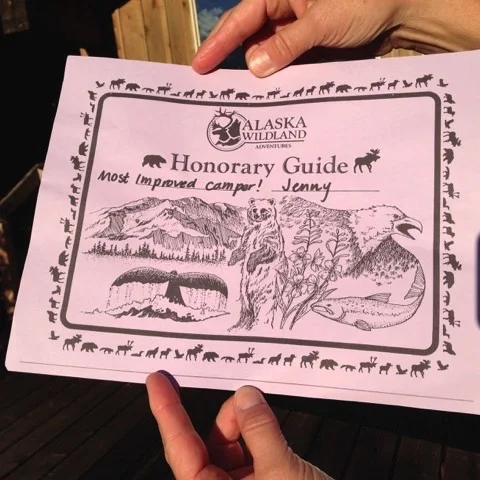
On our last night at the lodge, Elias, our guide, asked us to meet for a "ceremony."  Knowing he was going to advise about tipping practices in Alaska, I teased by asking if it would be an awards ceremony.  He made this especially for me. …
On our last night at the lodge, Elias, our guide, asked us to meet for a "ceremony."  Knowing he was going to advise about tipping practices in Alaska, I teased by asking if it would be an awards ceremony.  He made this especially for me.  
Rafting the Kenai

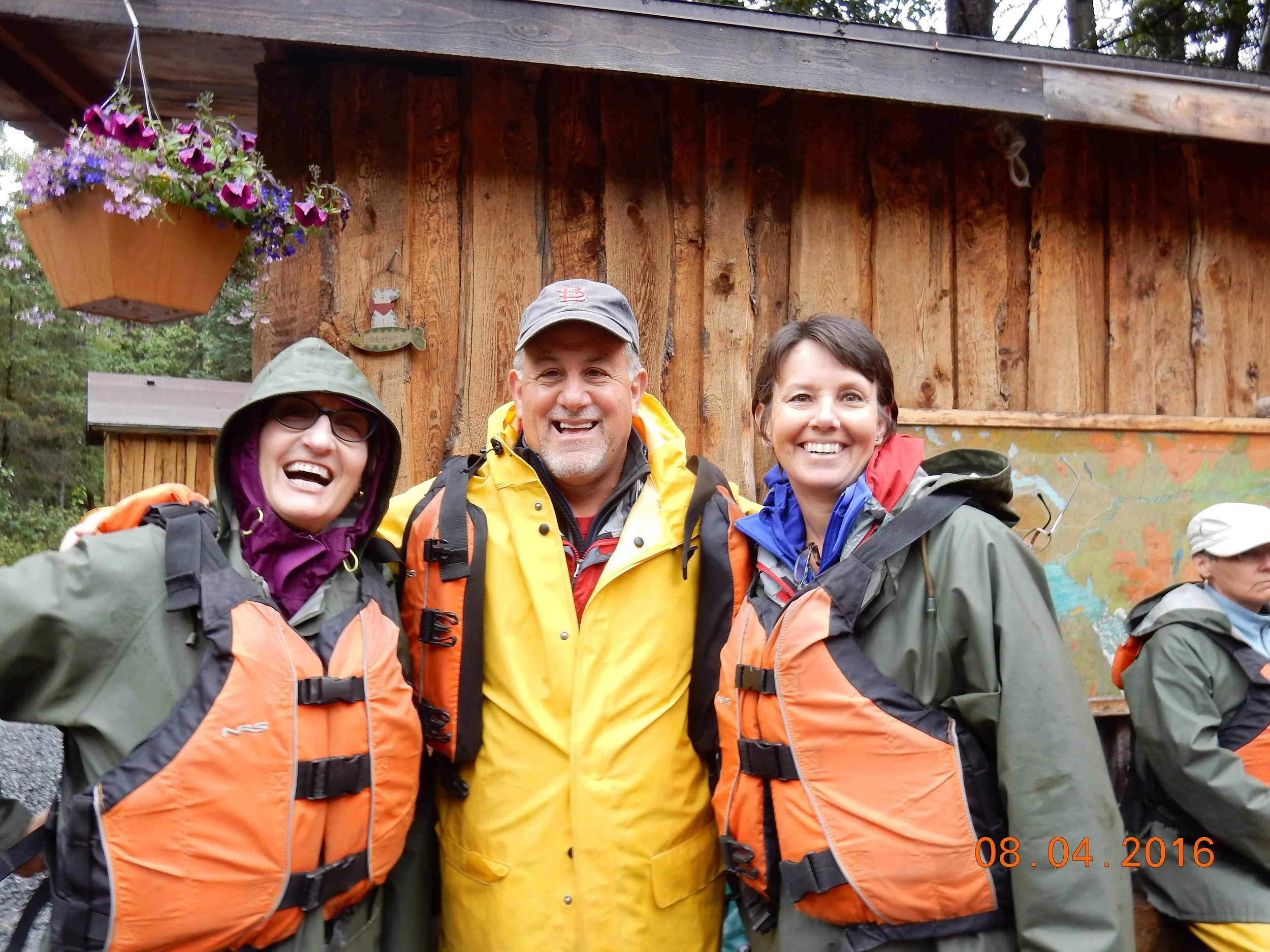
We convene at the boathouse after breakfast.  It’s raining.  Not a heavy rain, just a constant flinging of light drops.  Because the Kenai River is the progeny of glacier and sun, we’ve dressed warmly.  I’m wearing long johns under quick-dry pants; four layers up top—silk camisole, wool undershirt, fleece zip-up, and rain jacket.  And now we’re going to add another layer.  We mill and bump as the helpers distribute mismatched overalls, rain jackets, and boots—all in thick formless rubber, and smelling of dirty hair and armpits.  Hands push through sleeves, feet cram into tall boots; bend forward to swing suspenders over shoulders.  We’re all so horrifyingly unfashionable that I don’t want to look at anybody.  Our hiking boots are packed away; we’re told that we’ll be reunited with them at the end of our journey.

Three hoods hang from the back of my neck.  I pull each one over my head.  There are two Velcro wristbands on each wrist, and I pull them tight so the water won’t get in.  More than anything, I don’t want to get wet and cold. 

An awkward bunch, we troop to the river, where we receive instruction on how to get in.  There are three rafts, each holding six passengers and a guide.  One by one, we press into the calf-high water, sit on the fat pontoon, and swing our legs over and around.  And we’re on our way.

It stops raining; hoods come off. 

Our guide starts talking as soon as we’re on the river.  She has a squeaky voice, which is going to make me crazy.  From the beginning of this trip to the end, we find out more about this twenty-something woman than we want to know.  While she yammers ceaselessly, I ponder how some people love to tell strangers their inner thoughts, their plans.  Is this good or bad?  Preserve some mystery, I want to tell her. 

While the river’s broad and fast moving, the white water we encounter is no more risky than a mild amusement park ride, though splashes are involved.  And even wearing all these layers, the water seeps in.  I was diligent in closing off my wrists, yet my wool and fleece layers are soaked to the elbows within the first half hour.  I remove my sopping knit gloves and stuff them into a lifejacket pocket.  Then I try to keep my hands warm by curling them into my breasts beneath the lifejacket, but it doesn’t help. 

The rain starts up again.  Three hoods for one head.  The drawstrings of the outer two hoods are tight beneath my chin.  The snaps at my throat are closed.  And still my hair, neck, back, and chest get soaked. 

How are my fellow travelers doing?  Dawn and Ronnie are rocking along on the back pontoons, most proximate victims of the verbal onslaught from our guide.  Dawn looks uncomfortable.  She tends to get sick when she’s on the water.  I ask her if she’s okay, and she says she’s fine, but she’s speaking through closed teeth because her jaws are so tense.

David sits across from me.  He looks content, not nearly as cold as I am.  His glasses are covered with droplets.  Laura is next to me.  She’s gifted when it comes to spotting eagles and their nests.  Though she’s shivering, her eyes twinkle.  From this vantage, we’re surrounded by an impenetrable wall of green, broken by crags of granite, which she seems to find exhilarating.  Her husband, Adam, is across from her.  Happy to bob along, he’s playing with thoughts inside his head.  Every once in a while he’ll emit a “heh, heh, heh.” 

If it weren’t for the cold I’d be enjoying this.  The pace is pleasant.  The scenery is spectacular.  The air is pure.  Eagles are perched in the branches of the trees.  Periodically they take flight, claiming the sky.  Their whistle is dainty; incongruous with their wingspan and majestic demeanor. 

“Are you cold?” I ask Laura. 

“I’m freezing,” she tells me.  “My feet are soaked.”

At least my feet are dry.  At this point the rain goes from slight to torrential.  The spots on David’s glasses become waterfalls. 

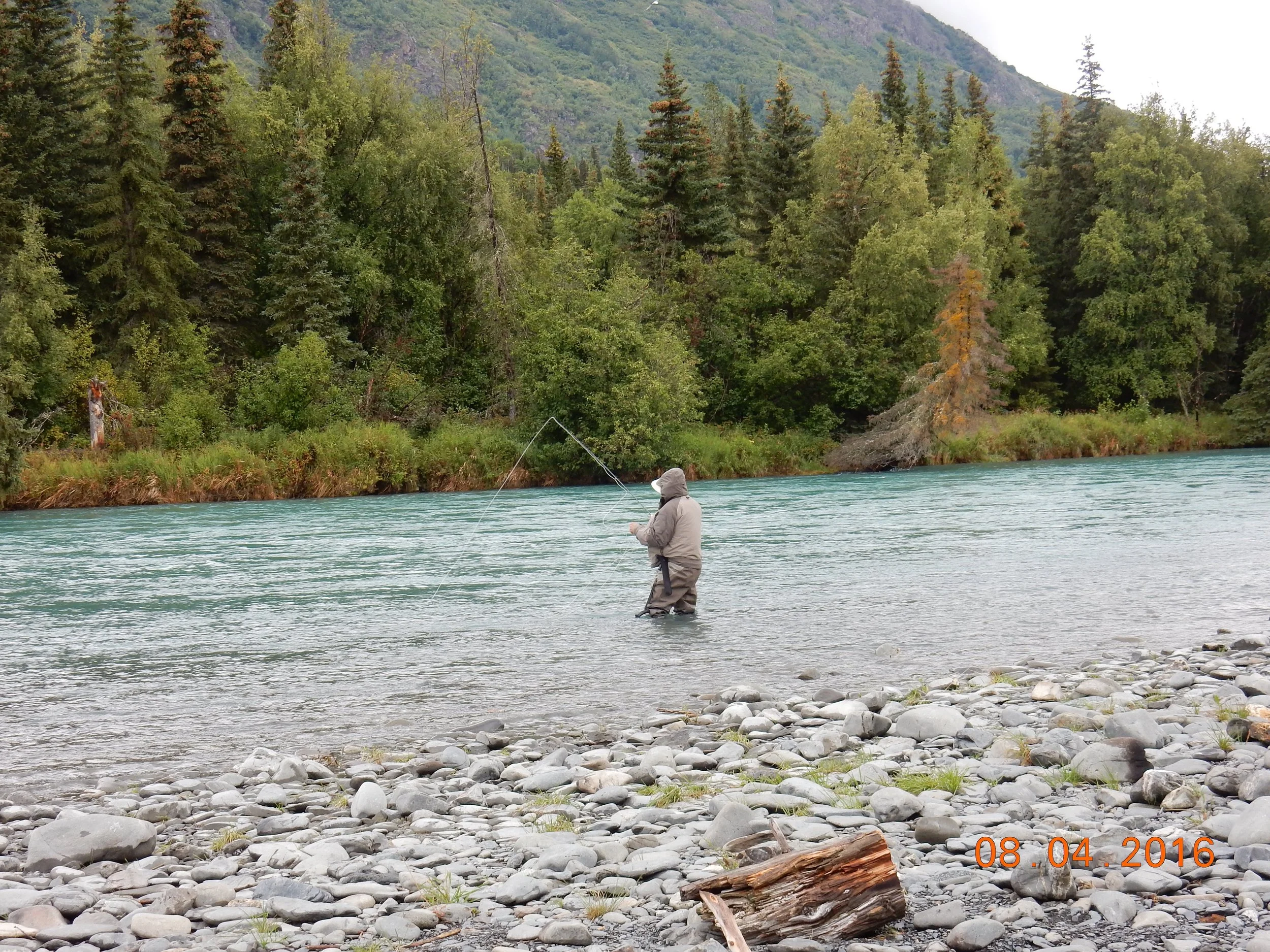
We round a bend and come upon a fishing tour.  Twenty people, dressed in the same ugly gear we’re wearing, standing out in the water, poles and nets at the ready.  Though they’re right on top of each other, they’re having luck.  There’s a reason why they’re all in the same pool—this is where the spawning salmon gather.  After that, until we reach Skilak Lake, we’re never out of sight of fishermen scooping their salmon.   

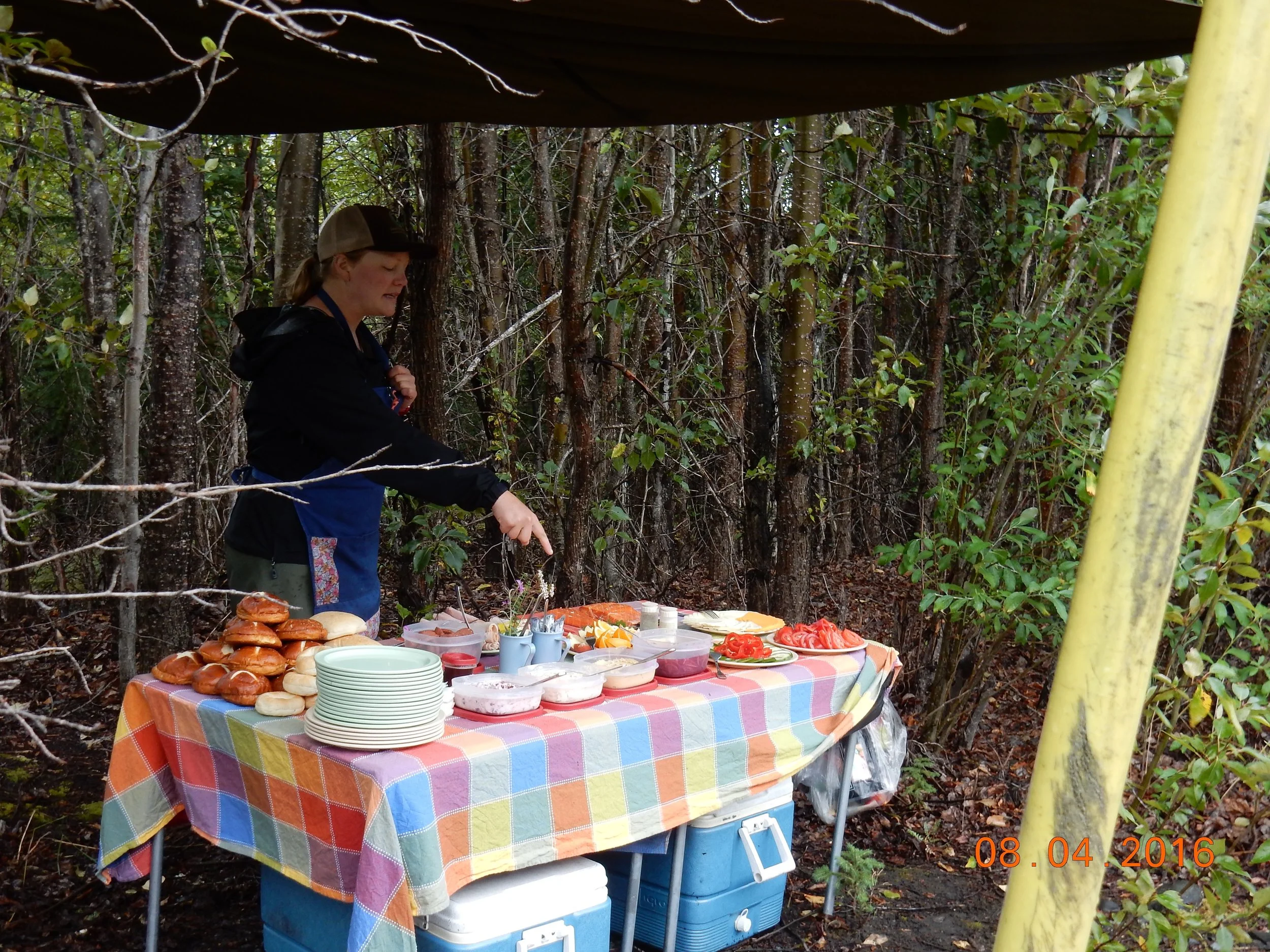
After a while our rafts come to bank on a rocky beach.  The guides leap out, set up a table and a tent to keep the rain out, then spread an impressive picnic of salmon, salad, bread, several gourmet cheeses. 

The rain has let up a bit, but the sky still drips. 

“Ladies to the right, gentlemen to the left,” one of the guides announces.  And that’s the way we find out that if we need to pee, which we all do on account of our reactive bladders, we must seek a private place in the wet Alaskan woods. 

One by one we wander in our designated directions.  As I squat between two trees, my cold butt exposed, I worry about Alaska.  I understand that these areas we’re visiting are remote and that infrastructure is impossible and destructive to the environment.  But we’ve seen a hundred people fishing.  Our raft group transports twenty-one; but we’re not the only rafts on the river.  And even if these tours don’t happen daily, they must happen several times a week.  So it’s conceivable that, during an average week during the summer, between eight hundred and a thousand people are peeing along the shores of the Kenai River.  This can’t be good.

And next, a rant.  There is a couple traveling with their children.  The mother moves her two kids to the front of the line.  Then she hovers with them over the salmon, meat and cheese plate, bread choices, encouraging them in their decisions, reminding them of past experiences and preferences, discussing the nutrient content of every item.  The mother is aware that she’s holding us up, that more than a dozen people are standing in the rain waiting for her to move her children along.  She smiles at us, not in apology, but as an invitation for us to identify with her in the intrinsic difficulties and joys to be found in motherhood.  And I am deeply offended.  David and I traveled all over the world with our children, and never once did we make them feel that their needs were more important than the needs of others, or that they deserved special treatment simply because they were small.  Rant over. 

We hang in klatches while we munch.  The women shiver while the men manfully claim that they’re comfortable.  We reboard the rafts for more of the same.  Ninety minutes later the river opens on to Skilak Lake, which is reputed to be serene and lovely, but on this day is rough, with white caps higher than the sides of the raft.  We must cross this hazardous obstacle in order to get to our next destination, Kenai Back Country Lodge.  An hour of up-and-down drenching hell.  Icy water coming at us from below, from the sides, from above.  David, at the front, is soaked.  The fierce waves attack him as though they harbor hatred. 

David is a good sport, always.  Not so, me.  I’m stewing in misery.  After we arrive at the opposite shore, ragged and beaten by the elements, we are told to drop our gear on the beach.  We’re handed our boots—my hands are too cold to tie them—and directed to the central hall and dining room, where we’re given an introduction to the lodge. 

The guides are upbeat, proud of this remote location, expecting us to be impressed by the amenities they work so hard to maintain.  Using jolly voices, they tell us that, wet as we are, the lodge has no drying facilities.  And no plumbing in the cabins, either, so if we need to use the restroom in the night we’ll need hiking boots and a flashlight.  Also, there is no electricity in the rooms.  And the walls of the cabins are canvas, not real walls at all. 

This is all very upsetting.  I approach the sideboard, pour a glass of Merlot, and retreat to our quasi-cab, where I change into dry clothes and give myself a lecture about living in the moment and handling difficult situations.  It doesn’t do the trick.  The warmest clothes I brought with me are dripping and we’re going to be in this cold place for two days.  David calmly unpacks and changes, silently tolerating my grumbles.  I return to the main hall, pour more wine, return to the canvas cabin, and sulk for another forty-five minutes.  By dinnertime I’ve mellowed a bit, so at least now I can sit around a table and be civil.  The food is delicious, but I’m too exhausted to care.  Everybody else had the same day I did, but they seem to have recovered quicker, adjusted better than I have.  Maybe after a night’s sleep . . . 

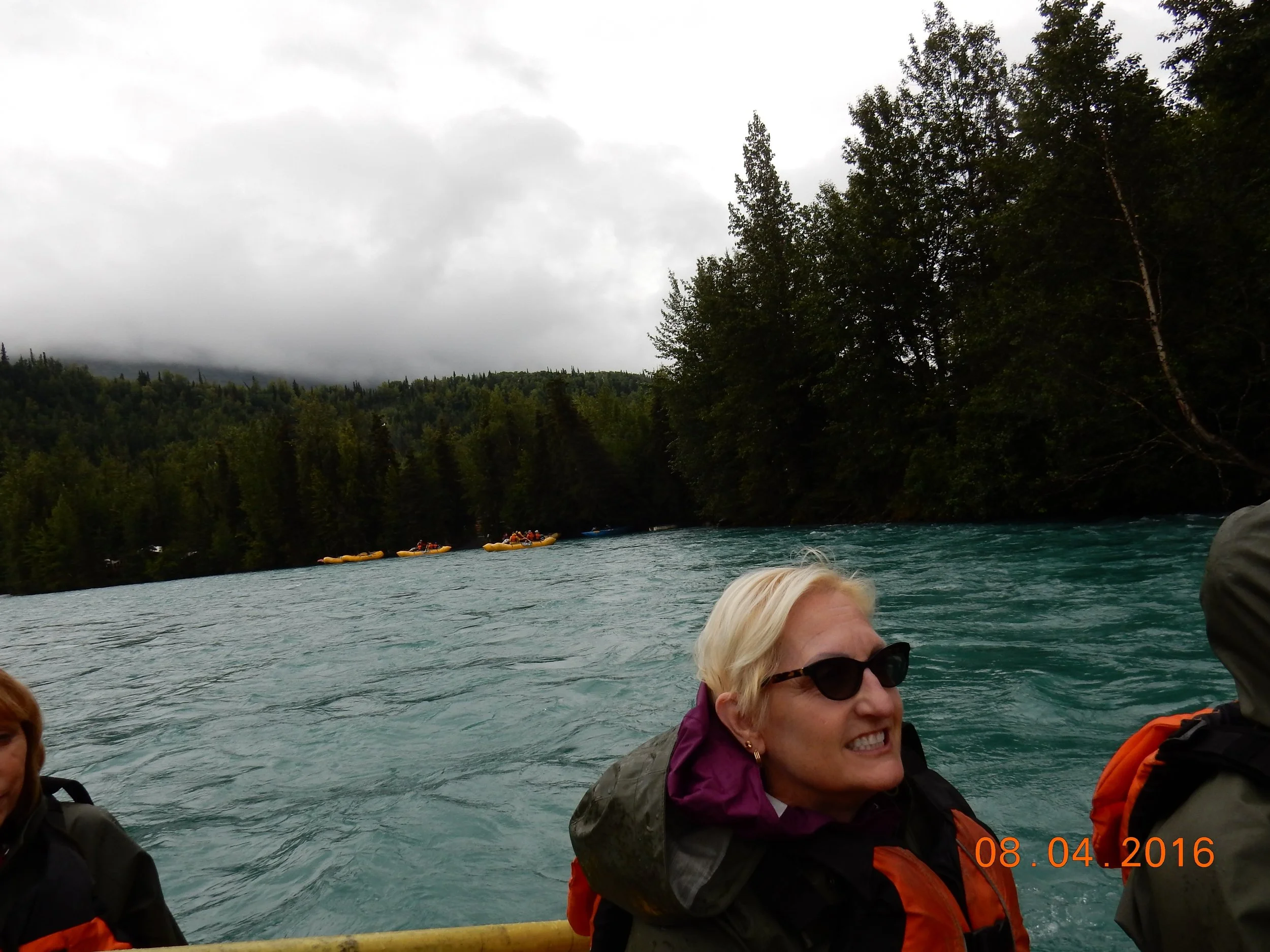
See what an outdoor woman I am?  I don't mind wearing smelly clothes or having flat hair at all.  

See what an outdoor woman I am?  I don't mind wearing smelly clothes or having flat hair at all.  

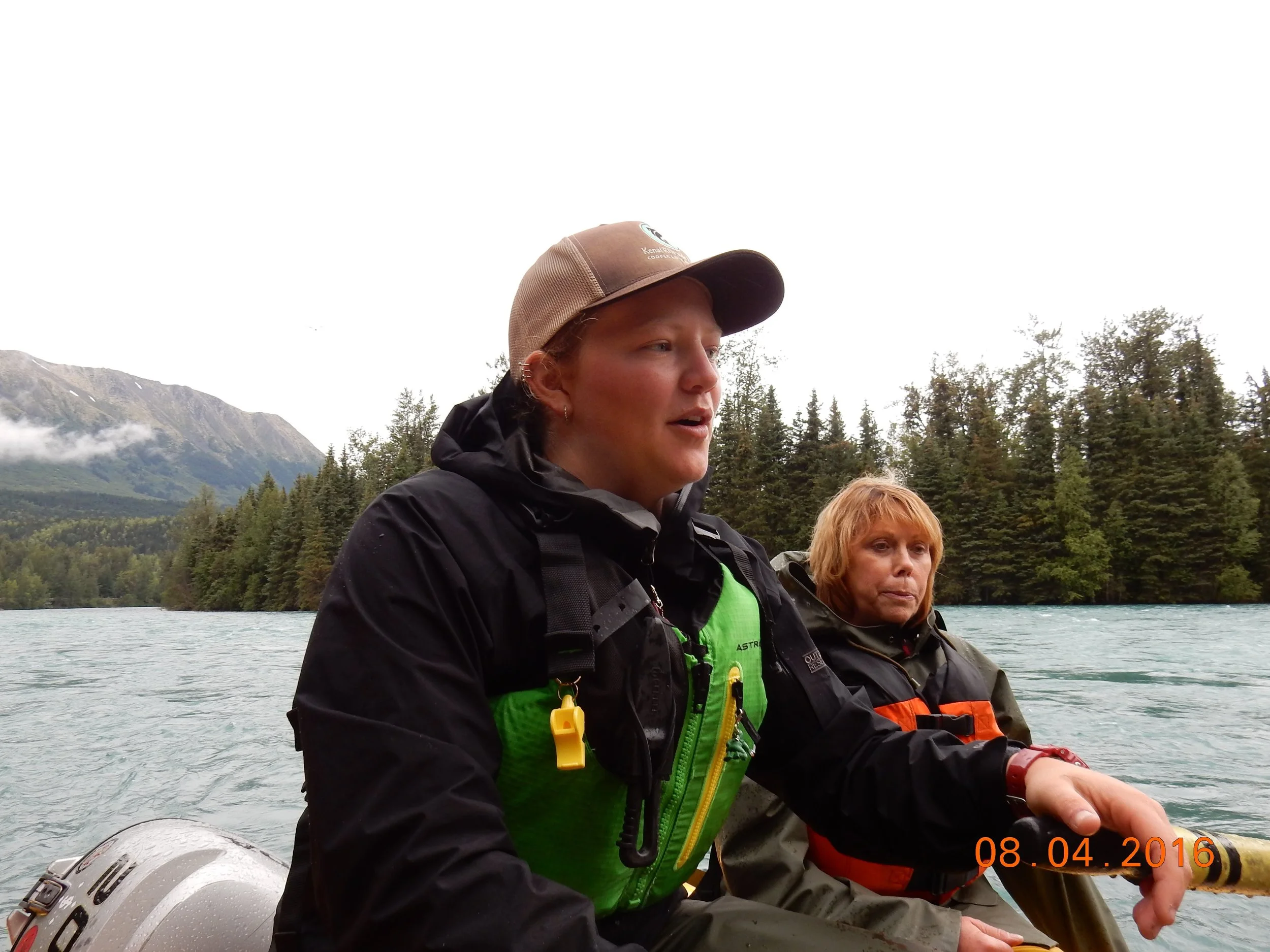
This is the guide.  Her mouth's open because she's talking.  Behind her is Dawn, who is ordinarily a pretty woman, but looks tense in this photo (sorry, Dawn).  

This is the guide.  Her mouth's open because she's talking.  Behind her is Dawn, who is ordinarily a pretty woman, but looks tense in this photo (sorry, Dawn).  

A rainy day picnic.

A rainy day picnic.

Me, with Dennis and Cheri.  Cheri actually took the time to read the literature, so she was better prepared than I in that she brought along a travel potty.  

Me, with Dennis and Cheri.  Cheri actually took the time to read the literature, so she was better prepared than I in that she brought along a travel potty.  

This guy looks cold.

This guy looks cold.

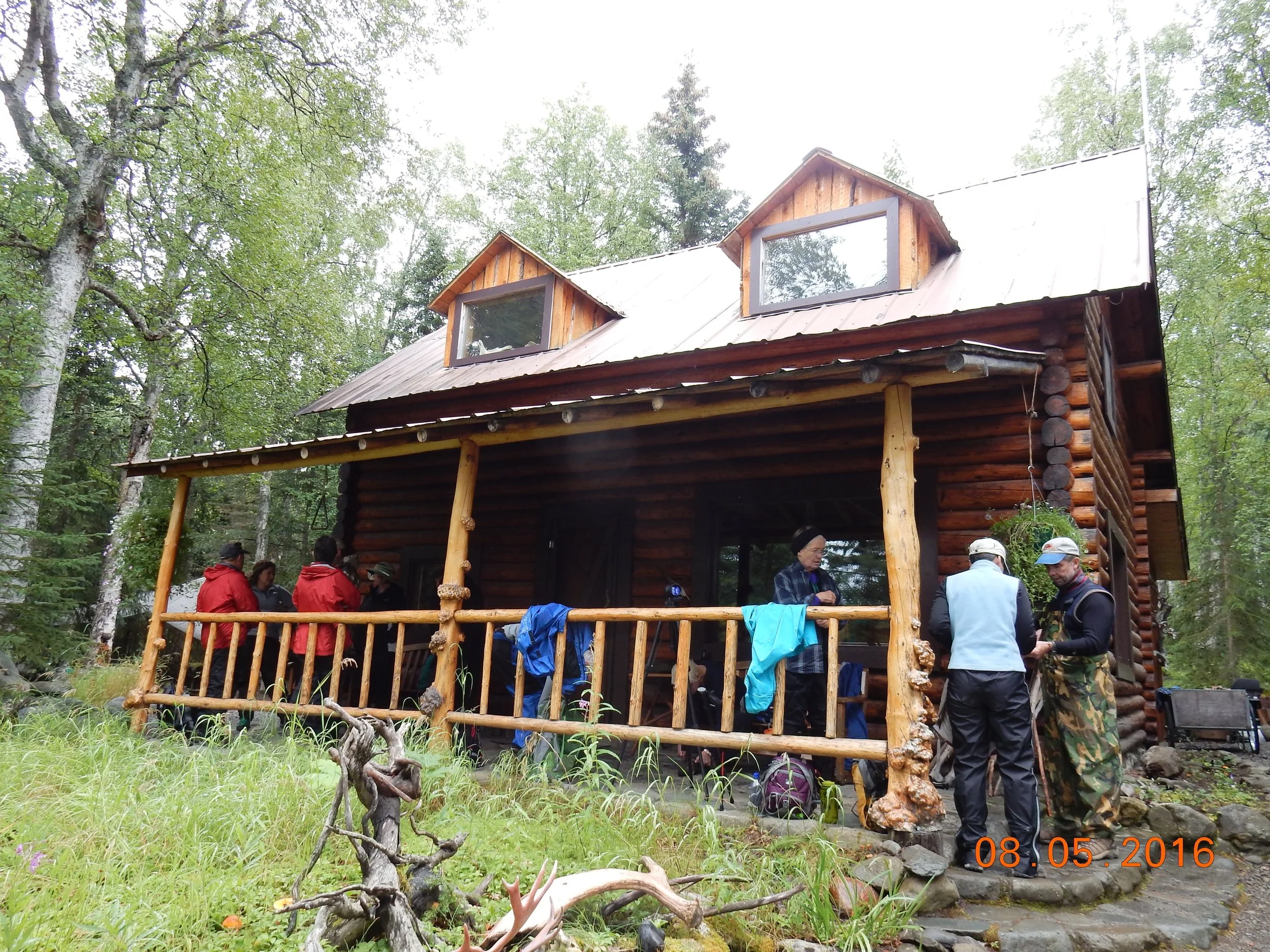
The lodge gathering place.  Wine is inside.  

The lodge gathering place.  Wine is inside.  

The next day we went for a six-mile, rough terrain hike.  

The next day we went for a six-mile, rough terrain hike.  

Tour Gang

Wet, cold, and worn out after dog sledding on the glacier, we arrive at the Kenai Riverside Lodge at around four.  We’re all shown to our separate cabins, where our luggage has magically appeared.  The cabins are well appointed, with rocking chair porches, cozy quilts on the beds, and shelving and hangers so we can get organized.  The bathroom belongs to a long-legged spider who intends to spy on our private business for the two nights we’re here.  The small desk in front of the heater is appreciated, as I get up early to write, a routine I never mess with.

Before we settle in, Elias, our guide, gives us a tour of the lodge.  He walks, points, talks.  There’s the place where we check in.  This is the boathouse where we’ll meet for the raft trip tomorrow morning.  Here’s a centrally located building that consists of a sitting area, a bar, and a dining hall.  The bar attracts my interest and as soon as we’re released from the tour, that’s where I go to request a Malbec.  Then I make my way to the large deck, conveniently located right in front of our cabin, that overlooks the broad, fast-running Kenai River.  Some of our tour mates, not as interested in a glass of wine as I am, are already there.  David shows up with a beer and, relaxing into the chairs that overlook the foaming water, we all begin the process of getting to know one another. 

Purists can be snooty about packaged tours.  And at times I’ve felt the same way.  I would never, for instance, go on a pre-paid tour of self-explanatory sites like The Great Wall or Pompeii or Petra.  But there are some places where the act of arranging your own transportation is so difficult and time-consuming that it overshadows the pleasure of being there.  Alaska is that kind of place.  During our explorations we’ll go to remote locations that can only be accessed by boats and helicopters, all arranged by our tour company.  All that’s expected of us is to pay, sign, and show up.  Nevertheless, the notion of traveling in close proximity to six other people for a long period of time causes anxiety.  There’s the risk that someone in the group might be annoying; and I tend to be intolerant.  Here are my early impressions: 

Dawn and Ronnie, of our generation, are traveling with their son, Adam, and their daughter-in-law, Laura.  They’re from Alabama.  To my shame, I look for things to not like about people before I look for things to like.  But to my delight, there’s nothing negative here.  These are entertaining people, offering a plethora of interesting characteristics.  A southern accent can be misleading.  A drawn-out twang can give the impression of slow thought.  And these canny folk, fully aware of the misperception, proudly embrace the drawl of their heritage.  The two men are savvy business successes—Ronnie recently sold a large business that he built from the ground up, and Adam is a busy builder who owns his own company.  The four family members are smart and deal with each other with kindness and humor.  The two men are very much alike and sometimes seem to communicate without verbal exchange.  And Dawn, the matriarch, is relaxed and open-minded.  She’s got thoughts of her own, but is content to let things flow; non-controlling, which tells me she thinks highly enough of herself that she doesn’t have to be constantly proving that she’s in charge. 

Adam is quiet and at first I think he’s reticent, perhaps grouchy.  But then I hear his laugh, and though I’ve heard about an “infectious laugh” this is the first time I’ve ever actually come across one.  It’s a quiet, almost sneaky, “heh, heh, heh,” that makes me think—well, no wonder that beautiful girl married him.  I bet she laughs every minute of the day.  Also, it turns out that he’s a wild man, a rule-breaker; during our brief stay at the Kenai River Lodge, he over stoked the sauna, almost catching it on fire, and snuck in to the forbidden staff area to use the dryers (heh, heh, heh).  (All the places we stayed were tediously, yet justifiably, energy conscious.)  If Adam doesn’t like an imperative, he simply ignores it.  I envy his audacity. 

Laura, with merry eyes and a head of brown curls, wins my heart when she says she loves to read.  Some people don’t read, and I don’t understand this.  Laura is an enthusiast, up on all the latest writing websites and current authors.  Discovering that I’ve got a novel coming out in the UK in September, she pulls out her phone, calls up Amazon.co.uk, and searches for the title, Old Buildings in North Texas, where the blurb is offered and I’m described as an “astonishing new American voice.”  Apparently it’s available for pre-order, and will be out on the fifteenth of September.  I didn’t know about this.  Shouldn’t I have known?  

“I’m going to receive twenty copies from the publisher,” I tell her.  “I think I should do something promotional with them, but I don’t know what.”  I imagine the hardbacks lined up on my shelf.  I guess I might give a few to friends or family members. 

“You’re supposed to offer signed copies on your website,” she tells me. “Your fans will definitely want them.”

See why I like her?

The remaining two people are Dennis and Cheri, from Missouri.  Cheri is the one I have the most in common with.  Like me, she gets skittish when she doesn’t know the plan.  She and I enjoy the same things—quilting and reading and working on our various projects.  We’ve raised our kids and aren’t outgoing, though I think she’s even more introverted than I am—she doesn’t even play Mahjong!  Most notable about her husband, Dennis, is that he’s courteous.  Every time we must clamber in or out of the van, he’s standing with a hand out to support the ladies as we navigate the gigantic step.  Retired now, he spent his career as a federal watchdog, investigating union corruption.  Fascinating. 

“Wow,” I say, leaning forward greedily.  “I bet you’ve got some stories to tell.”  I’m always on the lookout. 

“Oh, I could tell you stories.”

But, though I indicate an interest, no tales are forthcoming.  I sense that there’s bitterness there, as though he’s unhappy with the way the job came to an end.  Or maybe he simply doesn’t like to talk about himself.  Depths unplumbed; I hate it when there’s something I don’t know. 

Time for dinner.  Filet mignon, so tender it melts in my mouth.  Delicious roasted potatoes (never met a potato I didn't like), grilled vegetables, salad, freshly baked bread.  Dessert, rich and creamy.  And this is how we all learn that we're going to gain weight in Alaska.  

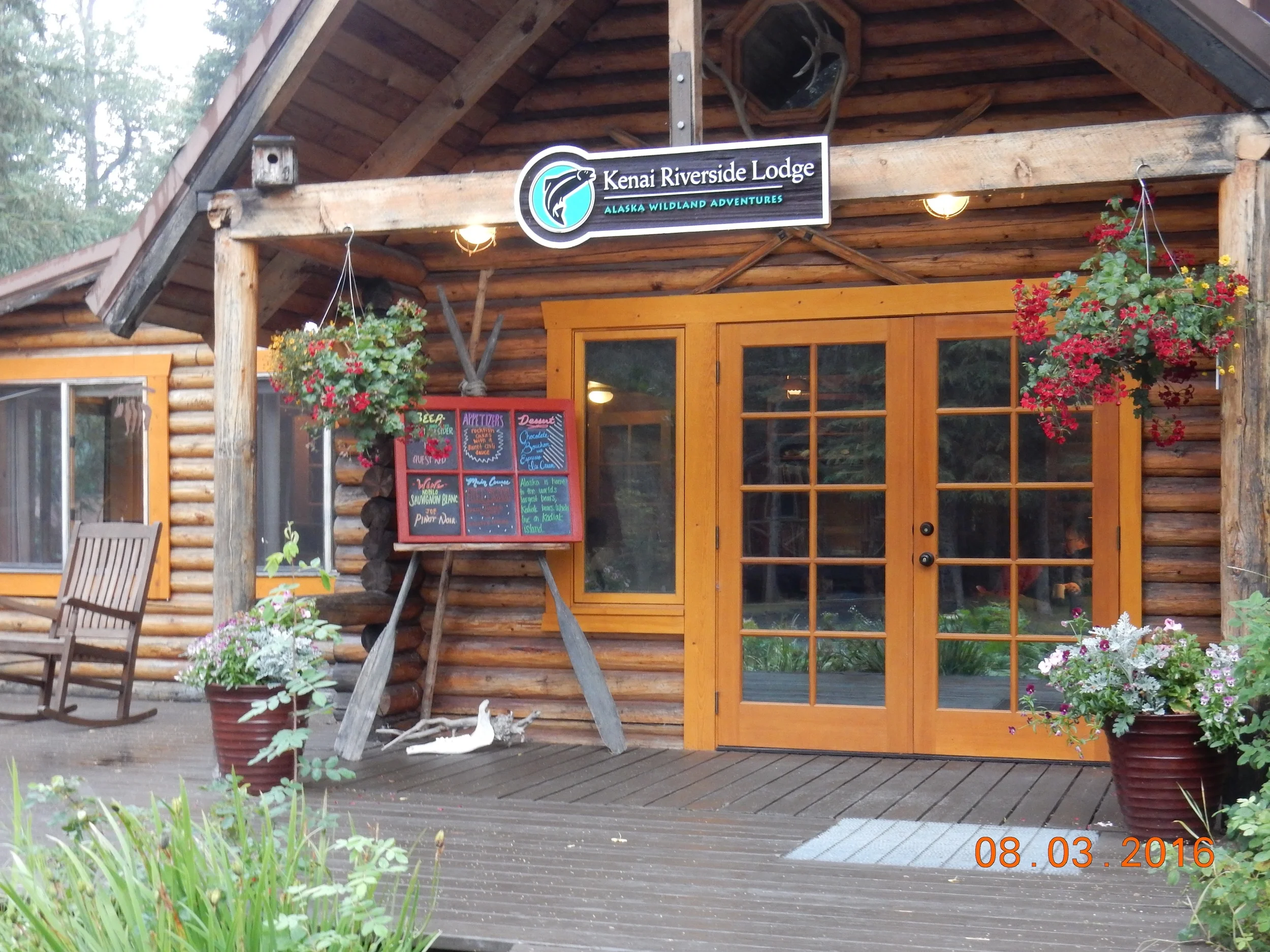
Isn't it a welcoming frontage?

Isn't it a welcoming frontage?

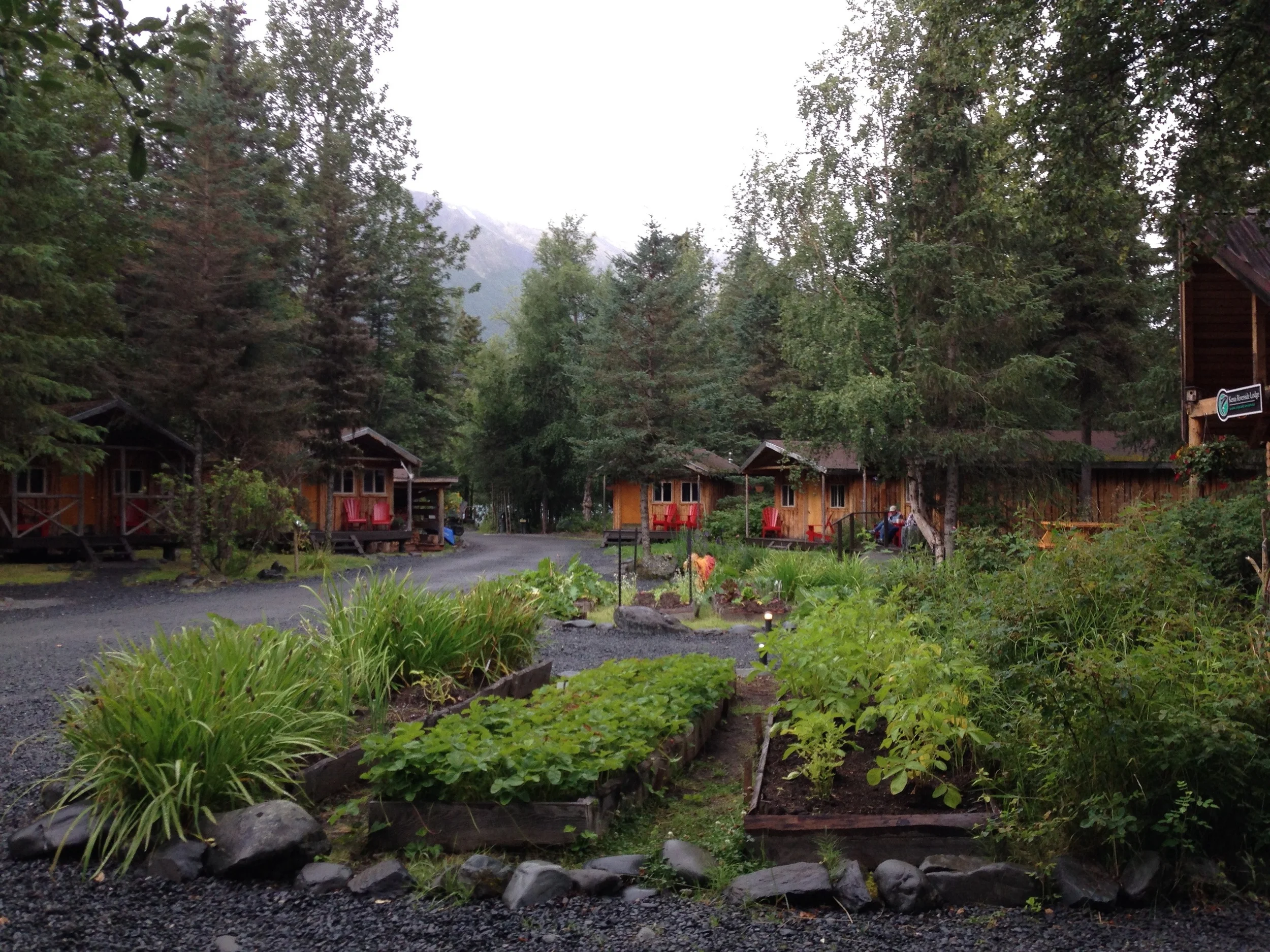
The cabins.  Ours is further back, near the river.

The cabins.  Ours is further back, near the river.

The Kenai River from the viewing deck.

The Kenai River from the viewing deck.

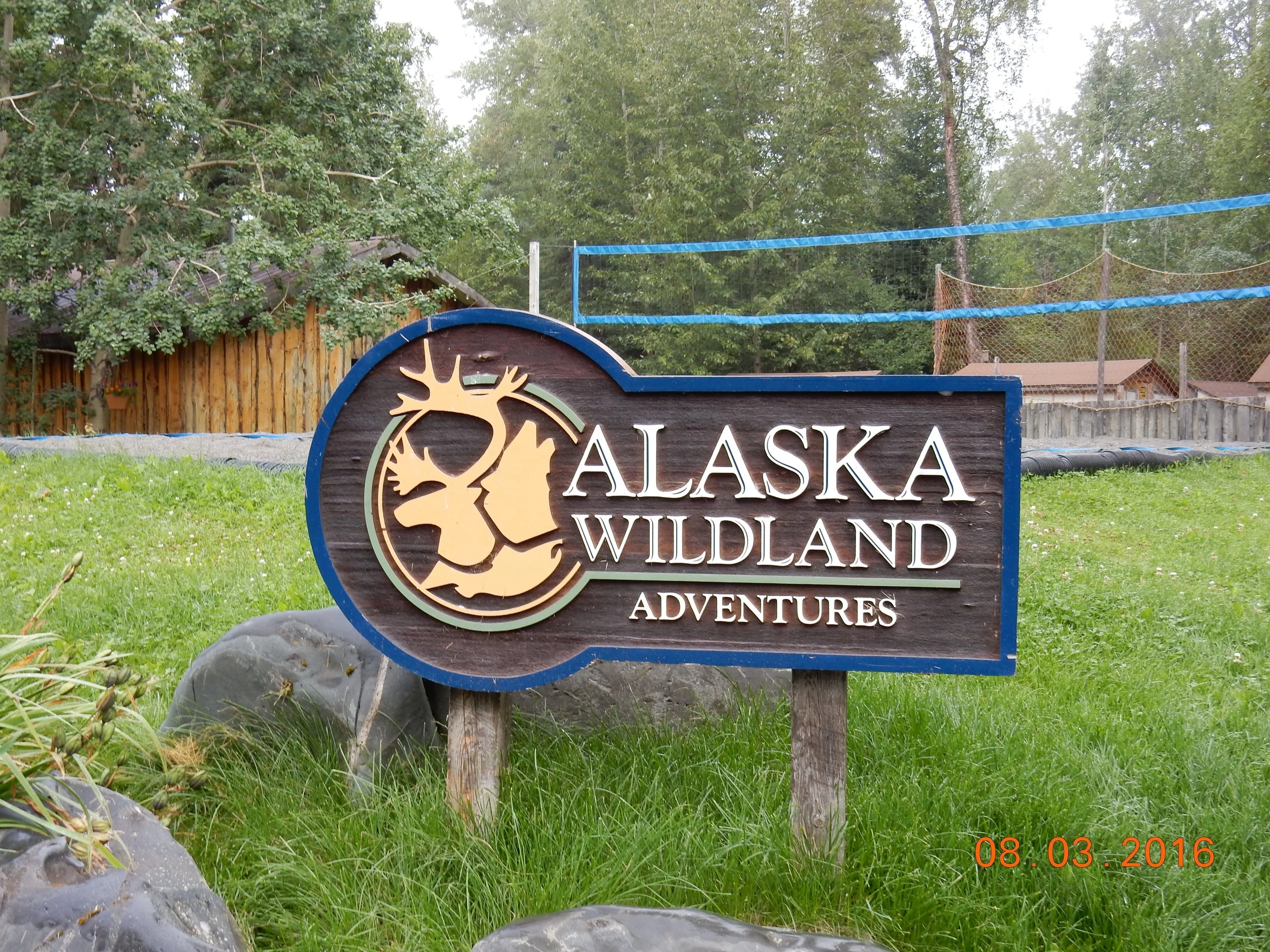
The name of our touring company for those who'd like to see Alaska.  

The name of our touring company for those who'd like to see Alaska.  

Dogs on a Glacier

On our first morning in Alaska we meet our guide and traveling companions in the lobby of the hotel.  Elias, the guide, is welcoming and condescending.  I like him immediately; I’ve always enjoyed arrogant men.  There are eight people in the group and we go around the circle and introduce ourselves, then immediately forget each other’s names.  We’ll be together for the next several days, so I imagine we’ll know more than names by the end of this.

From this point we begin the journey to a dog-training site on a glacier where we’ll learn about mushing.  We were instructed to dress warmly.  I wear long johns beneath quick-dry pants; on top, four layers—two wool, one fleece, and a rain jacket.  Putting on this many layers is labor.  And fashion has no place here, a circumstance that is always sad. 

It’s a two-hour drive to the helicopter that’ll lift us to the glacier.  The journey is broken by a couple of short ambles across boardwalks over swampy areas, with brief commentary offered by Elias.  This is the first time we hear about the earthquake of ’64, when the land dropped ten feet and huge areas were flooded with seawater, which caused the trees to die.  These trees now stand, forlorn, skeletal silhouettes, preserved by the salt.  They are called ghost trees and it’s against the law to cut them down because they’re part of Alaska’s history.  (We’ll hear about these ghost trees at least three times a day during our stay.  This is because guides are required to constantly share tidbits, and the number of tidbits is limited.)  Everybody takes pictures of the trees.     

The drive is on a well-maintained highway, bordered by the Cook Inlet on one side and a glacier river on the other.  There seems to be a lot of water.  Gushing or placid, creeks and rivers, tiny trickles between modest rock formations, and dynamic splashing falls from impressive cliffs.  Water, water, water.  Also, rain.  All this wetness has an effect on our reactive human bladders.  During the two-hour drive we must make three toilet stops, all at public non-plumbed toilets. 

The helicopter depot also has an outdoor closet toilet, which leads me to my first Alaskan conclusion:  plumbing is a luxury here, and someone is making a fortune by providing inexpensive, smelly facilities for the tourists.  Before we clamber on to the helicopters, we don even more rain gear—an additional raincoat, rain pants, gloves, and rain boots over our hiking boots.  Staying warm is hard work.  Take a picture. 

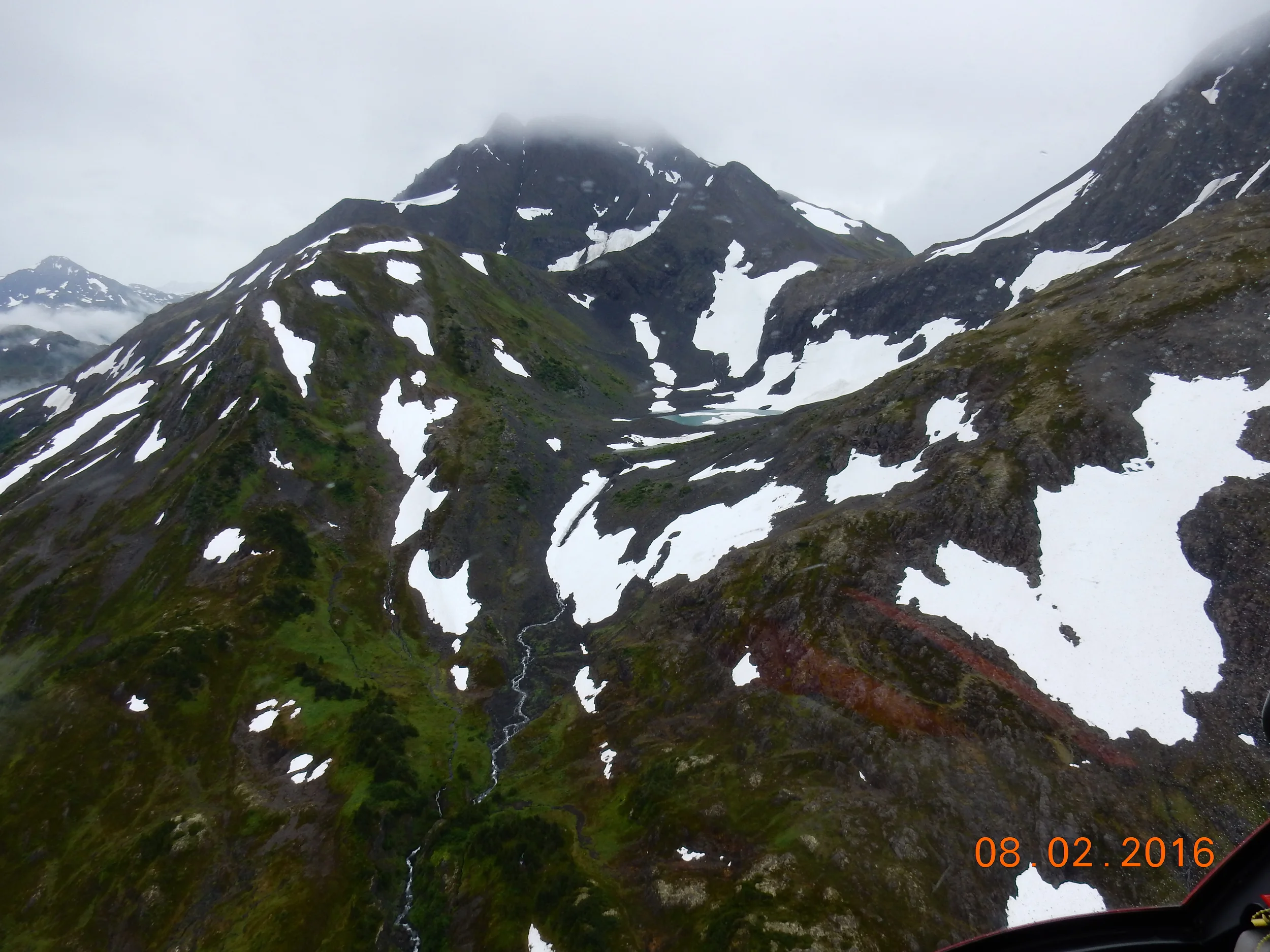
A helicopter ride to the top of a glacier—eh, I’ve done it before.  But it allows us to experience the panorama that Alaska is famous for.  It lives up to the hype.  Spectacular jutting peaks, gray with splotches of snow.  A painfully blue sky giving way to rolling fog.  Intensely virginal.  The cameras go click, click, click. 

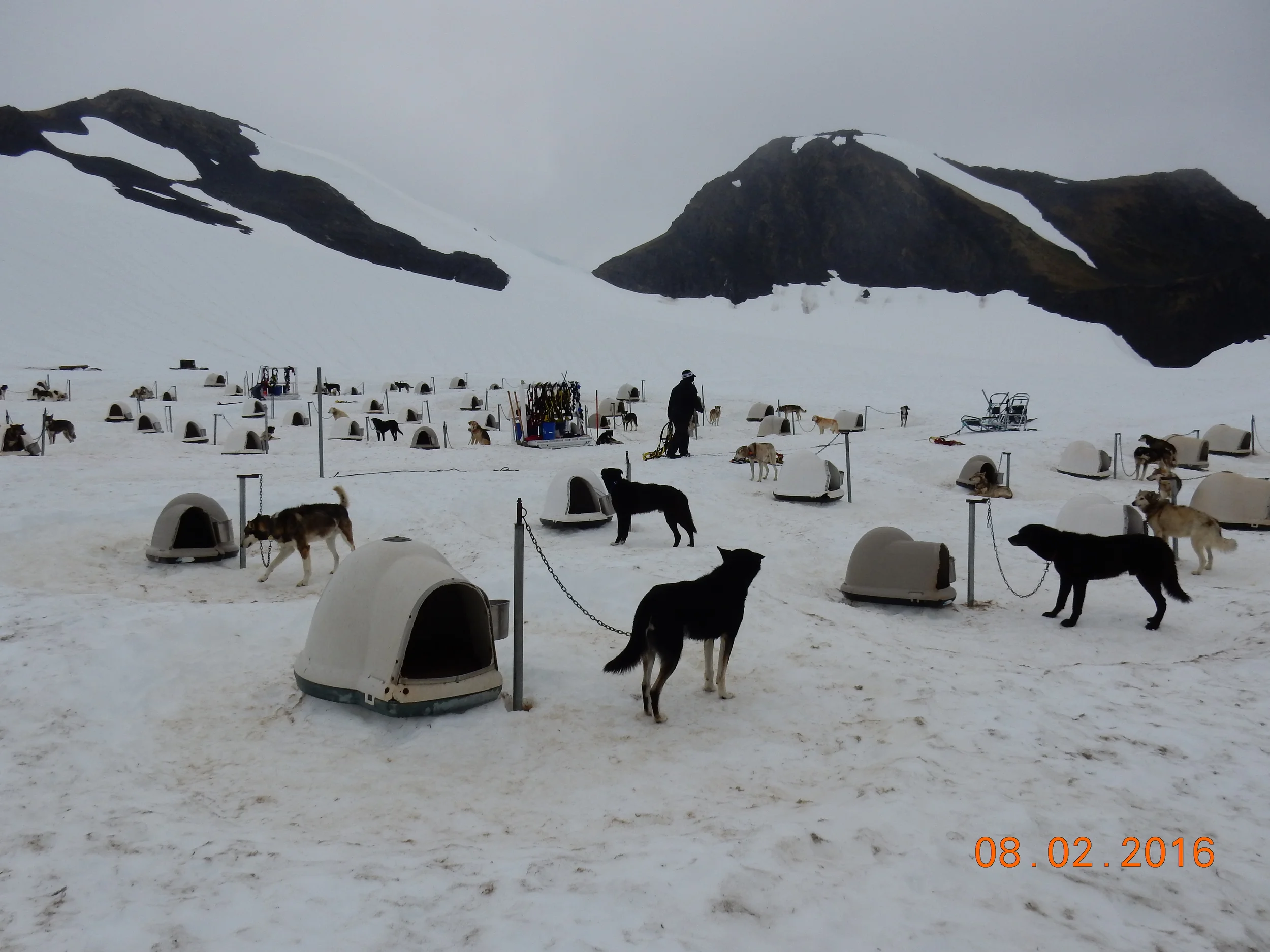
Alighting adjacent to the camp, another tourist group leaves as we arrive.  Beyond the landing point, sixty dogs bark and run circles around their shelters, eager and thrilled, as though we’re the first bundled people they’ve ever seen.  We’re greeted by a red-cheeked young woman, who immediately begins telling us about our surroundings.  And look—there’s a perfect spot for picture taking. 

The ice is thick and we slide with every step.  The camp is owned by Mitch Seavey, a multi-time Iditarod champion.  It is understood, but not discussed, that our tourist money finances his dog-mushing passion.  The Iditarod is explained—where, how often, how far, its history.  Distracted by the shrill yipping and the cold, I absorb very little of the information.  Expecting to see huskies, I’m surprised by the mixed-breed look of the animals.  I’m not sure how many people work on this glacier, but four are in view.  Our hostess explains that she and her co-workers live up here full-time during the summer, then move the animals off the mountain during the winter.  As she talks, one of the dogs drops a steamer.  Another worker, a young woman, rushes out with a shovel, scoops it up, and carries it away.  I imagine they need to be on top of the poop or the whole glacier would be brown. 

We’re told that a significant aspect of the sport is dog selection.  A good sled dog should be lean, strong, social, and possess exceptional stamina.  We’re led through the mechanics of sledding—going and stopping, balancing and steering.  We watch as the excited dogs are led to the lines.  More pictures. 

“The dogs love what they do,” our sled person tells us.  A member of our group asks where the toilet is.  He’s pointed to a white booth perched at an angle.  While it’s stupid to expect the porcelain option on a glacier, I fear I’m going to become weary of stewed sewage. 

“Where are you from?” I ask our pro.  “Why are you here?”

“I’m from X—” Insert any lower state.  In the days to come, I’ll discover that all our guides, with the exception of Elias, are from elsewhere.  “I’m here because I love dogs.  I’m going to vet school in the fall.  Also, my boyfriend’s here.”

The boyfriend issue is pertinent.  While I was in college I had a friend who, whenever she wanted to feel attractive, would run up to Alaska for a couple of weeks.  Because Alaskan life is rugged, the state attracts many, many manly men, which means easy pickings for the mammary-endowed.  If there were a competition for horniest state, Alaska would win hands down. 

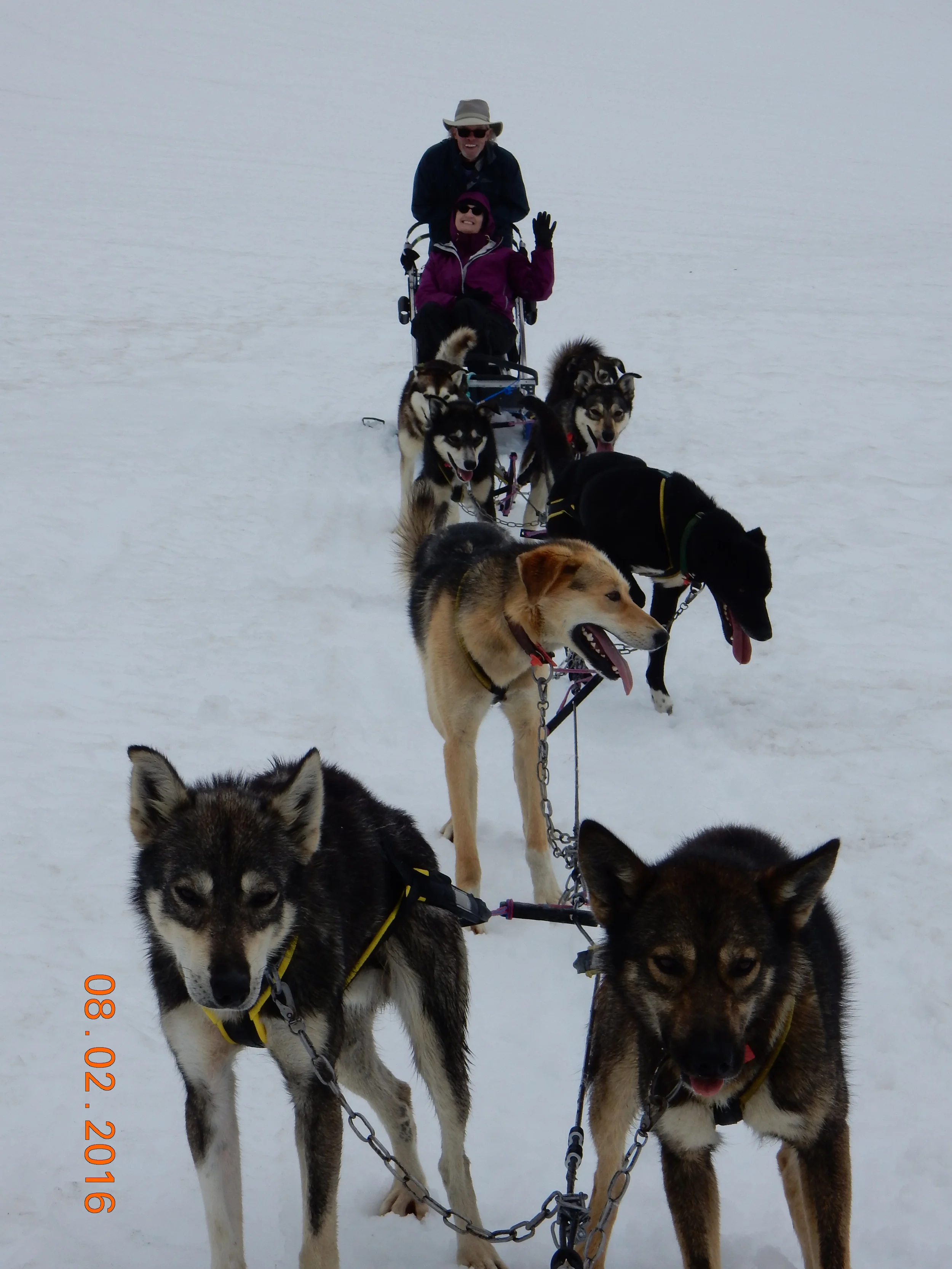
A dozen fervent dogs are in harness.  Two passengers per sled, plus the driver.  I take the standing position on the back rails while David takes the seat in front.  The musher stands between us.  The two large claws digging into the snow are the brakes; and when our guide removes them, the dogs take off, and they take off fast.  Hang on!  Zero to fifteen in a single second.  Whee!  We thump over small bumps; and we coast into and and out of large dips.  Balancing is tricky, but I soon get the hang of it—feet set, soft knees, firm grip, relaxed shoulders.  Our driver communicates direction by leaning.  I imagine it takes practice. 

We fly across the snow for quite a distance, stopping along the way for David and me to switch positions.  There’s picture taking.  We return to the group, thank our new friend, whose name we’ve already forgotten, climb into our whirly lifts, and wave good-bye to the glacier and its inhabitants.  We all decide that this was a fun and interesting excursion. 

What I’ve learned so far: 

1.  I won’t be putting on an item of clothing every morning—I’ll be putting on everything I brought. 

2.  Dogs like to have a job to do. 

3.  The workers are migratory.  The whole state closes down in the winter.

4.  Pulling the camera out every few minutes is annoying.  From here on out, I'm relying on David to take the pictures.  Thanks, David.  

5.  Everything is wet.  I’m going to be damp for the next ten days.

Next stop, Riverside Lodge, where hopefully I’ll be able to find a nice glass of Malbec.  Also, I hear there’s a sauna.   


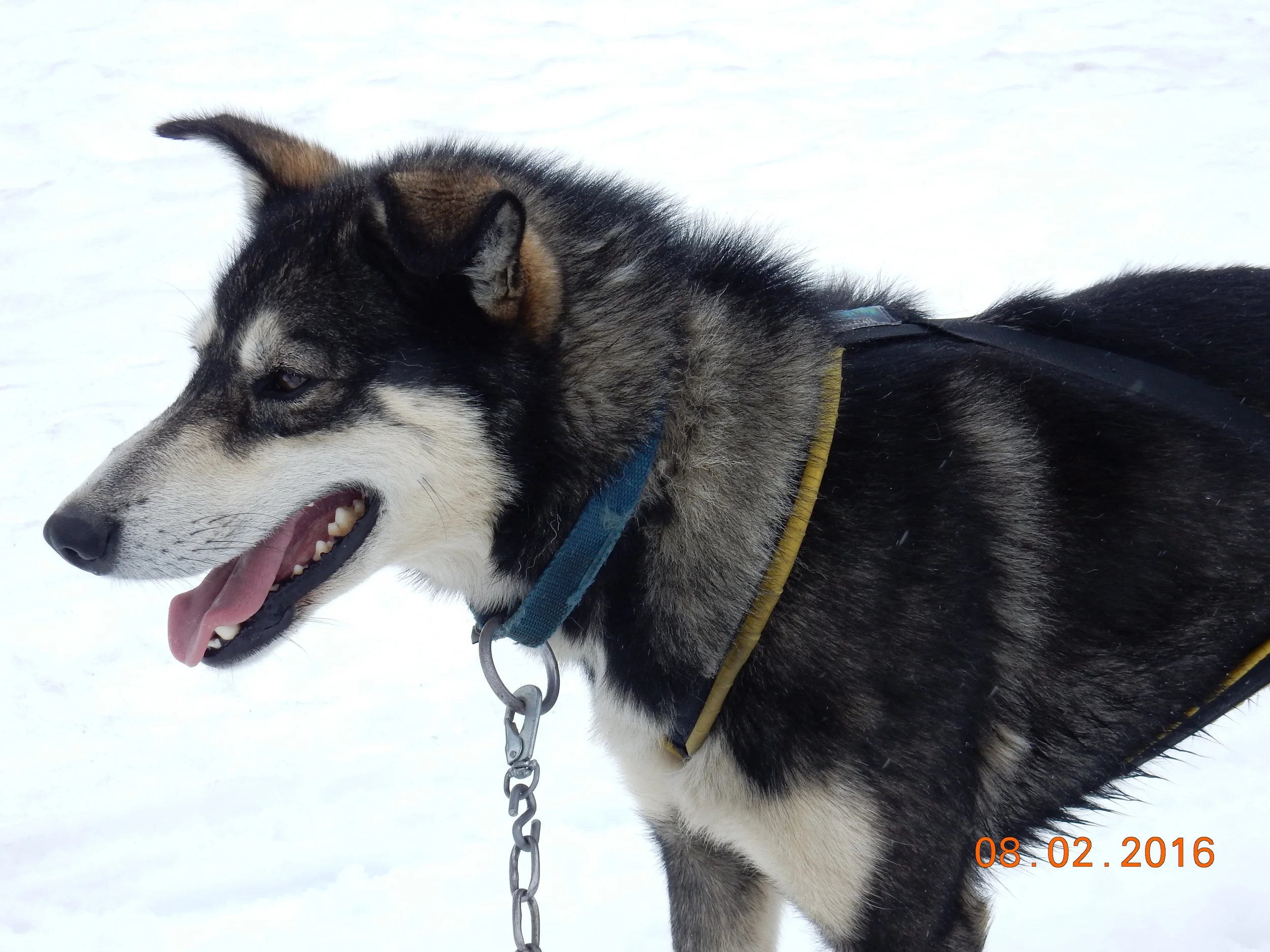
A handsome animal.  

A handsome animal.  

Summer camp for dogs.  Trip would not fit in.   

Summer camp for dogs.  Trip would not fit in.   

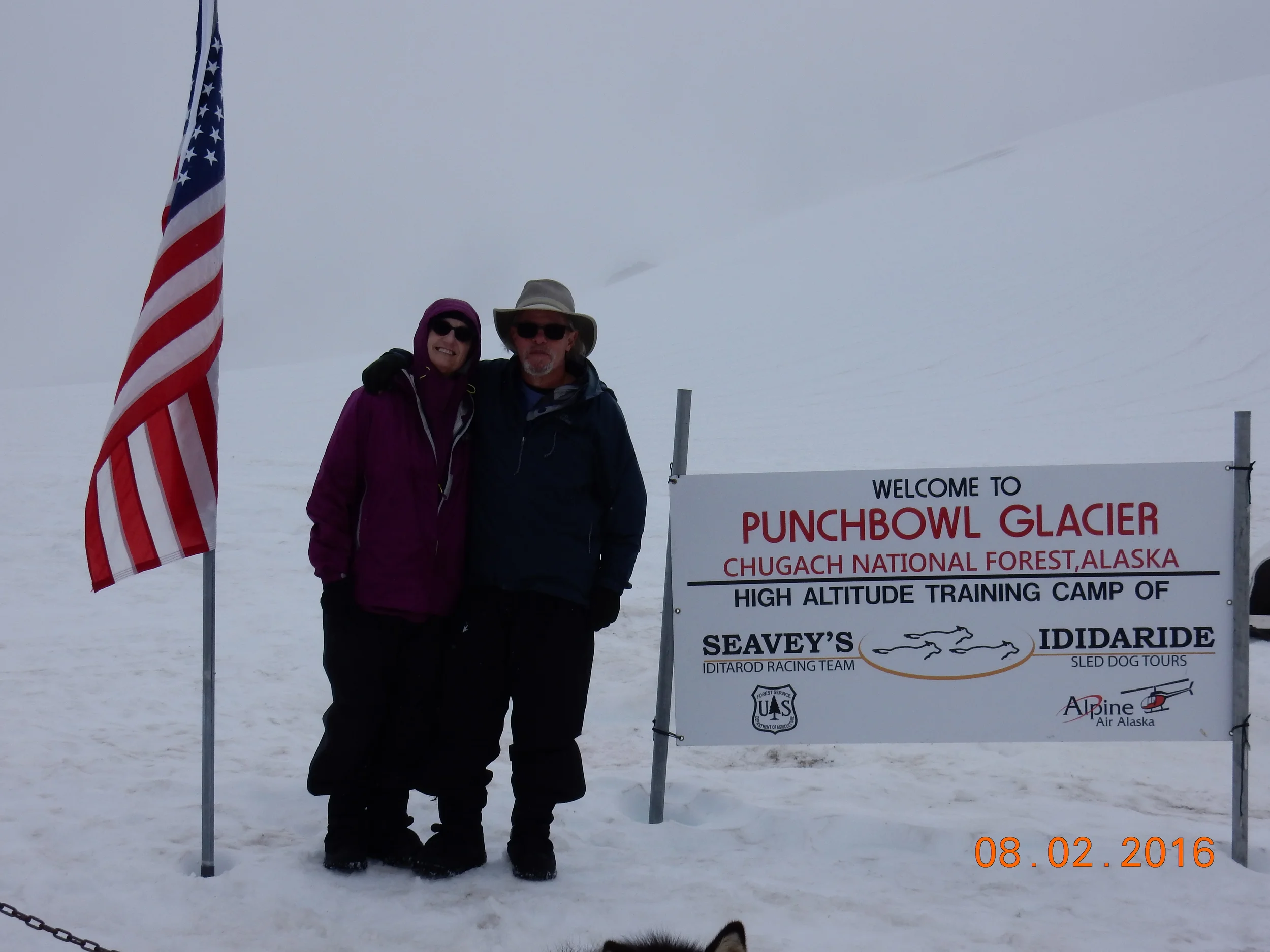
Photo op.  Yes, we were really on this glacier learning about dog sledding.  I did not make this up.  

Photo op.  Yes, we were really on this glacier learning about dog sledding.  I did not make this up.  

The two of us on the sled.

The two of us on the sled.

Taken by David from the helicopter.  Beautiful, isn't it?  

Taken by David from the helicopter.  Beautiful, isn't it?