Thai Cooking School


I know Georgia will like the Thai cooking class.  She’s a gifted cook, intuitive about flavor combinations, enthusiastic about putting food before family and friends.  She’s also able to taste a dish and identify the separate ingredients, which is practically a superpower.  Personally, I’m an uninspired cook.  I’ve got a few recipes I pull out when something special is required, but for the most part, dinner’s fifteen minutes from stove to table; and in another fifteen minutes it’s gone. 

A young man meets Resi, Georgia, and me in front of our hotel on Khaosan Road.  His name is Tuk (rhymes with book).  He leads us across the street, around the corner, and into the cooking school, where he introduces us to our classmates, who are seated around a table, waiting to get started.  Much is made of where everyone is from:  Martin is Hungarian; Evie, his girlfriend, is German and, as it turns out, is suffering a foul reaction to something she’s eaten and must race to the restroom every five minutes.  Poor Girl.  Two from Switzerland; he’s named Fabio, and she’s named Fabien.  Georgia asks if they’re twins and they laugh and share a look.  Apparently not.  An Israeli couple and their daughter arrive last. Their names are given—foreign-sounding, difficult to pronounce, pointless to remember. 

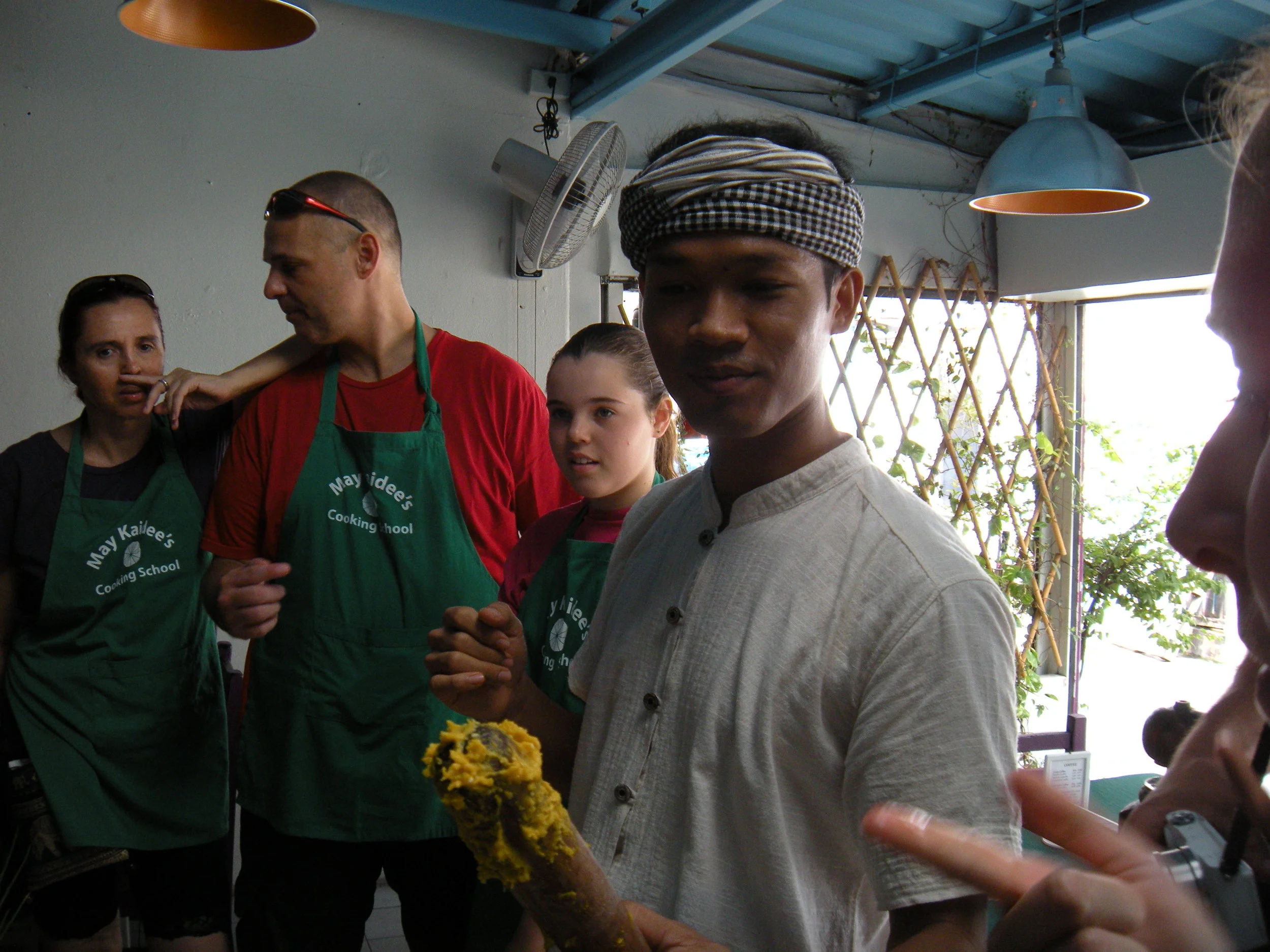
Tuk, it turns out, is the chef who will be explaining the foods and guiding us through the recipes.  He pays special tribute to his assistants, two quiet women who smile and duck their heads.  I’m relieved that he’s considerate toward them.  In the last cooking demonstration I attended, the chef berated her assistant until she made him cry.  I’ve never seen anyone so brazenly, proudly sadistic.  So Tuk’s kindness is a relief. 

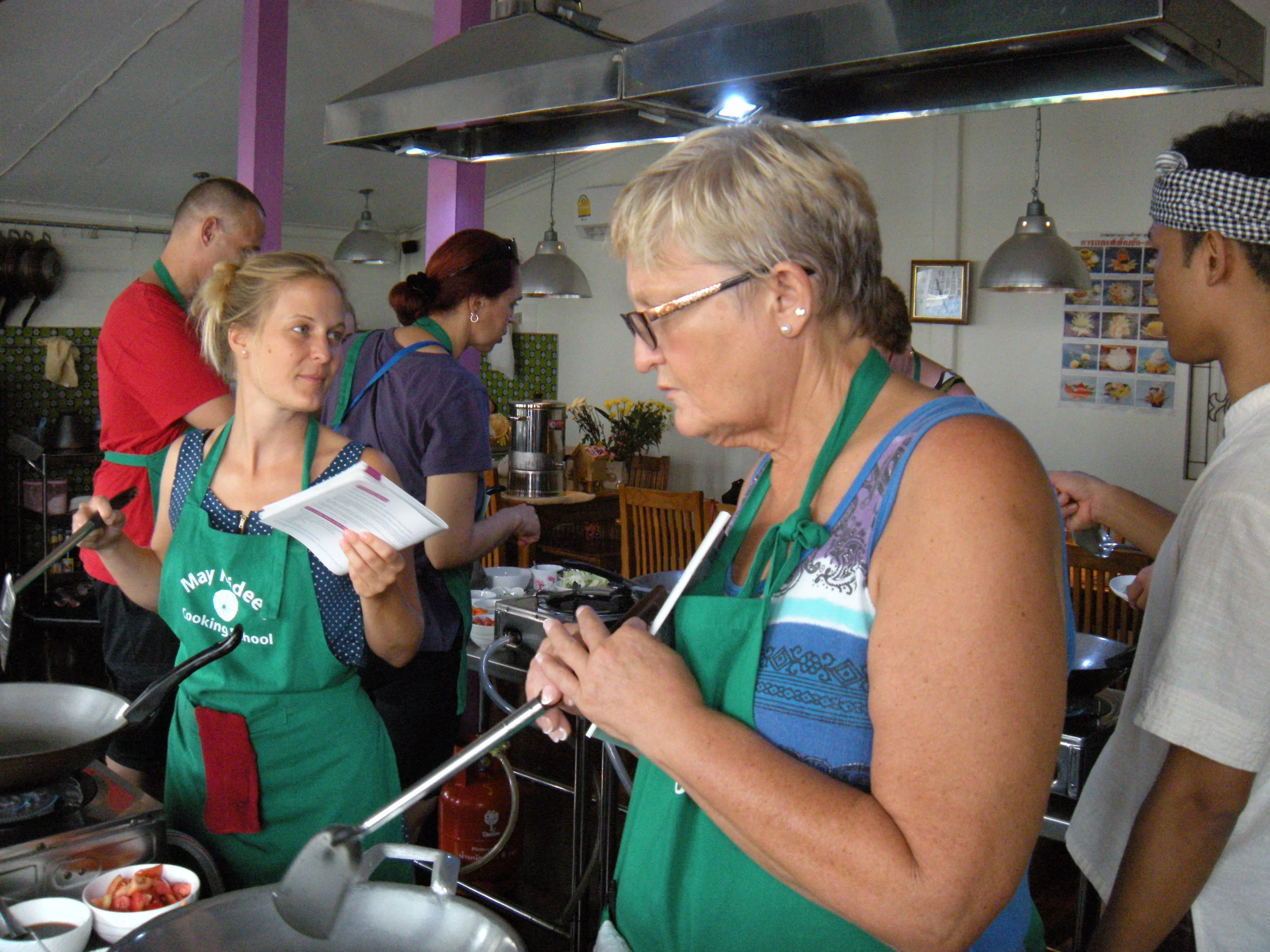
We’re assigned partners. Resi and I are together.  Georgia is paired with the Israeli woman who speaks no English, which makes her no use at all.  She can’t read the recipes, she doesn’t understand the instructions, she can’t communicate with her fellow chef-in-training.  Georgia’s happy to do it all.  She adds and stirs, asks Tuk questions, and hands the woman her share of the food at the completion of each dish.  Resi and I, both of us pragmatic cooks, hum happily along, taking turns adding ingredients and stirring.  The ingredients aren’t things that are found in either of our pantries—kaffir lime leaves, galangal, lemon grass, coconut milk, roasted rice powder. 

Here’s a list of what we make and eat:  pumpkin hummus, chili paste (this is a spicy staple used in many dishes), tom yam soup, pad Thai, fried vegetables with ginger and cashew nuts, green papaya salad, peanut sauce, spring rolls, Massaman curry, mango with sticky rice. 

In addition to doing all the work at her wok, Georgia runs around with her camera.  She gets pictures of Resi and me, our teacher and his assistants, the two couples, and the food.  She takes a picture of the Israeli daughter and offers to send it to the girl’s father if he wants to give her his email address, to which he replies, I’m assuming more loudly than he intended, that he prefers never to give out that information, an odd and almost belligerent reaction that draws notice from the whole group, making things weird for several minutes. 

This is a lot of food.  Too much.  We’ve consumed to the point of pain.  And there’s still the desert to get through.  Realizing that we’re all stuffed, Tuk’s solution is for us to get up and dance to make room for more.  Forming us into a circle around the room, he shows us the hand and arm motions to a Thai folk dance, then gets us moving around and clapping.  Surprisingly, five minutes of this renders us more comfortable, able to stuff in a few more bites.  I’m fond of neither rice nor mango.  While others proclaim it the best concoction ever, I take my polite two bites, and move it to the side. 

At the end of our cooking day Georgia’s still enthusiastic.  She’s got plans for the new recipes.  She buys the shredders and slicers that’re available for purchase at the front counter.  She’ll cook for her friends back in Utah.  When I ask Resi if she’s ever going to actually go to the trouble to follow the involved recipes and set a Thai meal in front of her family, she tells me that she’ll probably use some of the spices and implement some of the methods she’s learned—which I take to mean probably not.  Will David ever get to taste pad Thai in his own home prepared for him by his wife?  Wouldn’t hold my breath.  
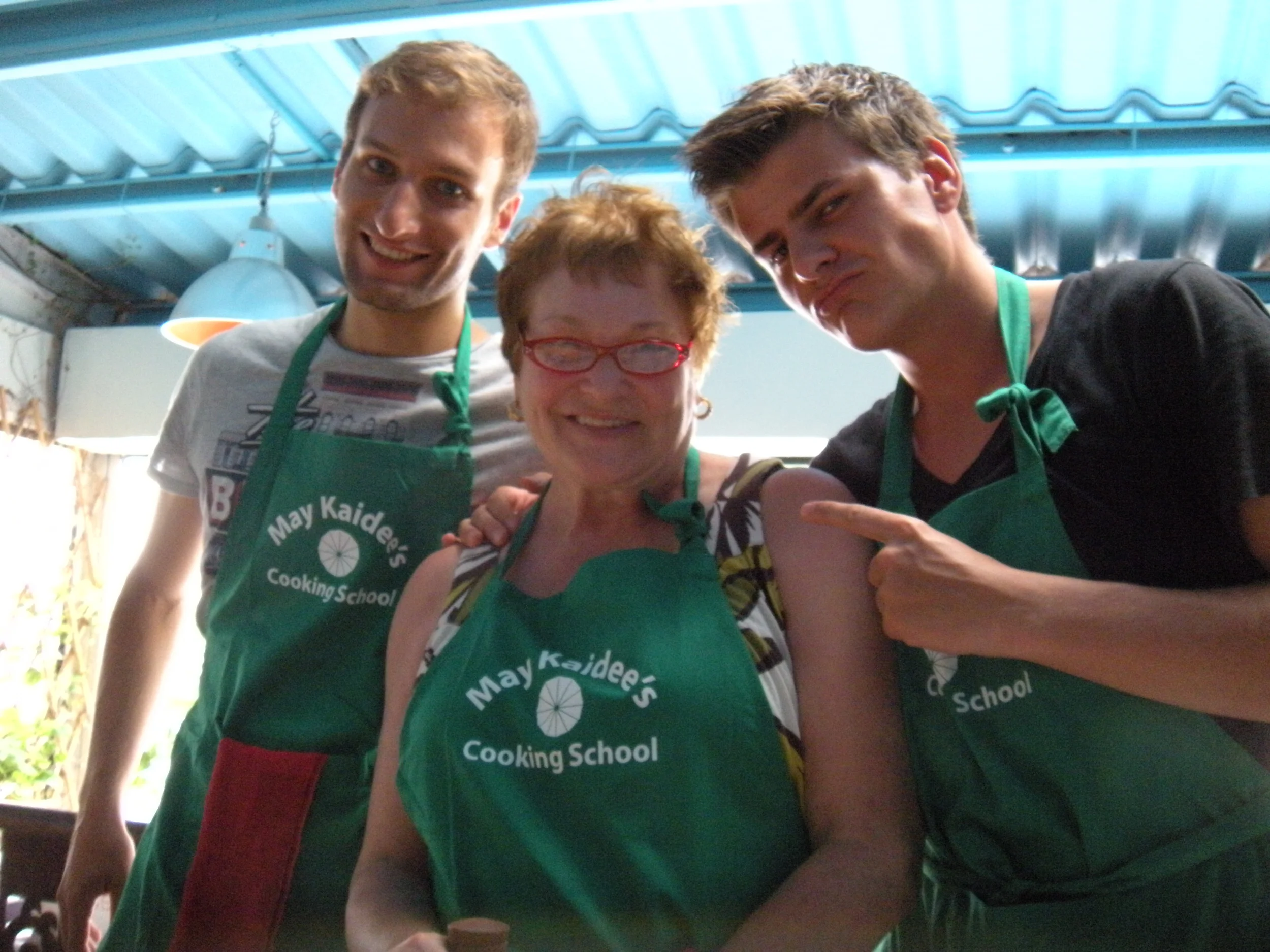
Georgia made friends with Martin and Fabio.
Georgia made friends with Martin and Fabio.

Tuk with the Israeli family
Tuk with the Israeli family

Resi was good at stirring!
Resi was good at stirring!

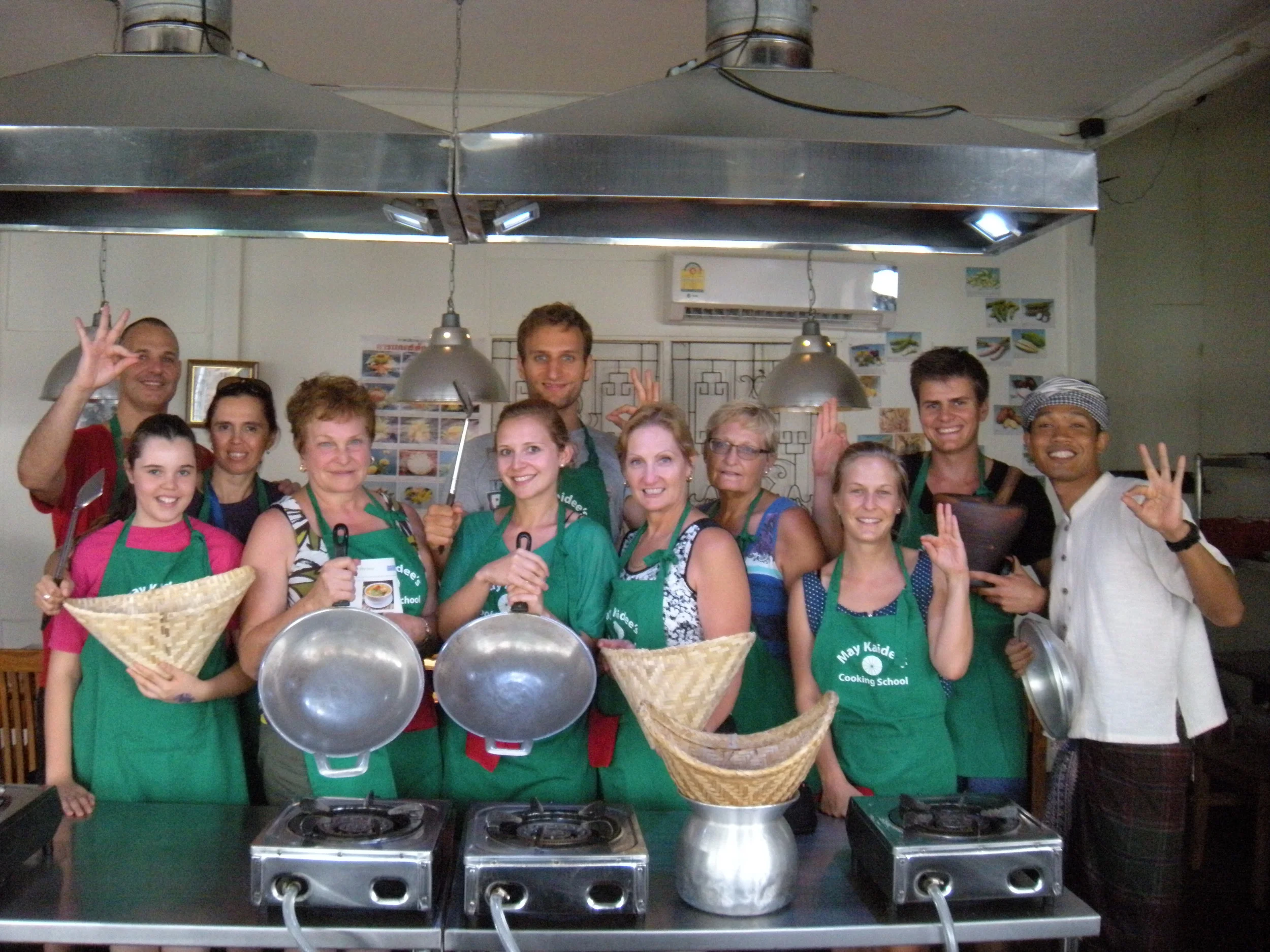
The whole class--our graduation picture!  
The whole class--our graduation picture!  

The Grand Palace, Bangkok

Last time I was at the Grand Palace, acceptable attire for women was cropped jeans and a wrap to cover bare shoulders.  I looked it up before I dragged Resi and Georgia here, just to be sure—and the website I found indicated that nothing has changed.  But when we get here a little man judges Georgia and I to be not quite decent enough.  Georgia’s pants show two inches too much calf, and our thin shawls simply won’t conceal our exquisite pearly shoulders.  He waves us over to the side, to the line where, for only a two hundred Baht deposit, we’re able to borrow shirts for both of us and a wrap-around skirt for Georgia.

We accept the articles and are shown to a changing room, where an electric fan is aimed into a low corner, where its breeze is not needed.  The place where it should be aimed is at me.  I reach out to adjust the fan, but the spaces between the wires of the guard are wider than I expect, and my thumb goes right through, catching the plastic blade of the fan and breaking it, causing an awful racket as the busted blade clatters round and round inside its cage.  I inspect my thumb—no damage.  The fan dies and silence prevails.  I’ve caused great consternation for the attendant, who calls her boss, who must call her boss.  I stand, pointing foolishly at the fan, telling them I’m sorry, but really, what good was it if it wasn’t pointed where it was needed?  The woman in charge is reluctant to let me leave, but I remind her that I’ll be back through to get my deposit, and we can settle it then.  I’m certain they’ll make me pay to replace it, which is fair.  I’m just glad I still have my thumb.

The heat hits Georgia hard.  Wearing two layers of cotton, the top layer heavy and impermeable, she’s red-faced and dripping before we even enter the temple area, too miserable to appreciate the history and magnificence of the colorful temples.  (Inserting my opinion—burdened by an overwhelmed infrastructure, Bangkok does an extraordinary job of caring for its main attraction.  The pavements of the Grand Palace are spotless, the reflective surfaces of the elaborate spires twinkle, brightly clean; and the renovation work, which is ongoing, is unobtrusive and reveals dedication and generous funding.)  Resi, too, is suffering.  Hot and exhausted, her knees are hurting, and every other step involves an up or down stair. 

I persevere.  I don’t make them walk the whole thing, but they must halt their wretched huffing and whimpering for a minute and recognize where they are, the grandeur that’s before them.  I think, by the time I allow them to leave the Grand Palace, they hate me a little for subjecting them to this hell, blaming me for the scorching sun, the sapping humidity, the pressing crowds, and even the long trains of puzzled children with matching shirts who must all hold hands so they won’t be separated—and so we must wait for the kids to pass, the hot sun beating on our vulnerable pale heads as their headcount shuffles on and on and through.

At the exit we return our covering-clothes.  My strategy of going unnoticed by keeping my head down works.  No one realizes I am the miscreant who destroyed their fan.  Should I alert them?  Absolutely.  But I’d rather not mess with it.  I do get pretty tickled, though, when Georgia tries to reclaim our deposit.  As she’s the one who paid and signed the form, she’s the one who must retrieve it.  But her check-out signature doesn’t match her check-in signature.  The man is confounded by her jagged scrawl.  He compares.  He dons glasses.  He points to the first signature, points to the second, shakes his head.  Overheated tourists form a line behind us.  Georgia and I exchange looks.  We are amazed that he is amazed.  What does he see?  It looks hunky-dory to us.  He makes her sign again, compares signatures once more, then reluctantly returns her money, still shaking his head.  On the way out I tell her I’m mortified to be associated with someone with an inconsistent signature. 

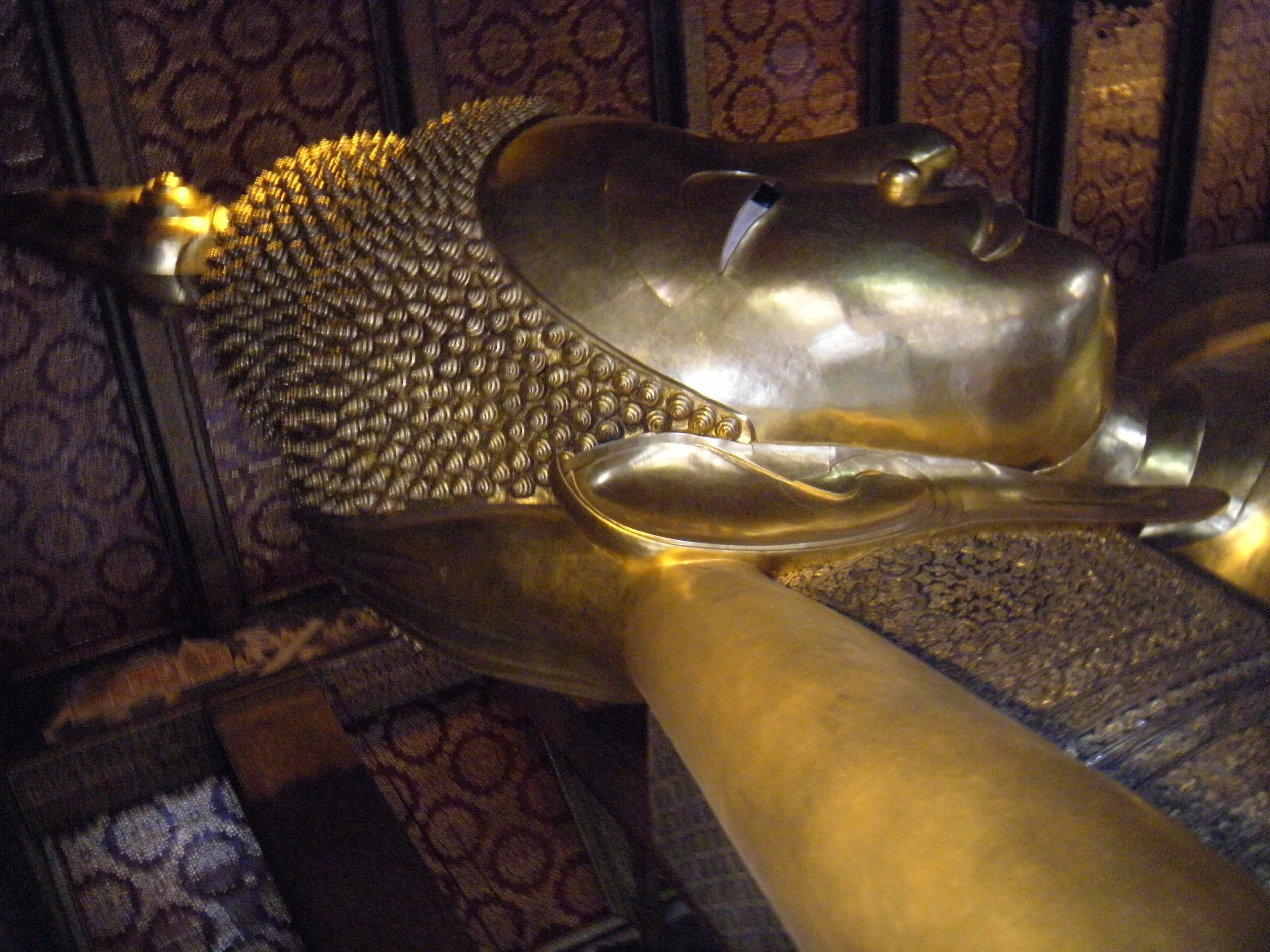
Next up, a treat.  We will not walk to the Reclining Buddha, we will grab a tuk-tuk, which Resi and Georgia haven’t ridden yet, and which I know they will enjoy.  We fly, the breeze refreshing, the bumpy speed making us all laugh.  We’re delivered to the gate.  I promise them we won’t spend much time here.  I’ve heard many people say that the Reclining Buddha is their favorite and I want to know why.  For a hundred Baht we make our way to the door of the temple, take off our shoes, and enter.  I’m not disappointed.  There he is, mighty and huge in his golden splendor, a joyful relaxed giant, offering a contagious serenity which I appreciate after our tense time at the Grand Palace.  Now I understand why so many like this guy who’s abandoned his chores and stress in order to indulge in a midday rest.  The Reclining Buddha is now my favorite, too.   

We take a tuk-tuk back to Khaosan Road, to the hotel, where we shower and put on fresh clothes.  Georgia, who claims she’s never sweated this much in her life, is so impressed that she takes a picture of her sopping clothes.  

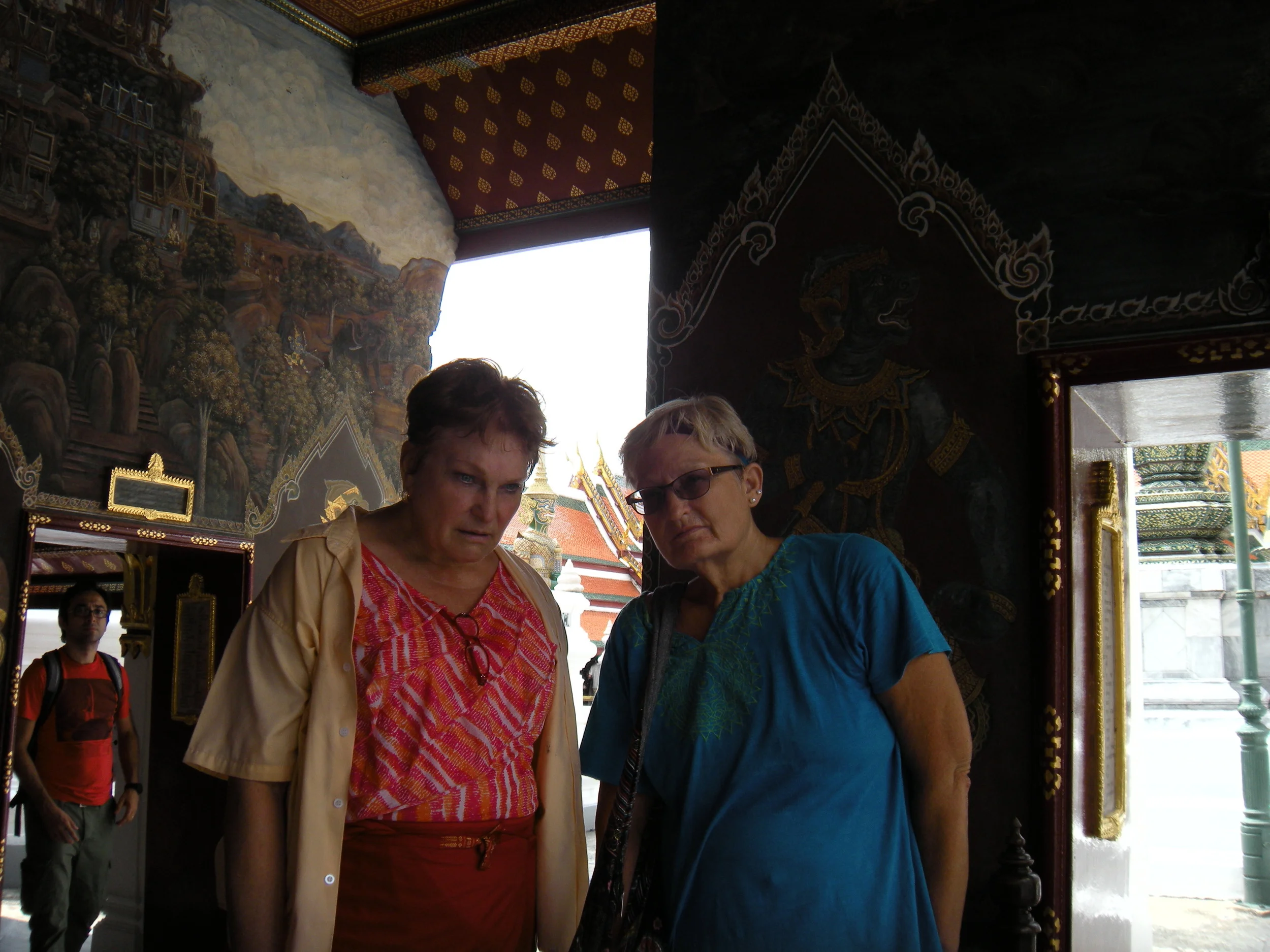
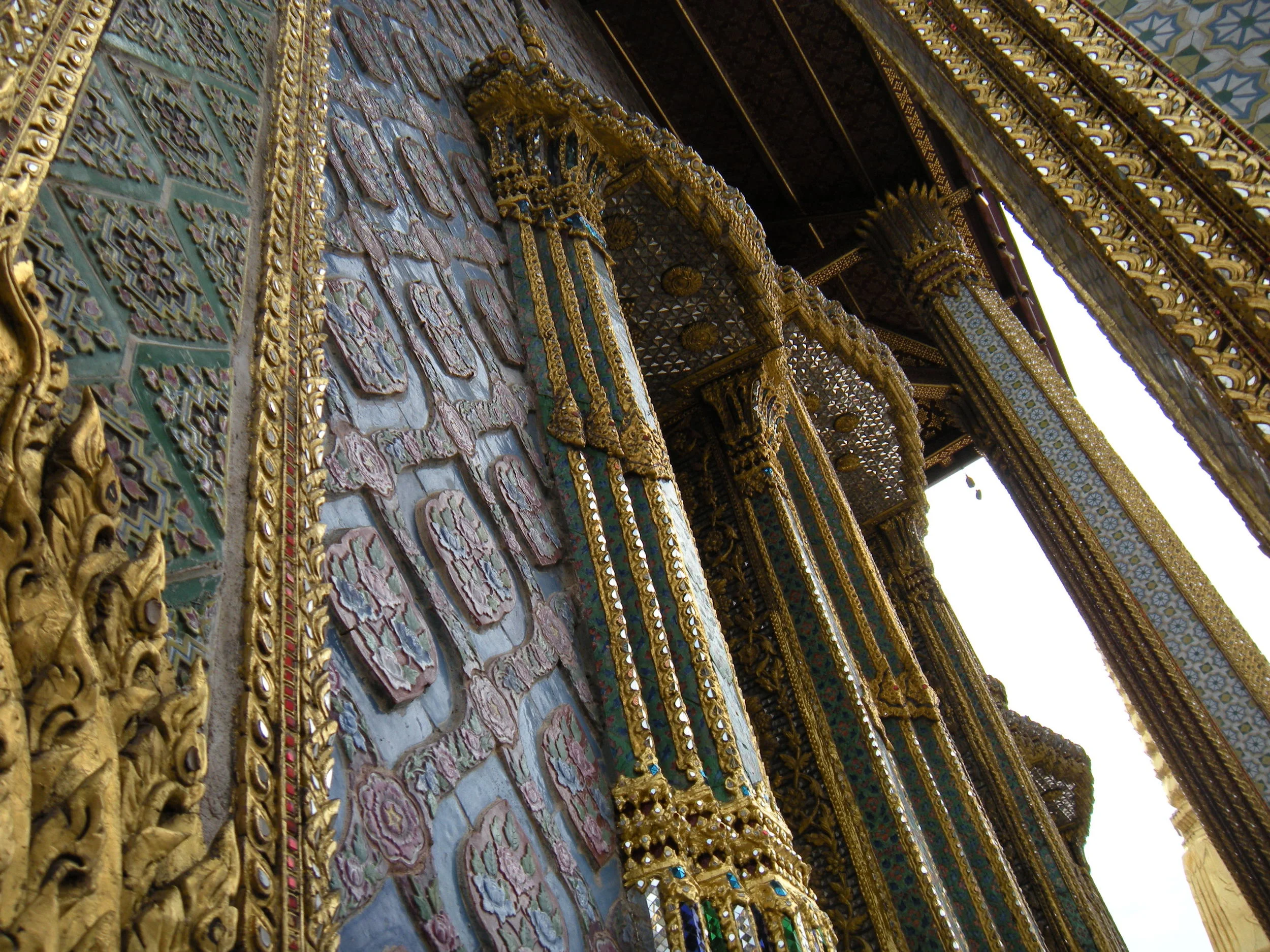
Grace and beauty everywhere you look in the Grand Palace

Grace and beauty everywhere you look in the Grand Palace

There are several of these guys, keeping watch.  Isn't he gorgeous?

There are several of these guys, keeping watch.  Isn't he gorgeous?

Georgia and Resi.  Can you tell how miserable they are?  

Georgia and Resi.  Can you tell how miserable they are?  

This doesn't do justice to the Reclining Buddha.  He's magnificent.  

This doesn't do justice to the Reclining Buddha.  He's magnificent.  

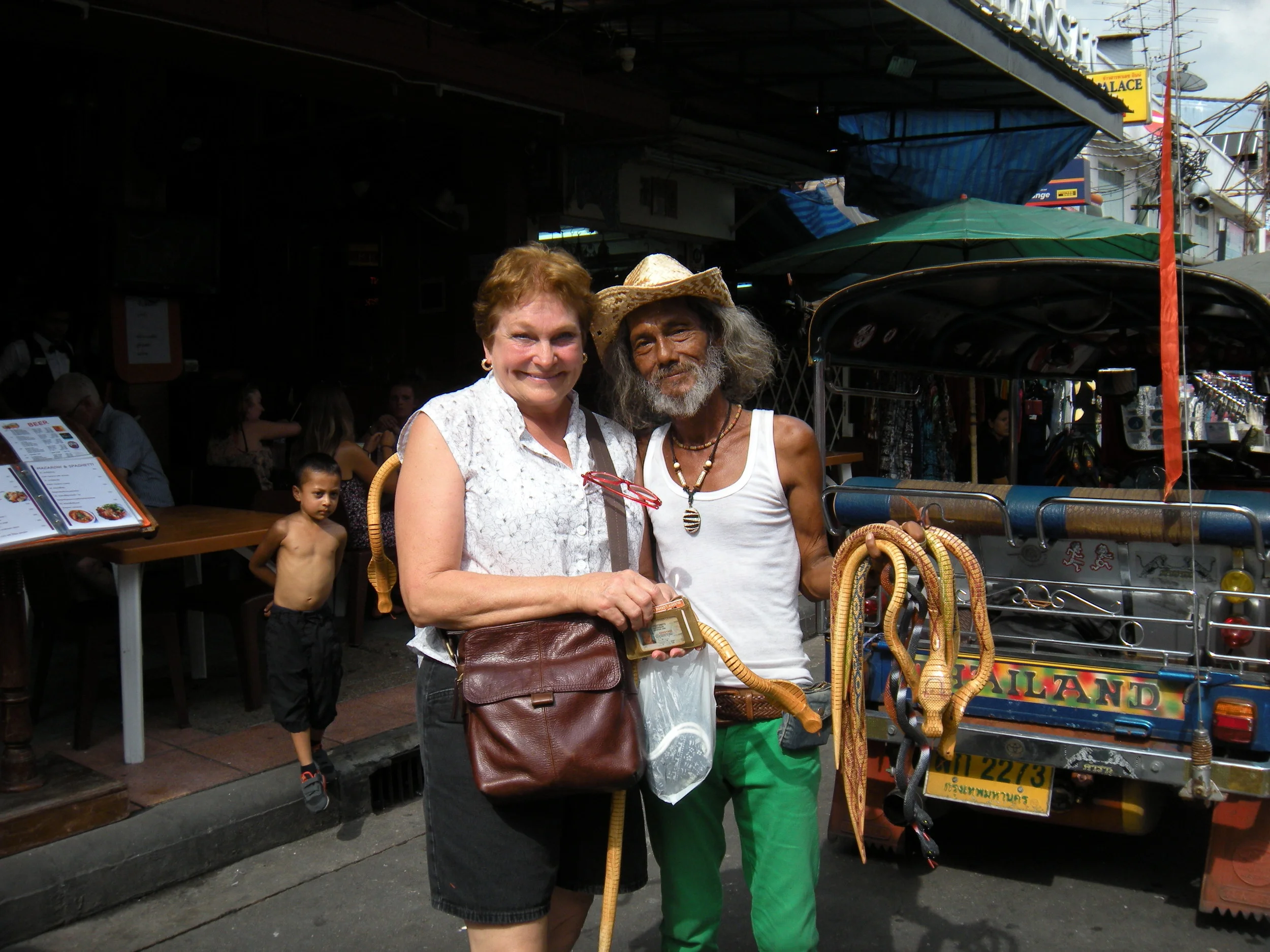
Georgia's happiest when she's making a new friend.  

Georgia's happiest when she's making a new friend.  

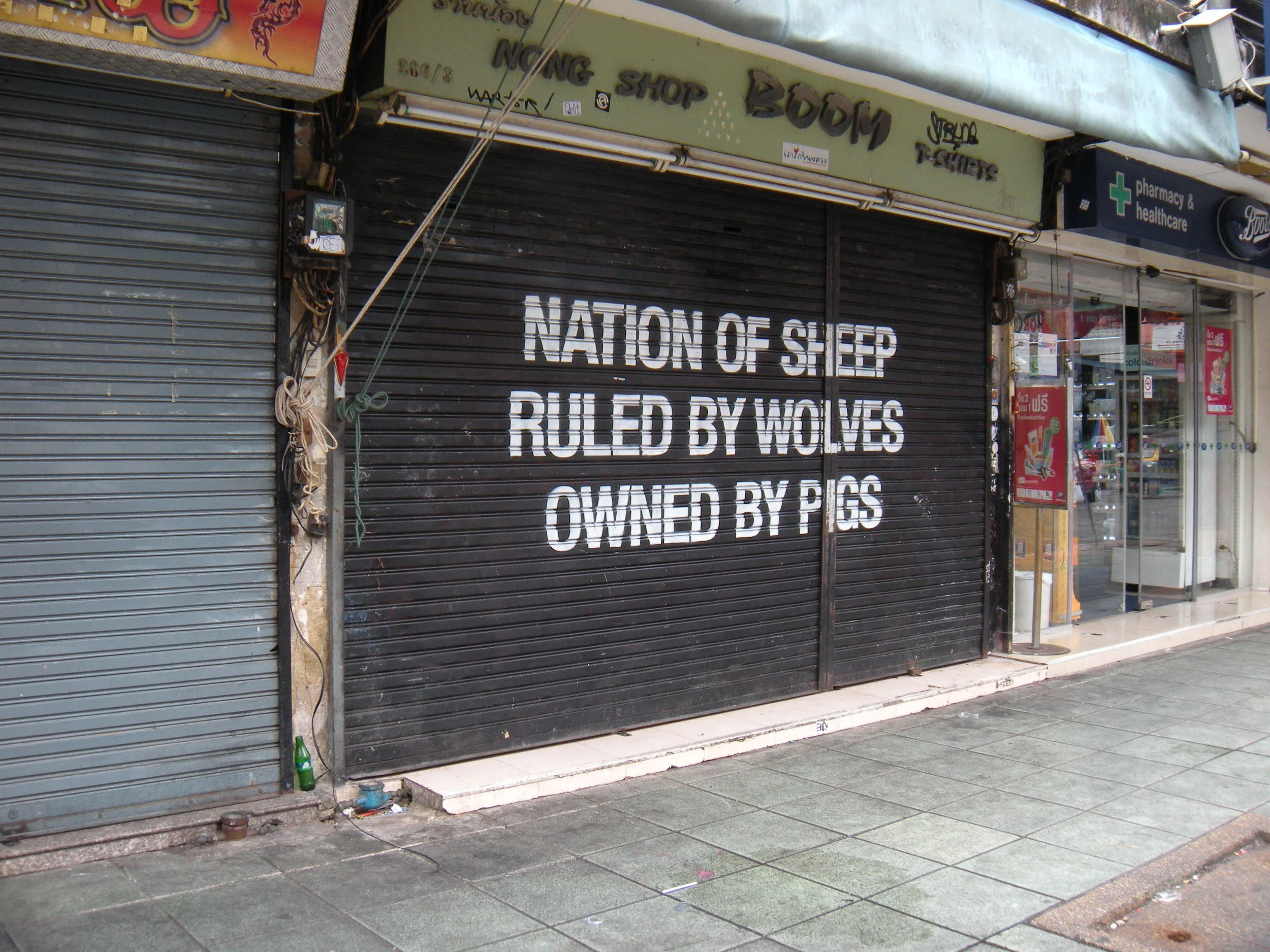
Though there's been recent unrest in Thailand, this sign on  Khaosan Road was the only evidence of discontent that we saw.  

Though there's been recent unrest in Thailand, this sign on  Khaosan Road was the only evidence of discontent that we saw.  

Pulau Ubin and Hair Color

Off the east coast of Singapore is a small island, Pulau Ubin, which means Granite Island.  People take a ferry—called a bumboat—out to the island, rent bicycles, pedal to a nature reserve, and get an idea of how wild and unkempt Singapore was before modern vision conquered the landscape. 

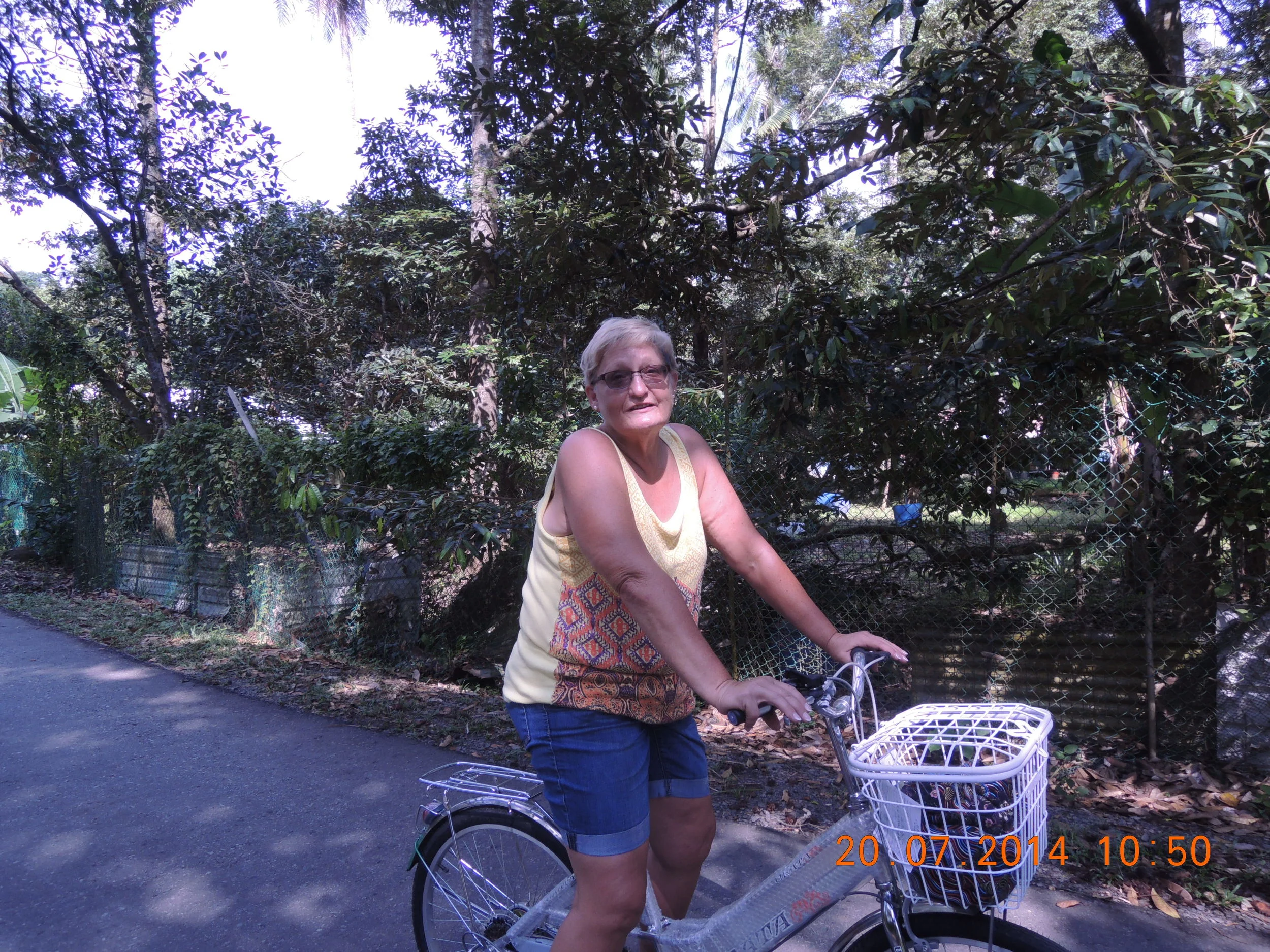
I asked someone who’d recently made the trip if a couple of women with hip and knee replacements could manage the ride from the jetty to the reserve—“Oh yes,” she said.  “Easy-peasy, nothing to it.”  My sister, Resi, and my cousin, Georgia, are from northern elevated climates, unused to the hot oxygen-laden humidity in this part of the world.  And their lower limbs are more machine than human. 

After five minutes of pedaling up a mild slope, they’re a frightening shade of puce, huffing and dripping.  Sweat mats Georgia’s curls to her head.  I’m not used to seeing Georgia with an auburn cast to her hair.  Except for one mad week when she was sixteen and rebellious, she’s been determinedly blond all her life, as have my sister and I.  The same summer that Georgia dyed her hair—a much more flamboyant red than it is now—I told her, in front of the entire extended family, that my mother thought she (Georgia) suffered from low self-esteem, an embarrassing blurt that compelled my mother to give me daily lectures about the benefits of being tactful.  The lectures did little good.  To this day, I manage to offend someone pretty much every time I open my mouth. 

David’s having a good time riding the bike.  He wheels back and forth, makes circles around us.  He’s wearing his adventure hat, the Australian chapeau he ordered from Canada.  About a quarter of the way to the reserve the smooth pavement becomes a rough pitted trail scattered with loose rocks and composed of extreme ups and downs.  We women are forced to get off and push the bikes up the hills.  Then new signs pop up beside the trail, instructing us to get off and walk the downhills, too, causing us to wonder—then why rent the damn bikes?  At first we comply.  But then we realize that this is just to preserve the brakes, which we don’t really care about.  So we push upward and coast down.  

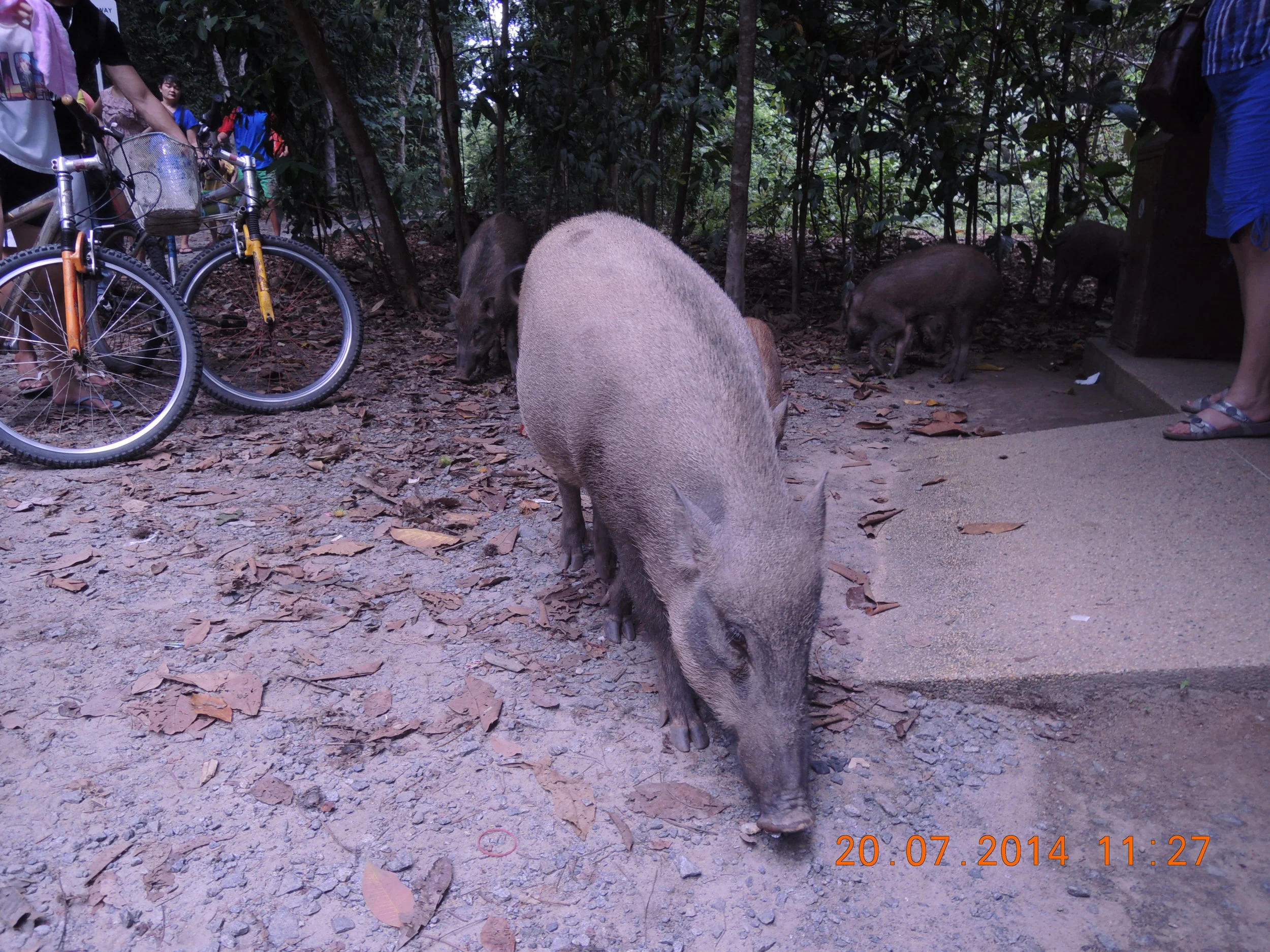
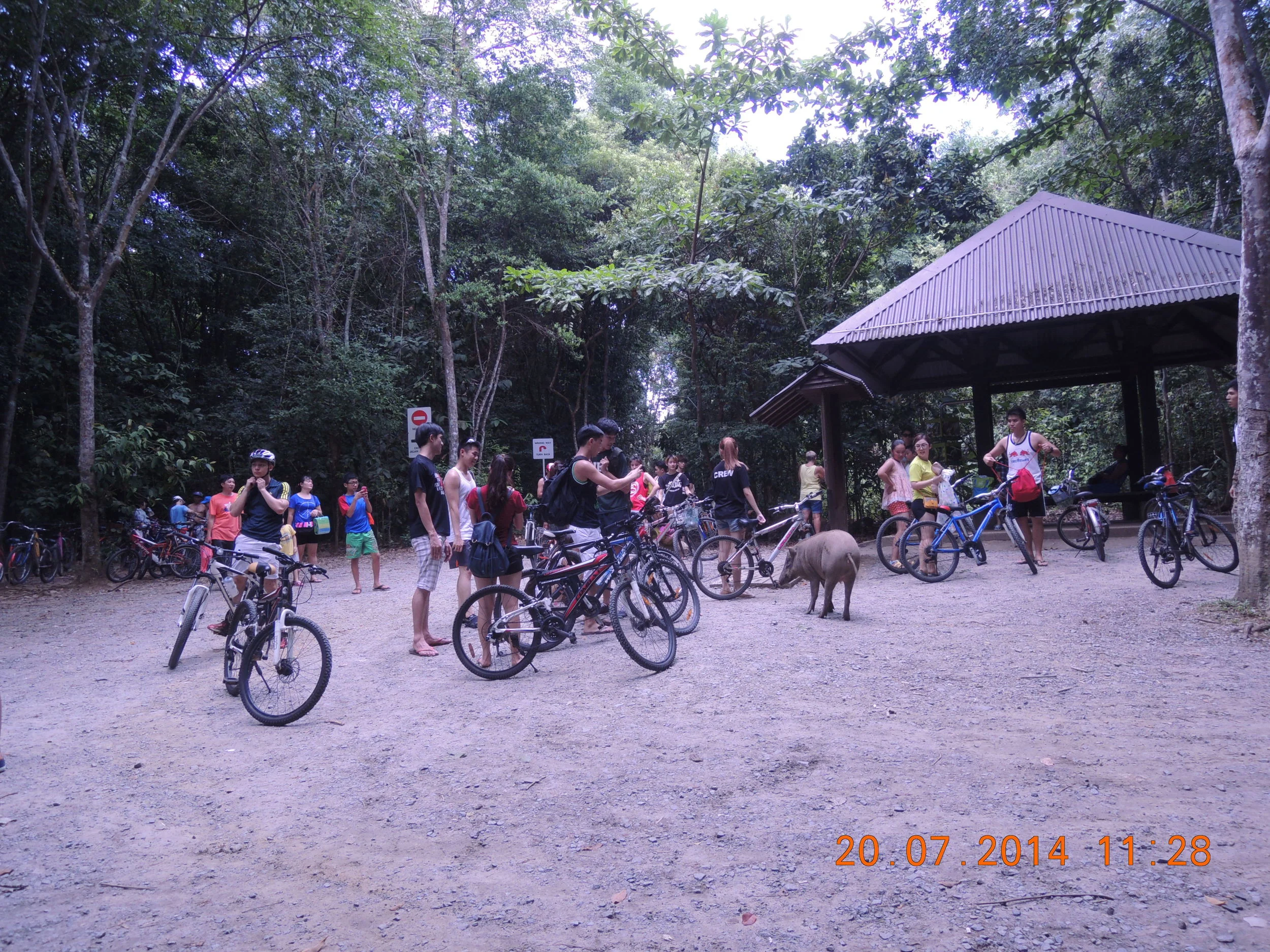
As hostess to this small group, I’m concerned with whether Resi and Georgia are having a good time.  I hope they’re not so miserably hot and fatigued that they’re unable to enjoy themselves.  But when we arrive at the nature reserve, and it’s time to get off and walk awhile, I look back to find that Resi has discovered a family of wild boar snuffling through the undergrowth, and that she’s busy taking pictures—so I can relax; if she’s taking pictures that means she’s interested instead of about to die.  It’s a crowded juncture, with people and bicycles milling.  Nearby a man holds out a fallen rambutan to a boar, almost getting his hand bit off.  Resi’s light hair stands out among the dark heads.  When she first arrived, I commented on her white/gold hair, a color I’ve not seen on her before.  “This is my gray,” she tells me.  “If you let your hair go natural, it’ll probably be this color.”  I have my doubts.  I think if I allowed myself to go gray my hair would be rat-colored, like Daddy’s was. 

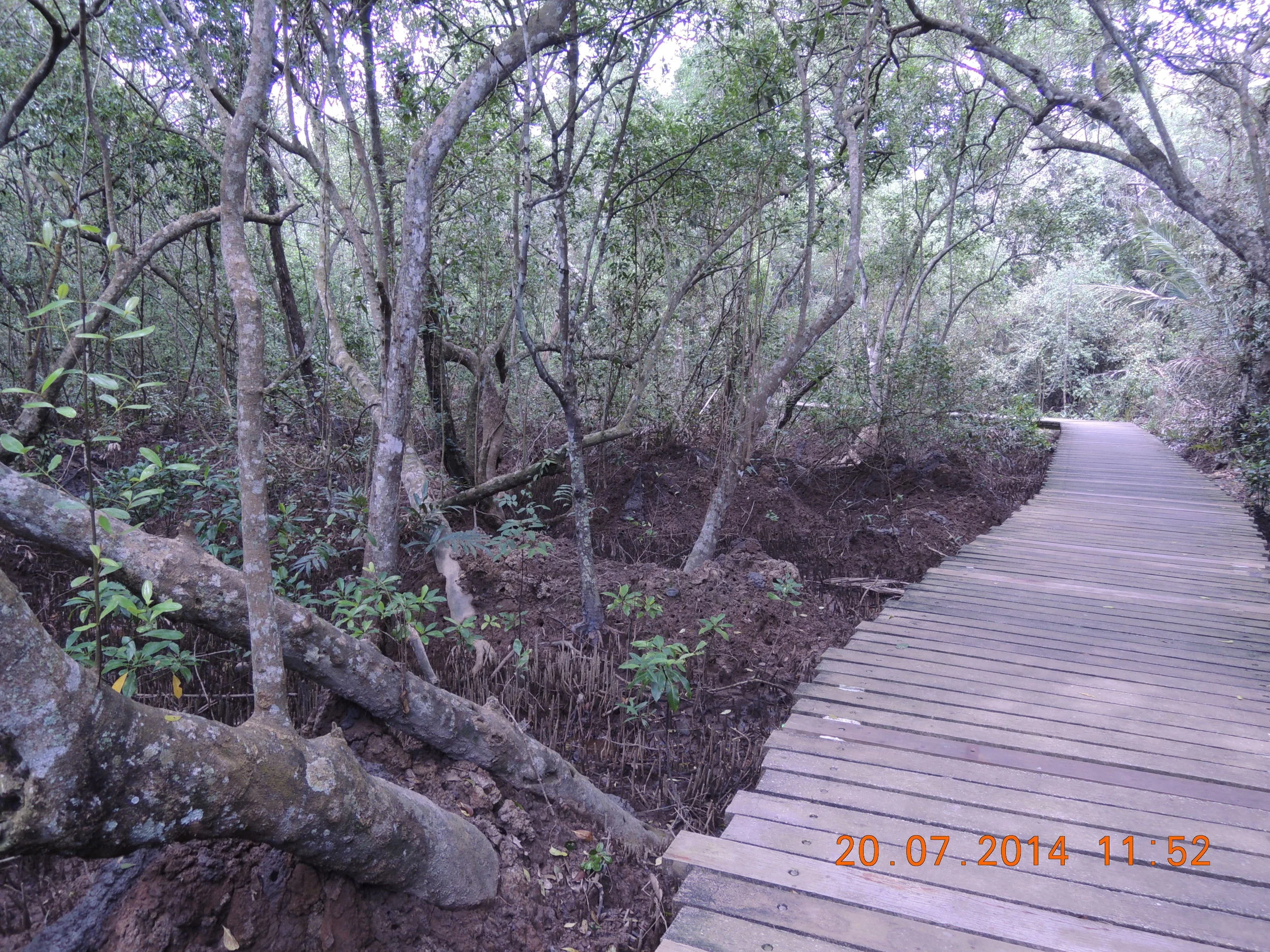
In the nature reserve we see more wild boar and a cute little bird.  We follow the trail to the sign that reads “Mangrove Boardwalk,” an inviting designation that evokes notions of sweet aromas and gentle breezes.  If they named the elevated walkway realistically—Smelly Swamp Walk—no one would come.   Rotten roots jut from the oozy black marsh on both sides of the raised path.  The jagged hills of the mud lobsters rise up, dotted with round apertures through which, presumably, the lobsters come and go.  They only come out at night, and it’s eerie to view the results of their labor without actually seeing them; it’s as if we’re seeing the dwellings of a society long dead.  They’re more like ghost lobsters than mud lobsters.  

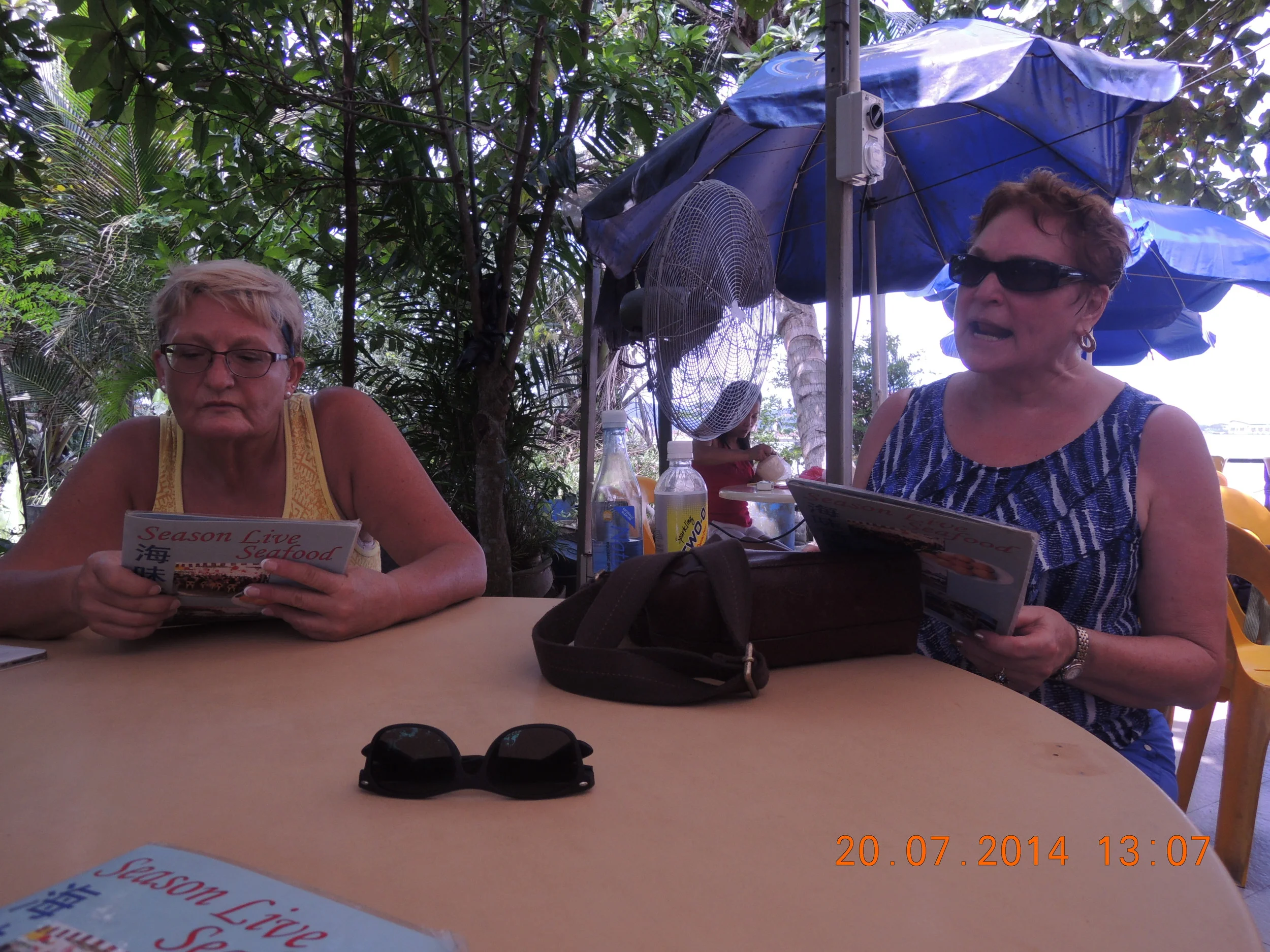
After we’ve traversed the walkway and seen all the available nature, we take an alternate, much easier, route back to the tiny village, where we stop for lunch.  Georgia insists she’s too exhausted to eat, but I bully her into ordering something.  She just rode a bike from one side of the island to the other, from sea-level to the top, and back—the woman needs sustenance.  We order a table-full of food and dig in.  David and I split a big bottle of cold Tiger, the perfect top-off to a hot day spent on a muggy boggy island.

This boar nearly bit a guy's hand off.  Don't feed the boar.  

This boar nearly bit a guy's hand off.  Don't feed the boar.  

Park the bikes here and walk into the nature reserve.

Park the bikes here and walk into the nature reserve.

Resi and Georgia relaxing after the ride.

Resi and Georgia relaxing after the ride.

Resi's comfortable on her bike.  

Resi's comfortable on her bike.  

Mangrove Boardwalk with the mud lobster structures between the trunks and roots

Mangrove Boardwalk with the mud lobster structures between the trunks and roots

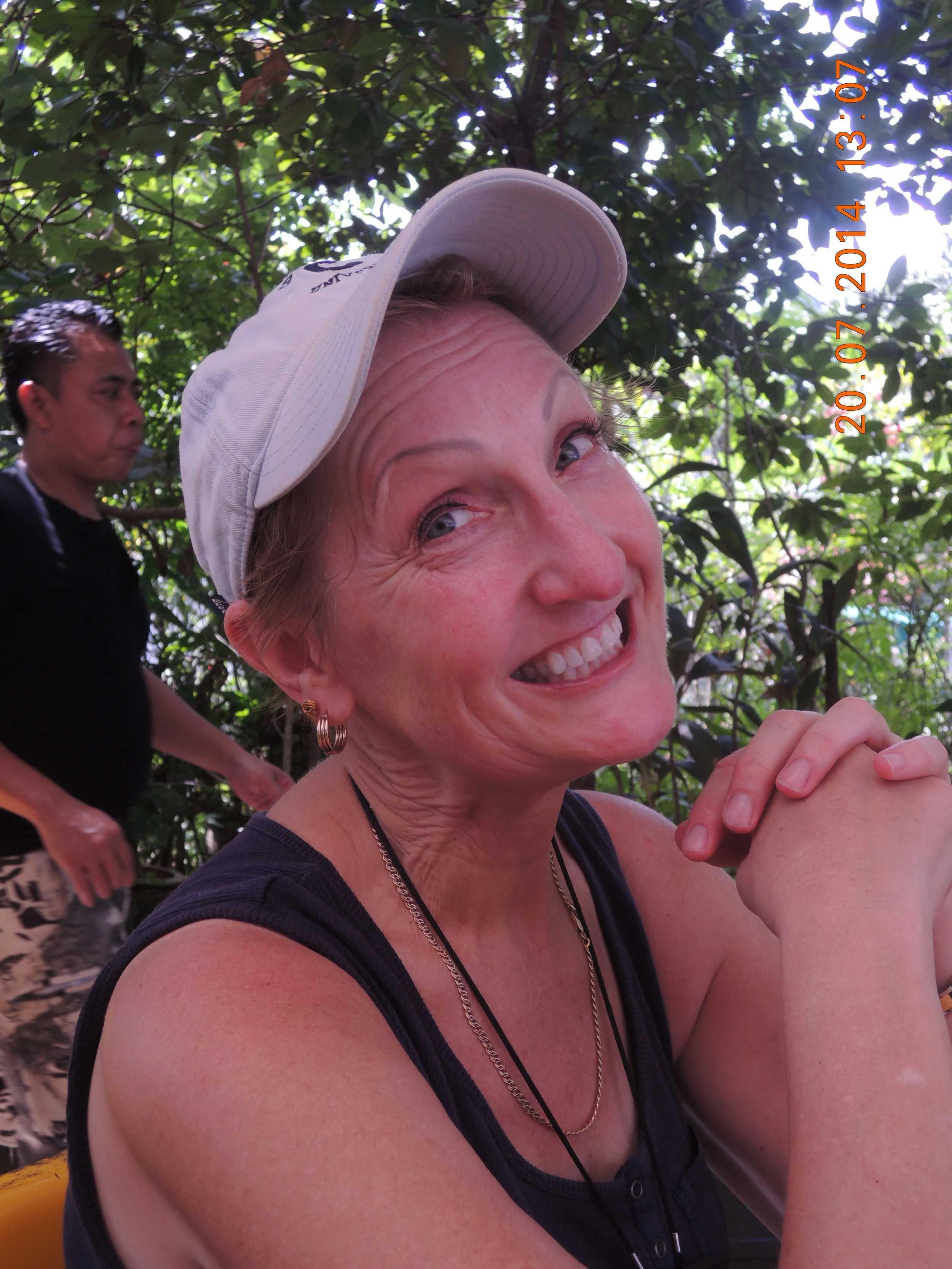
Me, big smile when the cold beer arrives.  

Me, big smile when the cold beer arrives.  

Out of Here

We’re leaving Singapore, moving back to Houston, at the end of August.  After three years, it’s time.  As always, the reality of moving comes down to lists—what to sell, who to notify, what we want to do or see one last time before we leave, what steps need to be taken to transport the dog, reservations for airline tickets, and reservations for cars and accommodation on the other side.  (Once again, the interminable overseas flight—and I merrily remind myself that this is absolutely the last time.)  Lists give David a sense of control, while they make me feel trapped.  On Saturday David’s list looked like this: 

Buy Shoe Laces

Change Money

Reservations at Shangri-la (where we’re staying as we’re packed out)

Reservations for Phuket (one last quick trip; we love Patong Beach)

Transfer work e-mail

Talk to hardware guy about solvent (David persists in his belief that clerks have knowledge) 

Update items for sale

Update inventory

Contact HR—storage and shippers

Fix Cabinet

My list looked like this:

Run errands, get things done

The core of any move is Stuff—packing it, distributing it, and, sometimes, cramming it in the garbage chute.  The tradition I embrace is that the maid always gets first dibs.  This time around, all I have to discard are clothes, but Jean’s the size of a ten-year-old girl.   I can’t see her wanting my faded shirts and jeans.  Once, years ago in Cairo, all I had to leave Nadia was a gigantic box of Tide, a rare and precious item at the time.  I had visions of her proudly washing her sons’ clothes, boasting to her busybody neighbors that she had the best detergent.  My feelings were hurt when I heard she sold it, which is just silly.  I gave it to her—what she did with it was her business.  And of course she needed money more than smell-good clothes. 

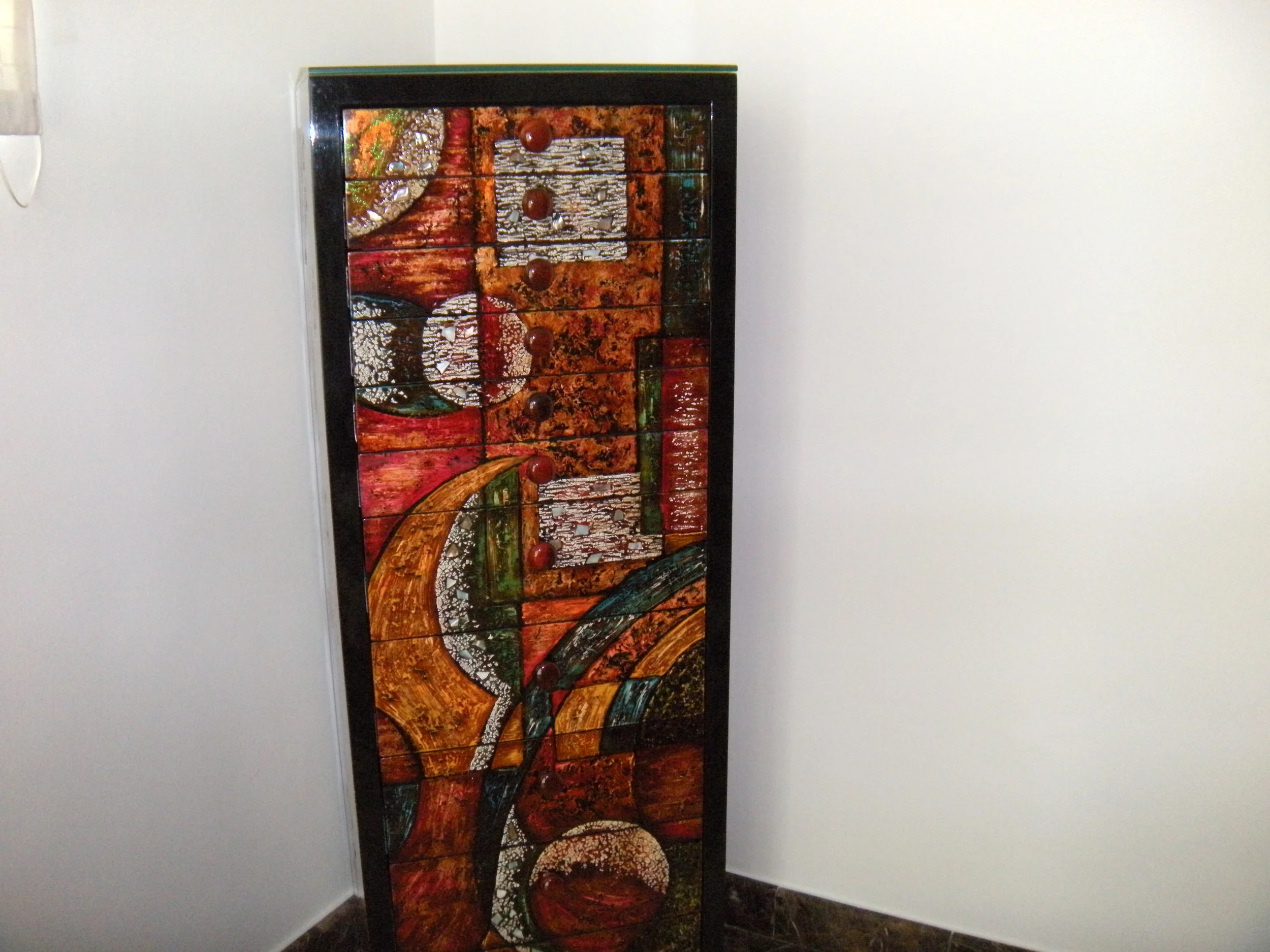
Over the years we’ve collected items from our overseas locations—things that will remind us of where we’ve traveled, the interesting things we’ve seen, the culture we were immersed in for a while.  Mostly it’s been art:  the Cahill watercolor of Aberystwyth, the Mansour from Egypt, and the two Dutch oils, one to suit each of our tastes.  Here in Singapore we’ve mainly stuck to smaller items—a green wooden jewelry box, a shuddered mirror, a piece of pottery from the Dragon Kiln. In Vietnam we purchased a hand-painted chest, with which we quickly developed a love/hate relationship—duty to get it into Singapore cost almost as much as the chest.  Oh, impulsive Waldos! 

Also, for every move, a list of possessions to be shipped must be compiled, and every item must be described and its value estimated.  That’s my job today.  What a pain.  But my sister, Resi, and my cousin, Georgia, will be here at the end of the week and at that point I’m putting aside the demands of the move in order to shop, drink wine, and play Mahjong for three weeks.  Yay! 

This is Jean.  Can you tell how tiny she is?  That chest comes to mid-thigh on me, and I'm not a tall person.  See the Dutch oils and the green box?  

This is Jean.  Can you tell how tiny she is?  That chest comes to mid-thigh on me, and I'm not a tall person.  See the Dutch oils and the green box?  

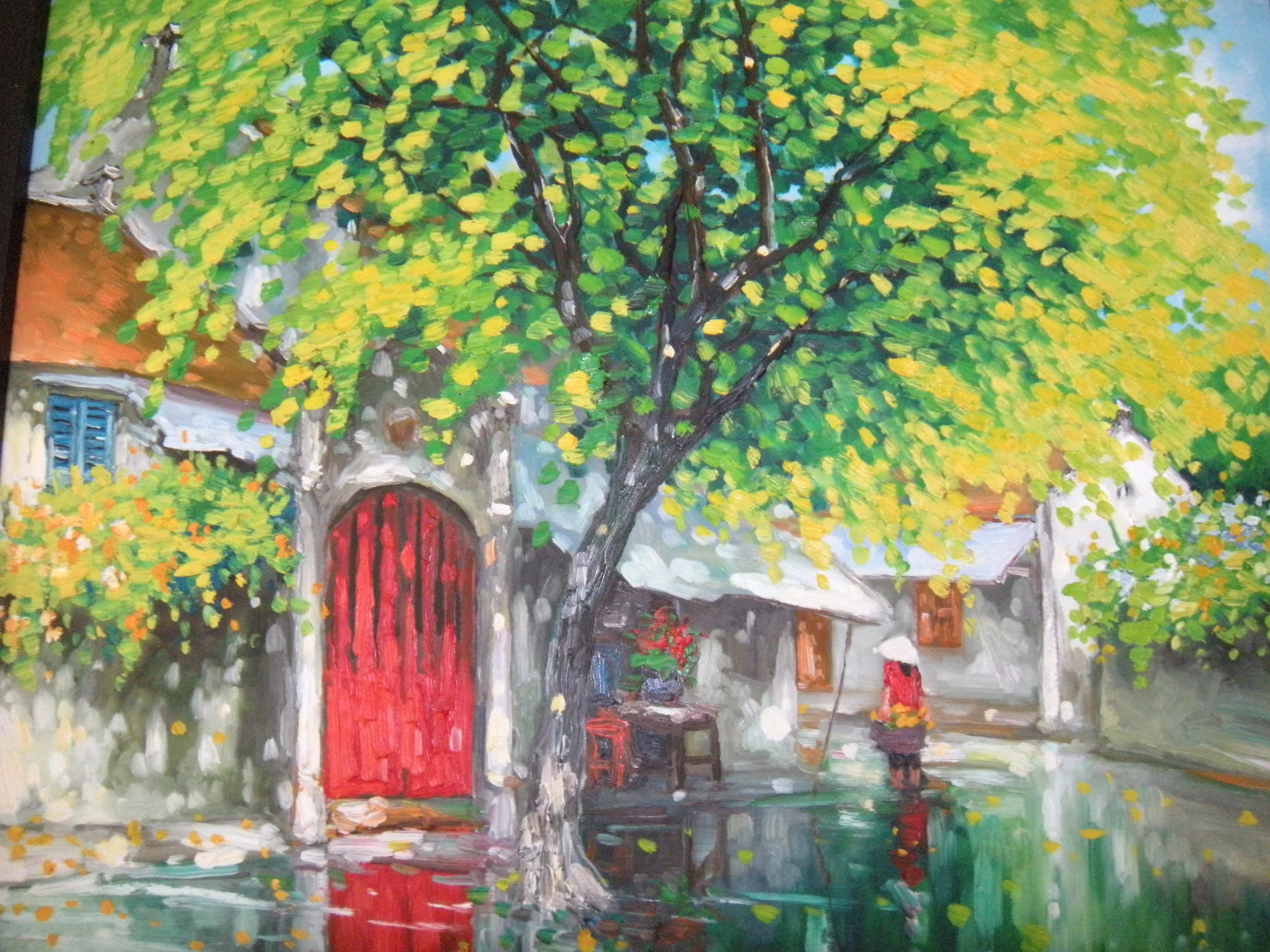
Here's a painting we bought in a shop on Tanglin Road.

Here's a painting we bought in a shop on Tanglin Road.

The chest from Vietnam.  Lovely, right?  

The chest from Vietnam.  Lovely, right?  

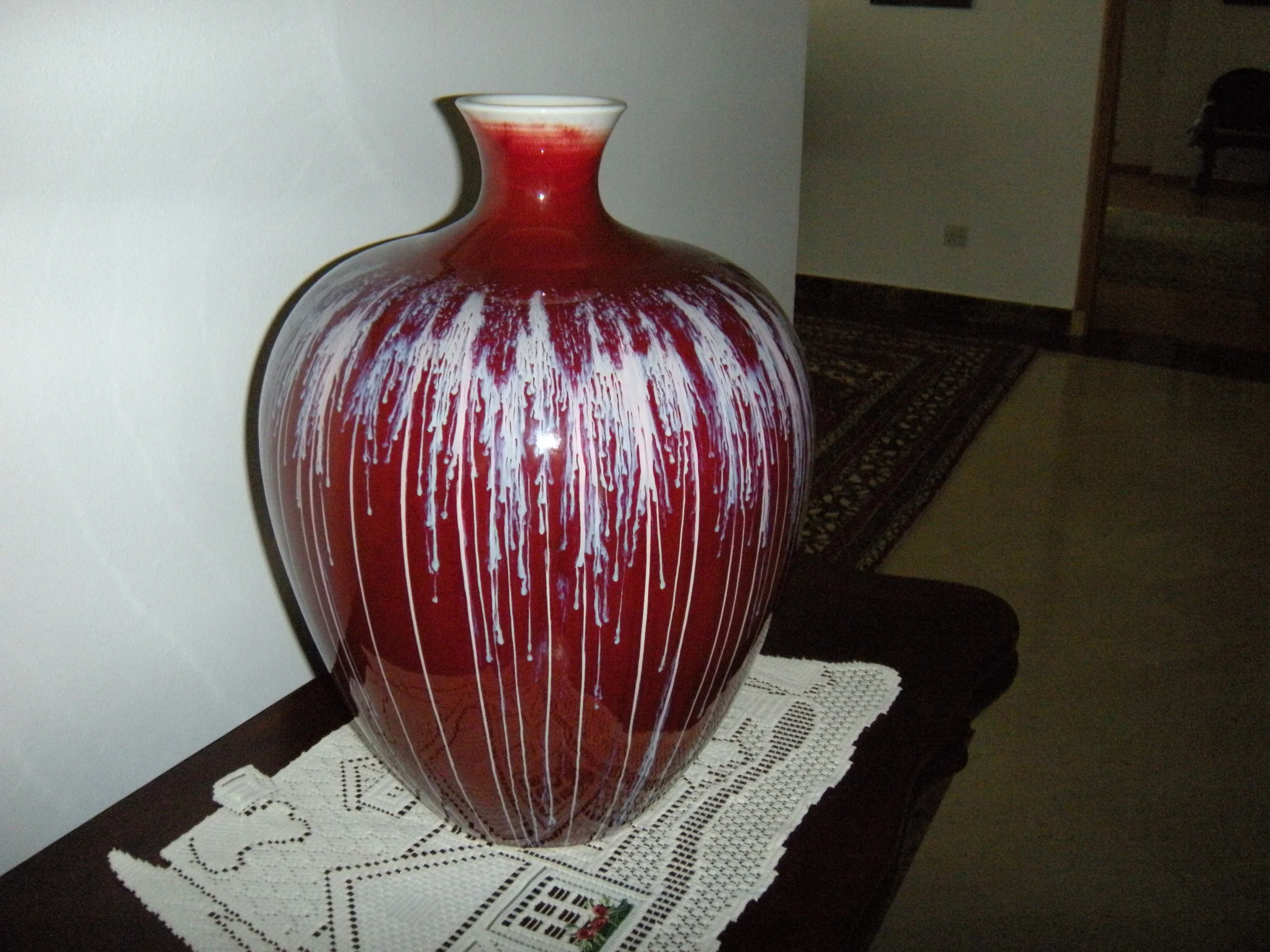
For the inventory--would you describe this as a vase or a jar?  

For the inventory--would you describe this as a vase or a jar?