God Between Life and Death

Beatrice Crawford Haenisch Peery.

A humble woman.  Sang in the church choir.  Believed in the words she was singing.  Songs about God’s mercy, salvation, provision, omnipotence, perfection.  Where does all that faith go, what does it mean, now that her brain is mush and her ability to praise God or even conceive of His existence simply isn’t there?

I’m here for a month.  I make the journey from Singapore to Houston every year to give my sister, Trina, a break from caring for Momma.  During this time I change diapers, spoon in food, hand Momma pills and the water to wash them down with.  I do these things with a stingy heart, duties I execute and escape from quickly.  A caregiver comes three mornings a week and as soon as she’s in the door, I’m out.  I’ve come all this way, to my home country, and there are things I want to do here—friends to see, stores full of clothes and gadgets, a property to check on. 

Momma’s daily journey is a long one.  She has few words left.  The phrase she mutters every minute is, “I’m tired.”  And when I say every minute, I’m not exaggerating.  She says it nonstop, all day long, from six in the morning until seven in the evening.  Her drooping eyes speak, and they say the same thing.

She gets out of bed.  Her diaper’s changed—either by me or Trina, usually Trina.  She drinks a cup of coffee.  She manages this on her own, but the cereal is beyond her.  She sits bent over, too weak to sit up straight, as one of us daughters spoons it in.  Both of us talk baby-talk to her, as though our high-pitched nasally nonsense will somehow relieve her exhaustion. 

After breakfast she showers.  Trina gives a body-contact wash, putting on rubber gloves and taking the soap into Momma’s private areas.  When it fell to me to administer the shower a couple of days ago, I fit the soap into my mother’s gnarled hand and instructed her to get on with it.  Then I sprayed her down like I would a car.  Sometimes I’m compassionate and sometimes I’m not.  That was a “not” day. 

Then, cleaned up and wearing a fresh day-dress, Momma embarks on a circuit that will last the whole day—a hunched shuffling trek from her bedroom to the living room, through the kitchen, in and out of the utility room, back to her bedroom, once more to the living room.  Sometimes she collapses into her chair, but for no longer than a minute, then she’s up and pacing again.  I estimate by the end of the day she’s walked three miles, the whole time mumbling about how tired she is. 

What’s driving her?  If she had words, she could tell us.  Is she too wracked with pain to be able to relax?  She was busy all her life—maybe she feels a latent need to be somewhere, accomplish something, go, go, go.  Or is she looking for something?  Someone?

“I’m tired. . . I’m tired. . . I’m tired.”

Yesterday, in the living room, a variation.  She said, “It’s tired in here.”

I laughed.  “Is it more tired in here than it is in the kitchen?”

It’s taken me a while to realize that what she’s tired of is living.

People embrace the notion that they’ll live a useful life, and that when they stop being useful, they’ll die.  Death is seldom so accommodating. 

Dear, dear Momma.  Dying is like giving birth—drawn-out excruciating labor followed by great joy. 

My sister, Trina Haenisch, is virtuous and noble, a dry-humored woman who laughs instead of cries, and rubs lotion into an old woman’s aching deformed feet.  So if I’m looking for God’s presence in this hell, she’s it.  And I’ll be forever grateful to her for the care she gives our mother.  
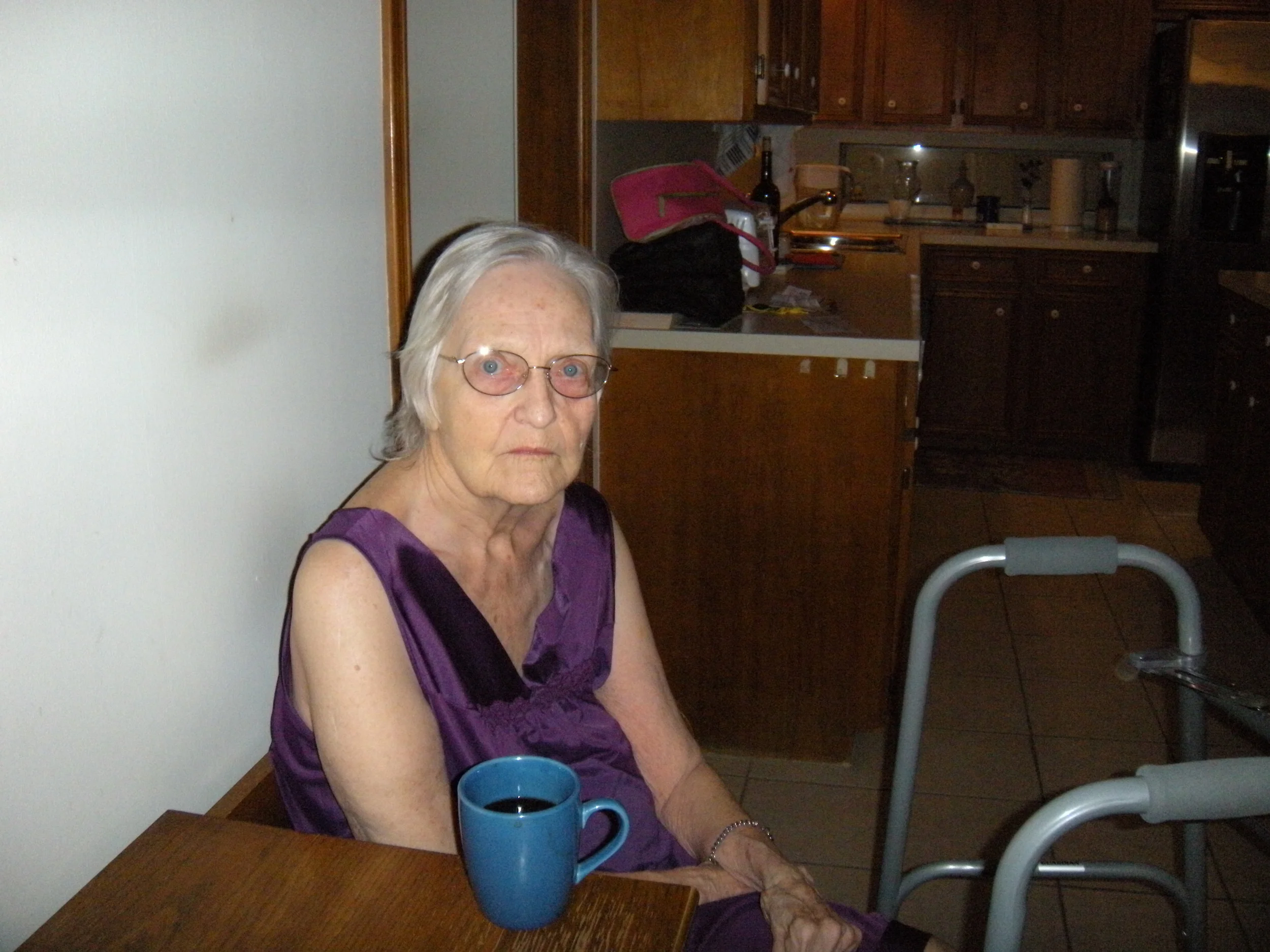
Momma and her coffee.  The corked wine in the background is mine.

Momma and her coffee.  The corked wine in the background is mine.

Trina getting ready for work.  
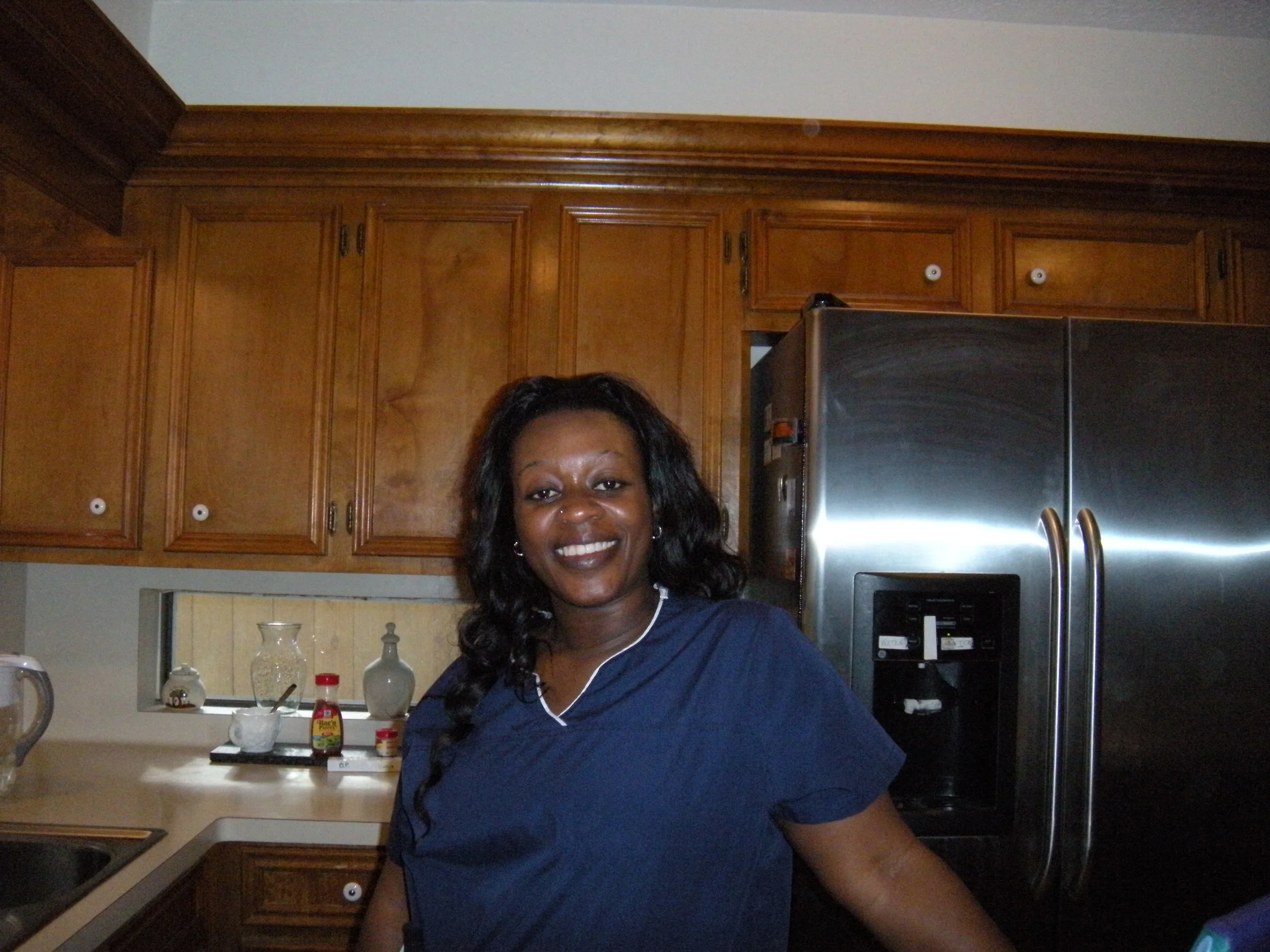
Trina getting ready for work.  

Diana, the three-times-a-week helper.  She's very good with Momma.  
Diana, the three-times-a-week helper.  She's very good with Momma.  
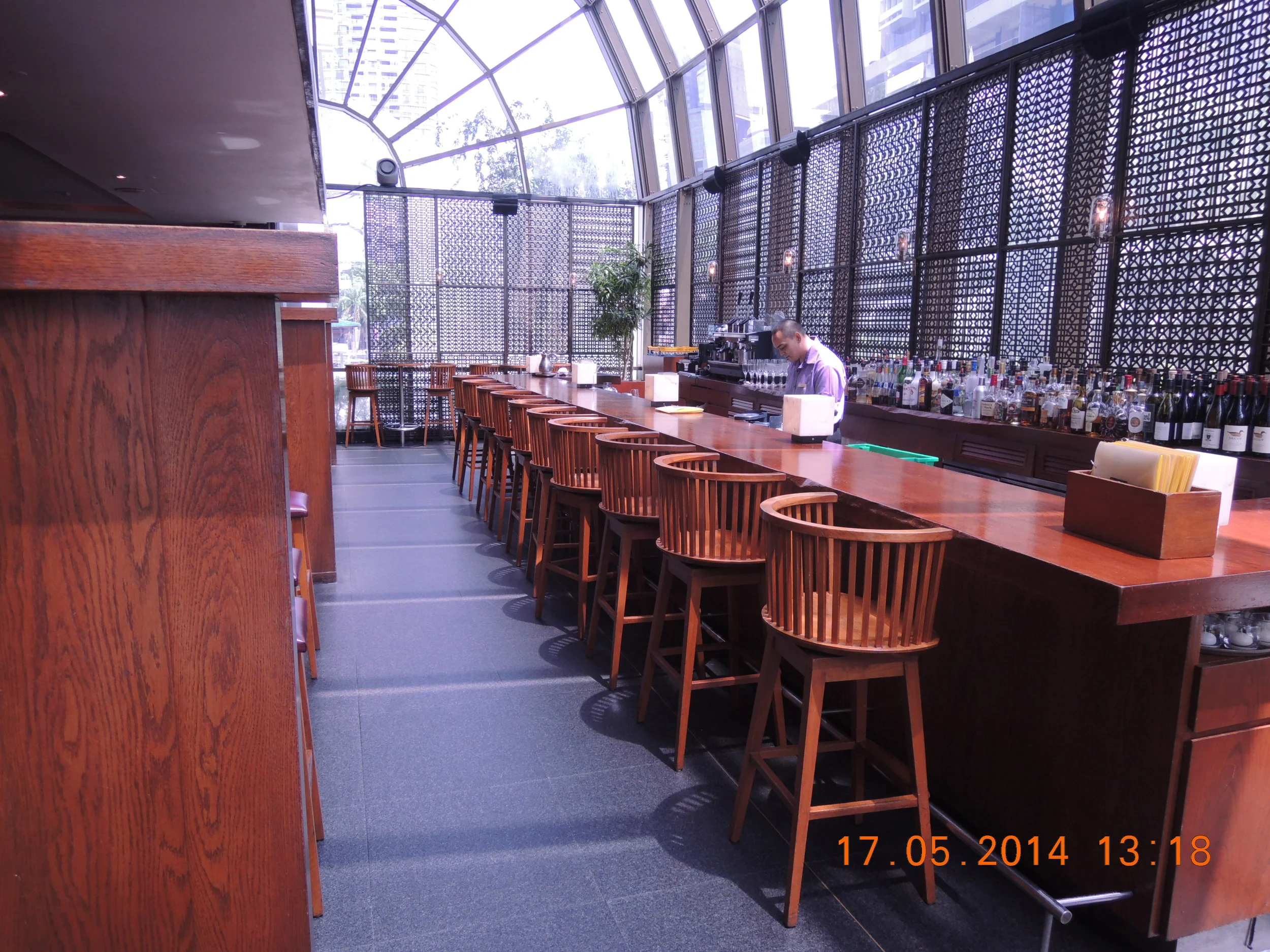
Hyatt Martini Bar

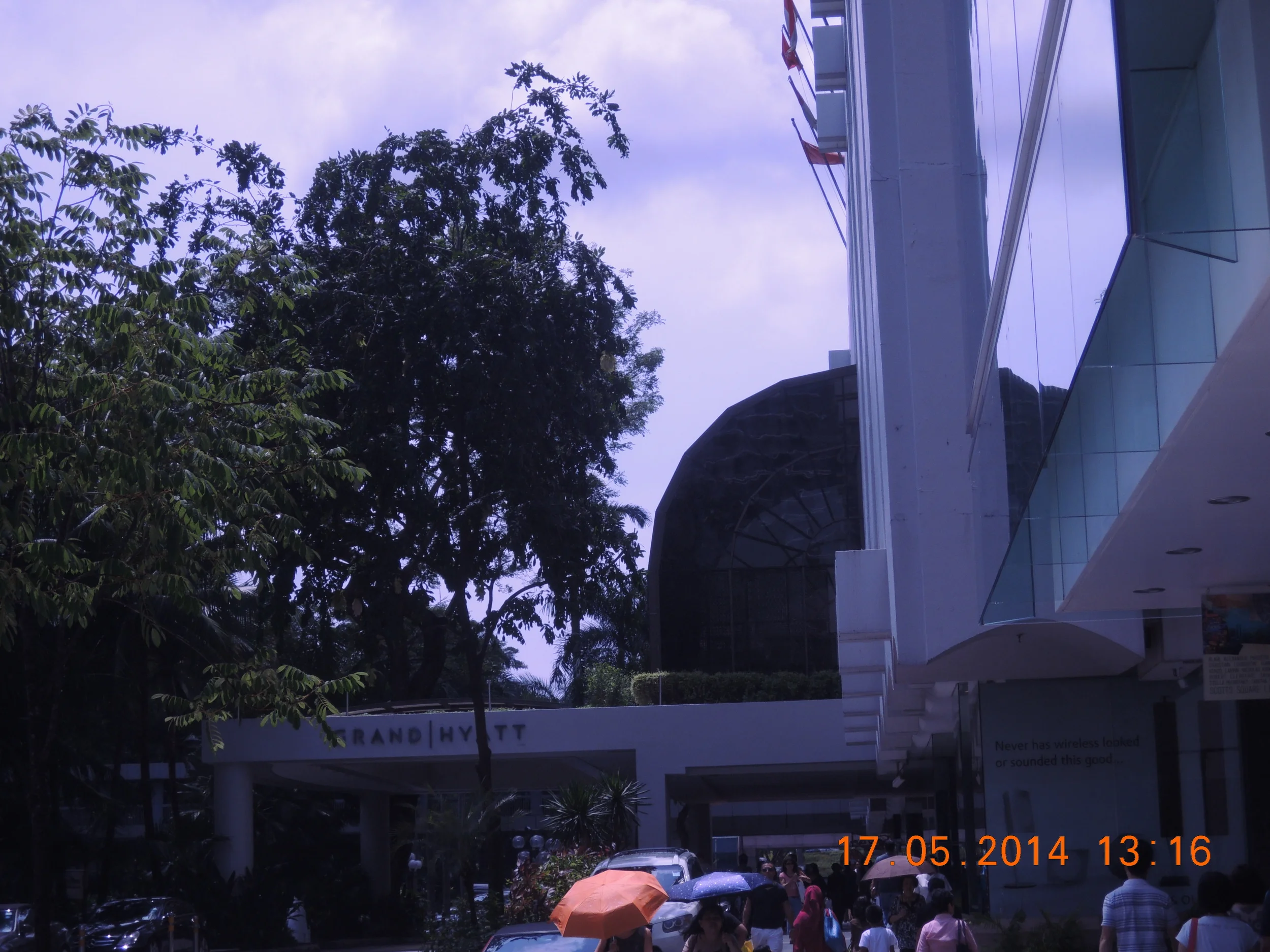
On some Fridays, after he gets off work, David likes me to meet him at the Hyatt martini bar on Scotts Road, where martinis are half-price every weekday until seven o’clock.  We like Grey Goose.  Also, they serve peppered cashews, which are yummy. 

Friday is their busiest evening and David likes me to get there before he does to get seats.  This is the plan today.  I change from my shorts to a skirt, comb my hair, and make the walk up the hill, down the other side, and across the elevated walkway.  But when I get to the bar all the seats are being saved.  There are several seating areas, each comprised of chair-and-couch arrangements, cozy pods for convivial drinking.  But today all the seats are draped with pashminas and sweaters, stacked with purses and packages; one chair even holds a pair of shoes—and huddled in the dim corner of that pod, a thin bare-footed woman gazes at me with guilty eyes, ordered by someone from work, or by the man she’s in a relationship with, to get here early and hold places—exactly, come to think of it, as the man I’m in a relationship with expects me to do. 

On the lower level, by the window, a table and two chairs come free.  I head that way, but before I reach it, another woman slides in, drapes a shawl over the remaining chair.  A waitress approaches and asks how she can help. 

“There’s no place to sit,” I tell her, feeling conspicuous, the only person standing in the whole place, unoccupied chairs all around.  She scans the area, then motions toward the empty stool right behind me at the bar.  The man who’s sitting beside the vacant stool sees me reach for it, pulls it close, and drapes his arm across the back of it.  “It’s being saved,” I say, my voice strident, whiny with disappointment and indignation.  All these chairs, held for people who aren’t here.  It’s not polite.  It’s not reasonable.  There should be a rule. 

The man who’s saving the chair turns and addresses me—“Here, you.  I don’t like the way you’re talking to this girl, like you think you’re better than her.”  Australian, buzz cut, blunt features.

“No,” I say.  “I don’t think I’m better.  I’d just like a place to sit.” 

“You’re a snob, sailing in here like royalty, making demands, talking down to the poor waitress.”  His face is flushed with belligerence, and his tongue is thick and slow. 

I’m hurt and humiliated in front of the several people looking on.  Do I deserve his censure?  I can be shrill when I’m impatient and frustrated, but I’m not mean-spirited, not ever.  I hate it when people think I’m less than what I am.  David enters the bar.  We order our martinis and drink them standing.  I tell him we’ll need to find a new martini bar.

Two weeks later I’m out walking my dog, Trip, and I see the man who called me a snob.  He approaches, his expression one of benign inquiry, no recognition whatsoever.  “Do you know where The Ardmore is?” he asks.  “Sure,” I tell him, pointing to the cluster of tall buildings up the way.  “That group of high rises, up the street and across.”  He says thanks and heads off in that direction.  

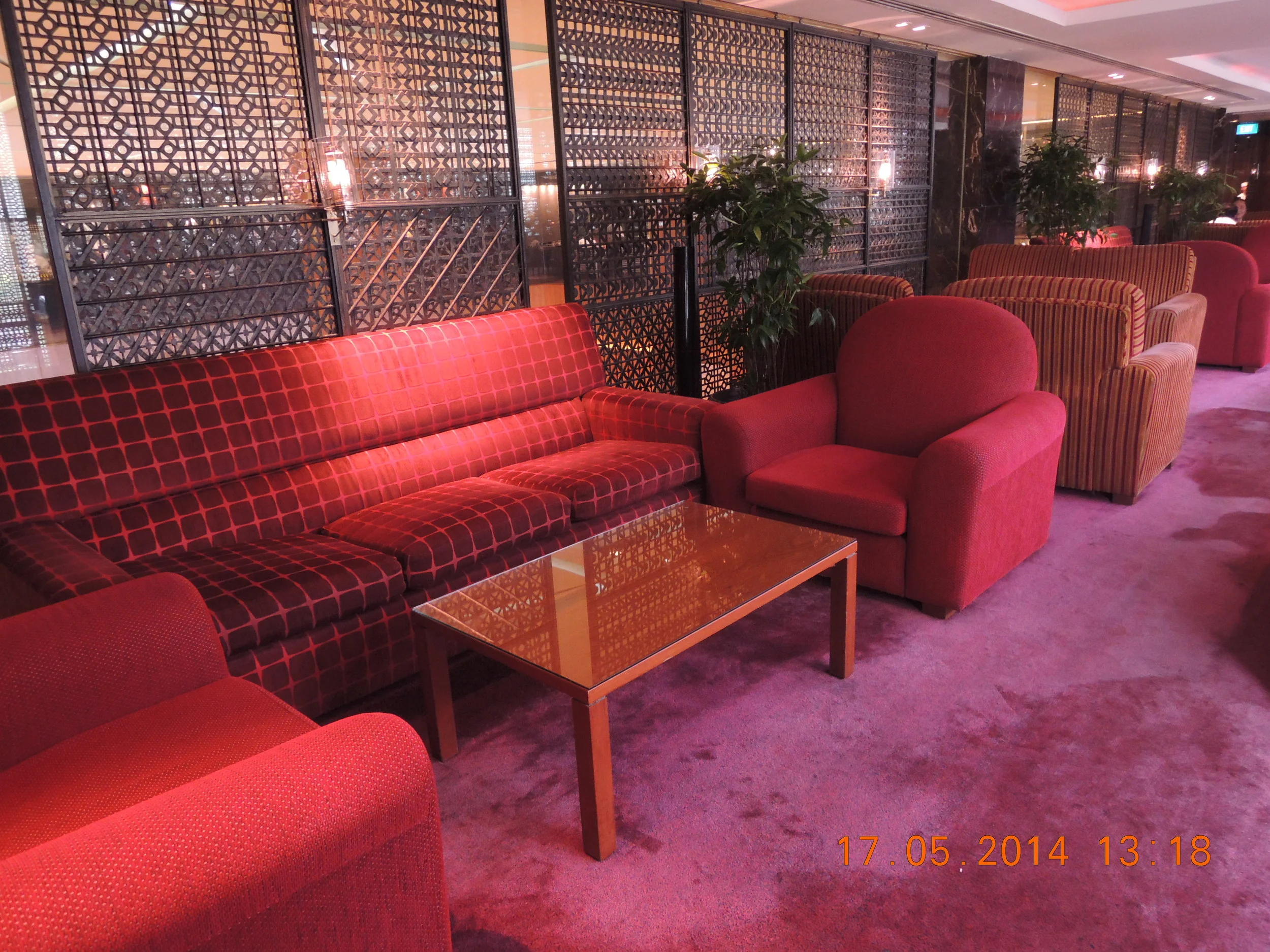
A cozy setting for a martini, when seats are available

A cozy setting for a martini, when seats are available

The bar extends over the sidewalk.

The bar extends over the sidewalk.

There it is from the outside, the gray-brown glass protrusion.  

There it is from the outside, the gray-brown glass protrusion.  

Renovation

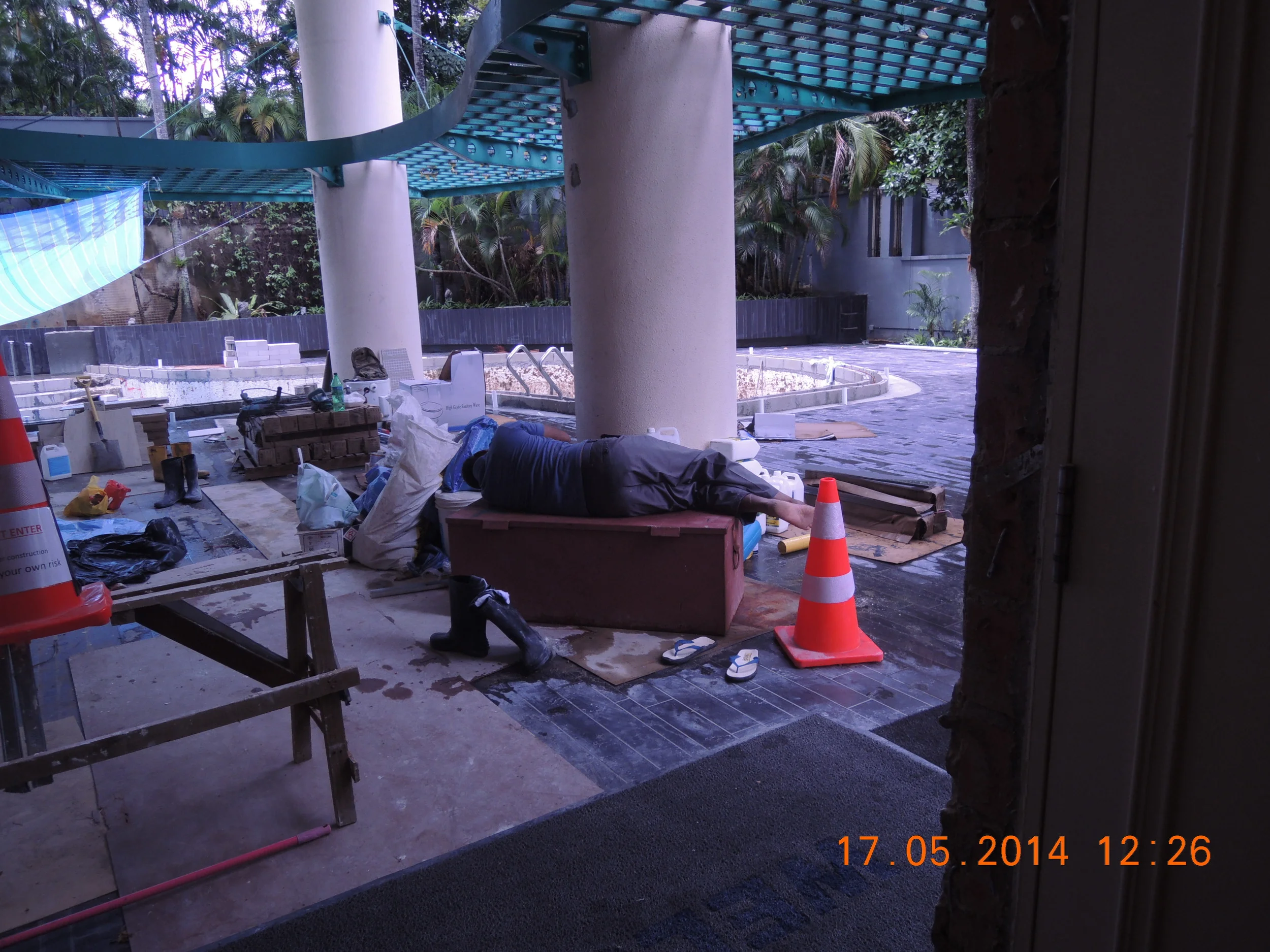
No one asked our opinion about the remodel that’s taken over the portico, driveway, and lobby.  This is because we’re leasers, not owners.  I imagine the four or five residents who own flats in the building discussed the project.  Did they deliberately invite this hell?  Did they foresee muddy footprints everywhere, the noise, these dark people napping in all corners of the property at midday?  What negative condition could have prompted the owners to take this action?  It was a clean lobby, lovely floor and walls, wrought iron railings along the stairs and handicapped ramp.  The driveway was cobbled and the portico was roomy enough to allow taxis to exit without excessive maneuvering.  Visitors offered compliments regarding the marble floors, the subtle chandeliers, the cheerful fountain, the refreshing breezeway, the inviting pool—though no one in the building was sad to see the waterfall being torn out; it was a blight on the vista, a twelve-foot crag, and the splash reverberated through the lower fifteen floors. 

In Singapore, the noise a jackhammer makes when it breaks up cement is referred to as “hacking”—and considering the way buildings are constantly being torn down or renovated, it’s not unusual to hear the term several times a day.  The morning the work began a notice appeared in the elevator warning that there would be “hacking” for the next couple of months.  It never occurred to me that the noise would be so thunderous that I wouldn’t be able to host book group or Mahjong, but that’s exactly how bad it got, and still is.  From eight in the morning until six in the evening the hacking soars up and out, smashing into the walls of the other high-rises, and ricocheting back at us until it’s uncertain whether it’s coming from over there or over here, above or below. 

Today they closed off the residents’ elevator, leaving only the service lift in use.  I’m not a snob.  I don’t mind sharing the elevator with delivery people or live-ins or the maintenance staff.  But now, and for the next vague period of time, everybody’s using only one elevator, whereas before there were three.  And in order to get to the single elevator, a hike through a hardhat zone is necessary.  Workmen stop working and step out of my way when I leave the building.  I’m a hindrance to their progress.  Tools clutched, their brown eyes follow me as they wait for me to pass; and the same thing when I return.  Oathman, the man who’s in charge of the comings and goings, is quite agitated, ushering people through the cement carnage, explaining to everyone that it’ll only be four more weeks. 

I’m leaving for Houston next week.  When I return to Singapore, a whole new lobby will be in place.  

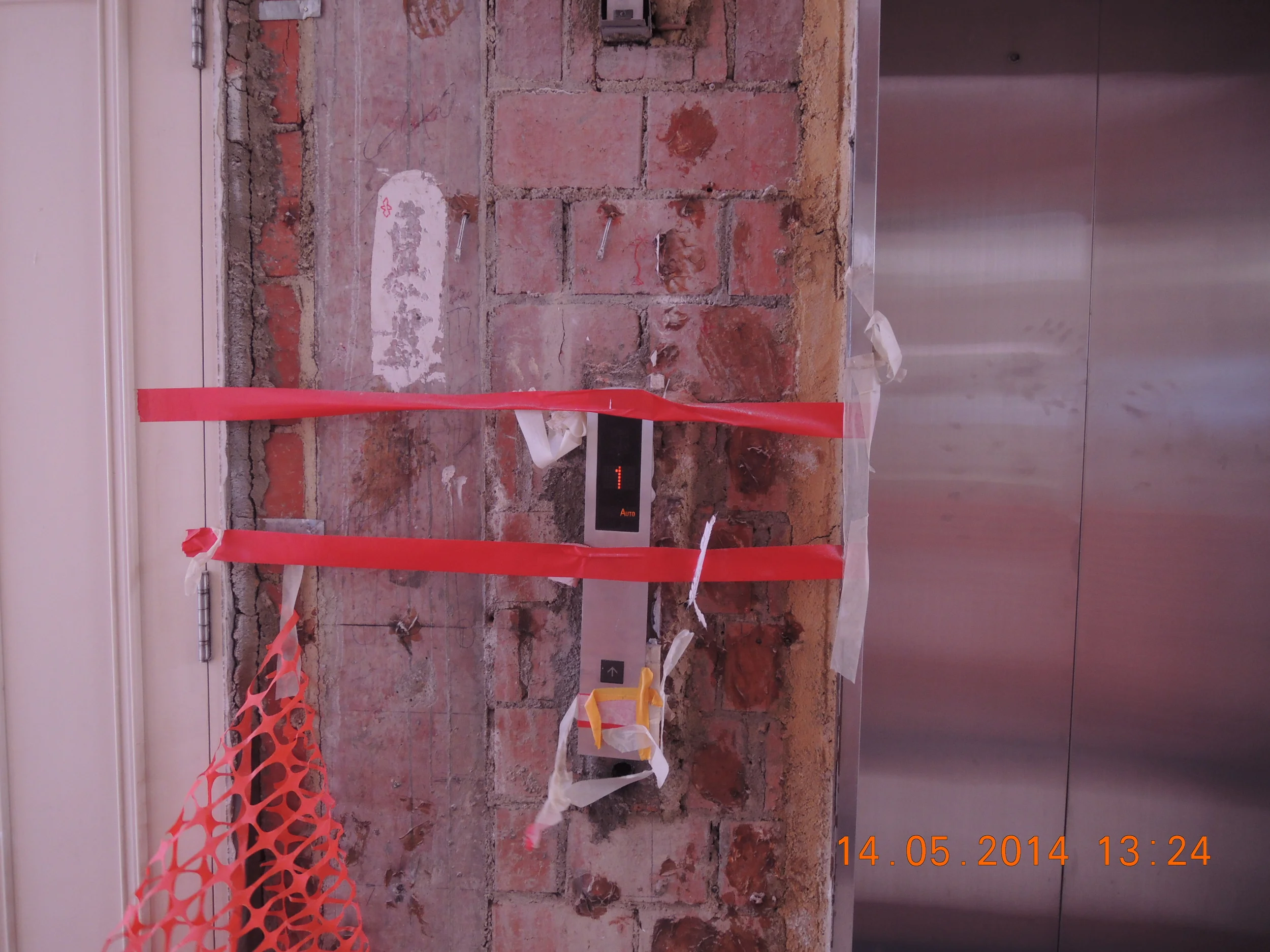
The elevator control fell into my hand when I pushed the button for my floor.  I laughed while Oathman raced for the tape.  

The elevator control fell into my hand when I pushed the button for my floor.  I laughed while Oathman raced for the tape.  

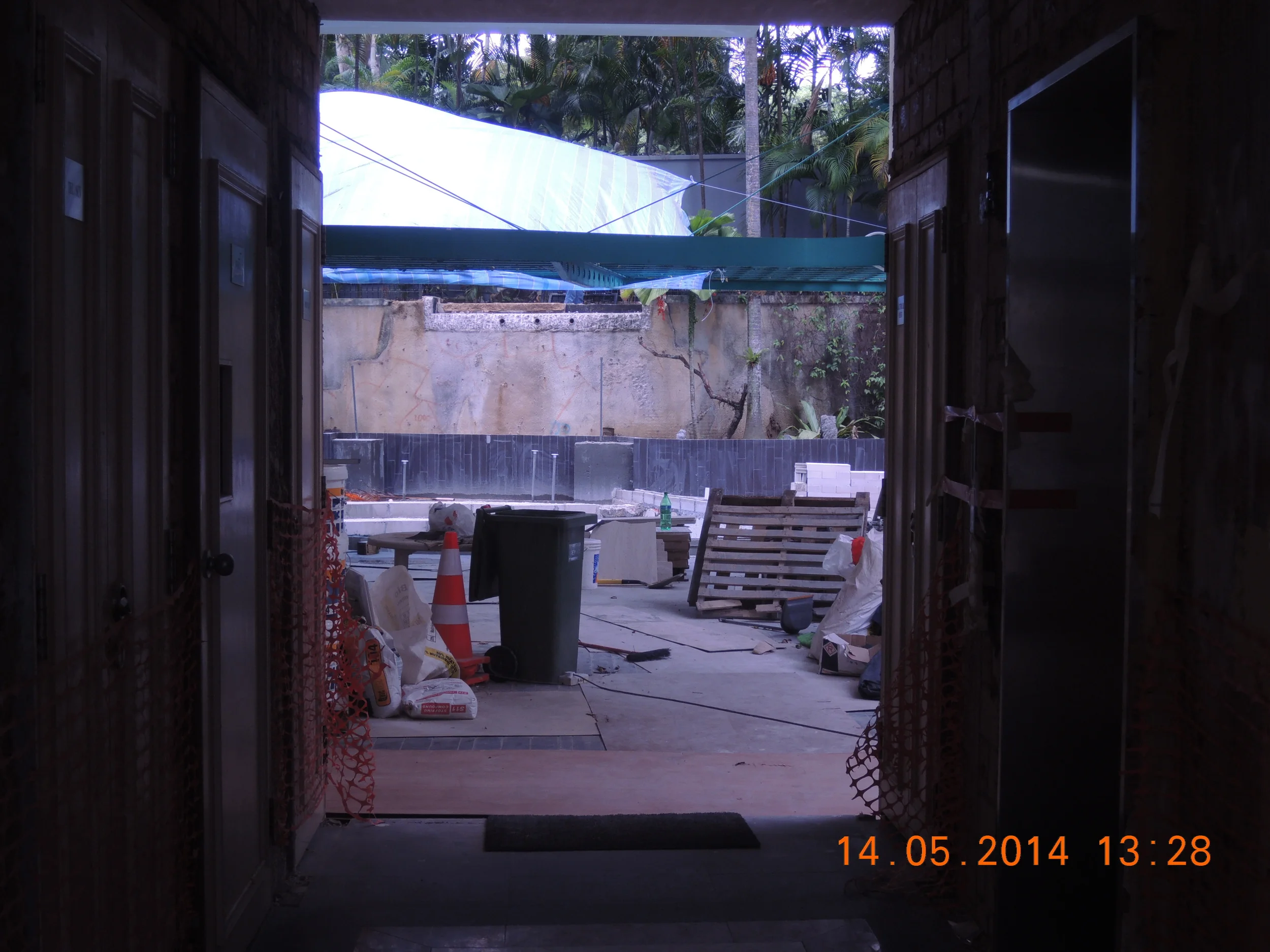
Where the poles are poking up is where the hideous waterfall used to be.  

Where the poles are poking up is where the hideous waterfall used to be.  

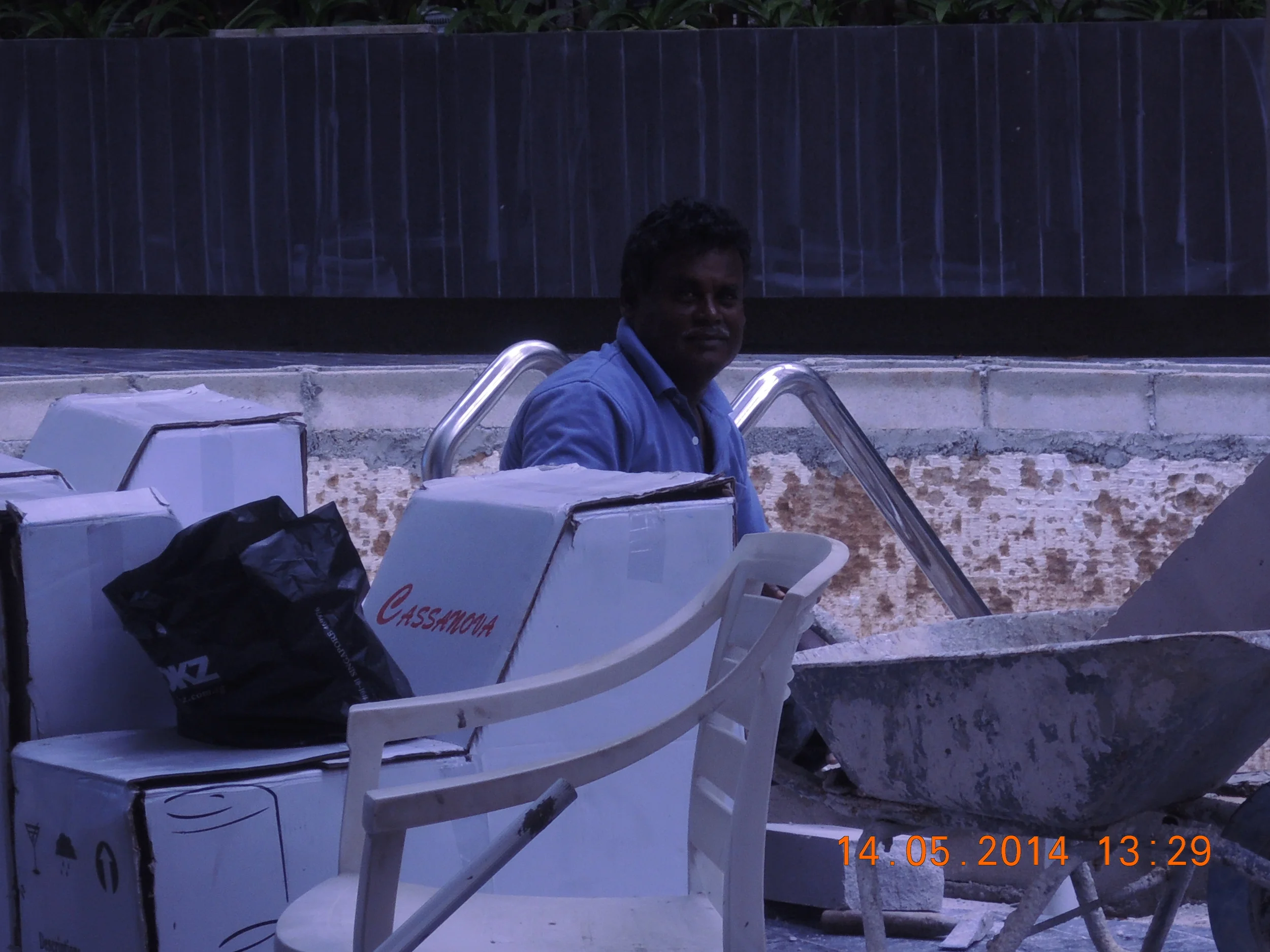
This worker was happy to have his picture taken.  

This worker was happy to have his picture taken.  

Naptime.

Naptime.

Tribe Camera

When David and I first moved to this highly populated and touristy area near Orchard Road, if someone in our path was taking a picture, we dutifully stopped and waited, replying, “No problem,” to their “Thank you.”  But we soon found that there were so many lens-up folks blocking the sidewalks that our progress was more stop than go.  So we ceased being polite about it.  Now we’re the couple that barges on through.  Our images can be found in photo albums from India to Indiana.  If the tourists aren’t taking pictures of each other, they’re blocking foot traffic by huddling around their cameras or phones, looking at the pictures they’ve taken so far and trying to decide where they should set up the next shot. 

This excess photography is because Singapore is too stunning.  Perfect backdrops are everywhere.  Interesting statues are tucked into shady corners.  Fountains flow from walls and splash in courtyards.  Forests grow on rooftops.  Colorful bougainvillea waves from overhead walkways.  Malls, ultramodern at ground-level, sprout massive towers that poke the sky.  A museum in the shape of a hand?  I gotta get my picture taken in front of that.  A giant spiral pedestrian bridge?  Perfect place to stop and snap a selfie.  A ship on top of a fifty-five story hotel?  Take one of me, right here, slanted upward so it’s in the background.

Another result of having so many people taking pictures is a ridiculous camaraderie, a sort of “Hey, we’re all in this together” friendliness that grates on someone who’s as easily irritated as I am.  Men and women on the street have no problem approaching me, a stranger, holding out their cameras, and asking me to take pictures of them.  Regardless of what the insane camera people assume, all cameras are not alike.  The zooms, the on/offs, and the shutter releases are located differently on every model—but that doesn’t stop someone I don’t know from pushing his or her camera into my hands and rushing away to pose for what seems like forever while I try to figure out how the stupid thing works.

The oddest camera-related experience David and I had was in Goa.  We were scrambling around a Portuguese ruin, Fort Aguada, when a group of about six approached.  One of them was holding out a camera.  David smiled—he tends to be friendlier than I am—and graciously resigned himself to the imposition of stopping mid-step and fiddling with their camera.  To my dismay, they all circled around me, putting their sweaty arms around my shoulders like we were the best of friends, signaling to David that they were ready.  When David returned their camera, they handed it to me, gathered around David, and asked me to take a picture of them with him.  Then they grabbed some other hapless stranger, asking him to take another picture, this time with all of them squeezing in around both of us.  When other fort scramblers saw this camera dance, they, too, moved in and held out their cameras, asking the people of the current group to take their picture with us.  By the time we left the fort, David and I estimated that about twenty memory cards held pictures with the two of us as the focal point, surrounded by strangers.  This was over a year ago and I still don’t have a clue what it was about.  I mean, what the hell, right?  

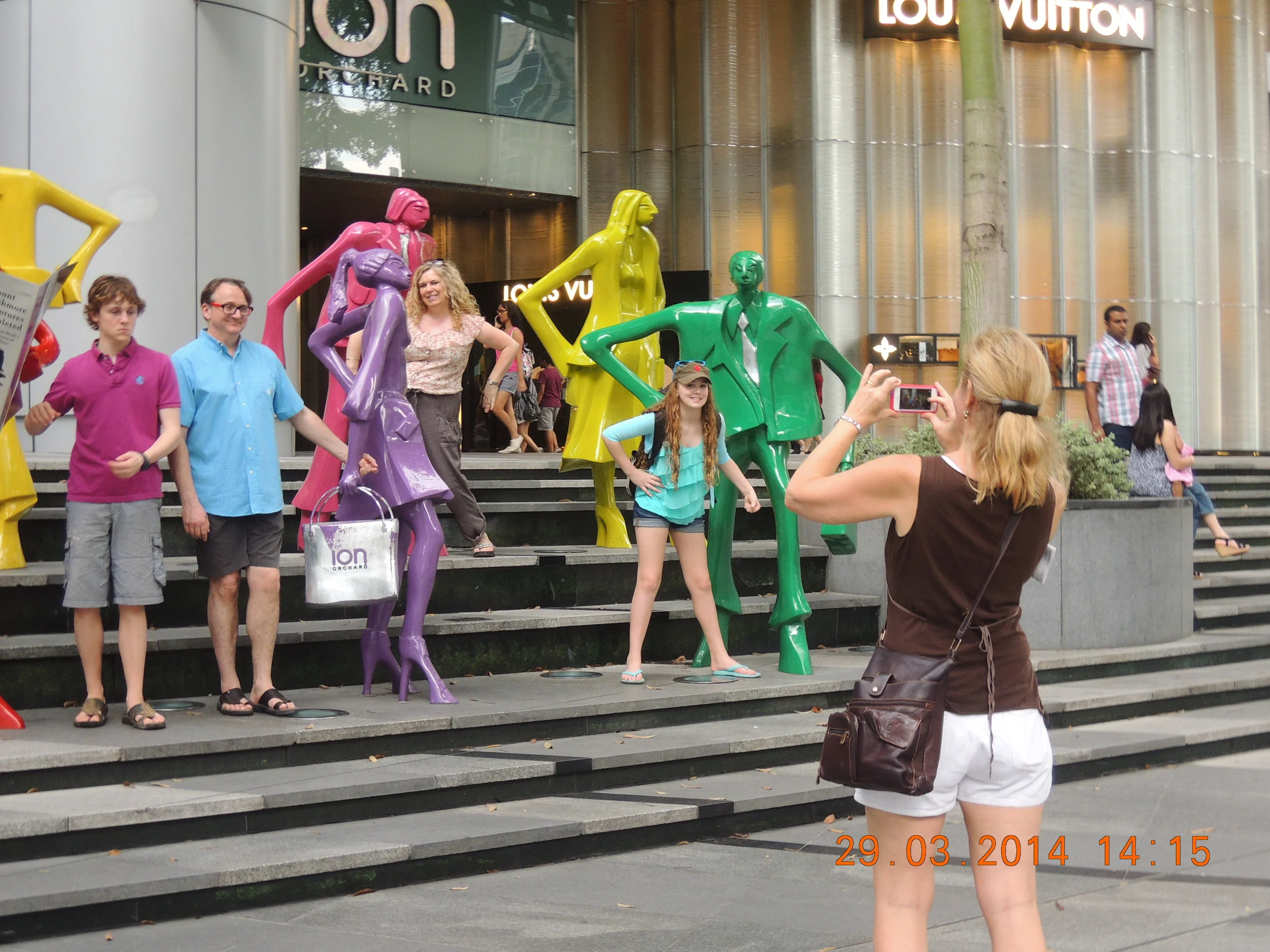
On the steps of Ion Center

On the steps of Ion Center

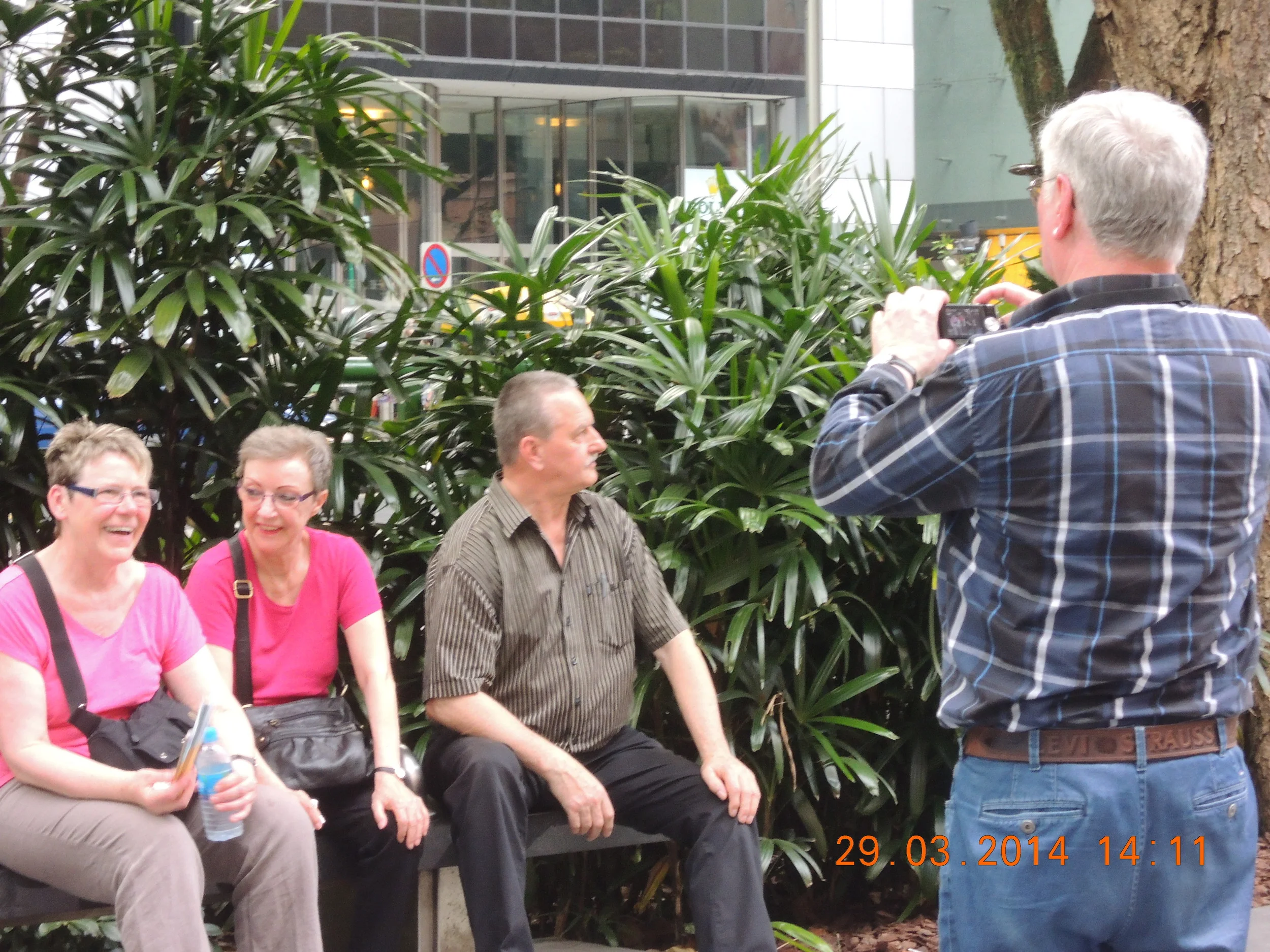
Three people with cameras up

Three people with cameras up

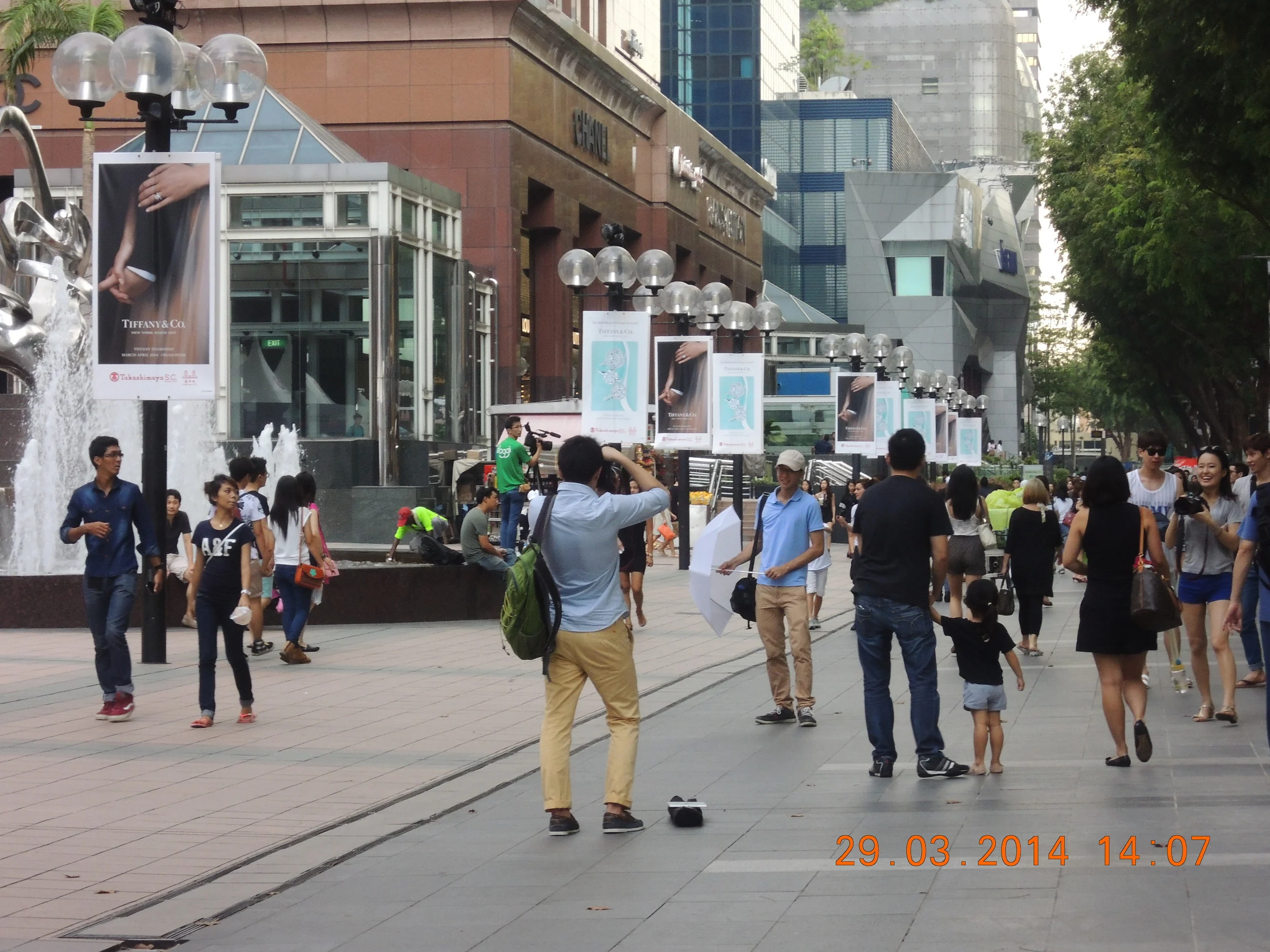
Tourists on Orchard--it's hot out there.

Tourists on Orchard--it's hot out there.

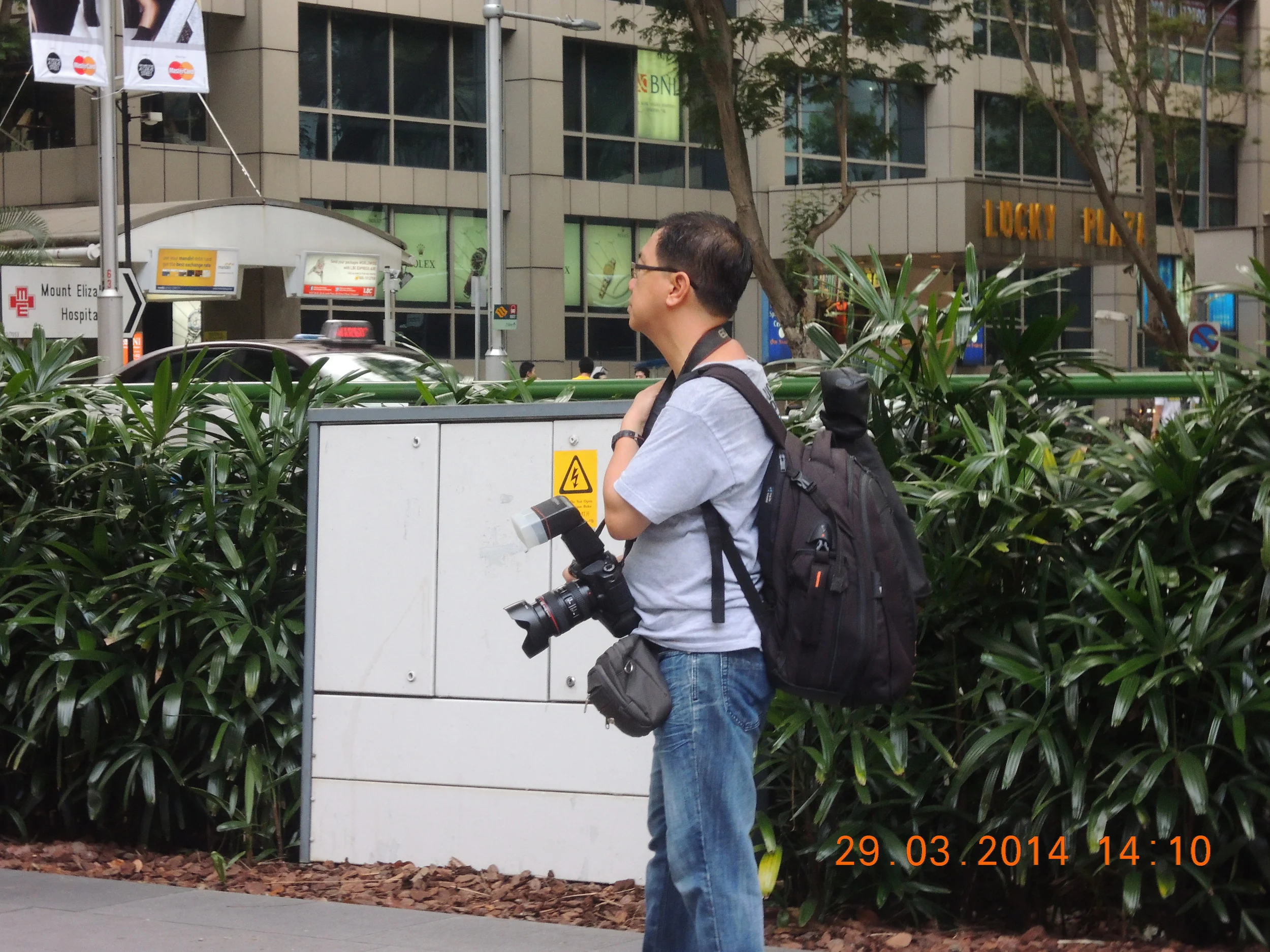
That's a big camera.  

That's a big camera.