Beijing For a Week

After returning to Singapore from Borneo, Leanne and I visit Beijing.  My son, Sam, has lived there for three years and speaks Mandarin, which’ll make the trip easier.  We arrive in Beijing on a Thursday afternoon. 

A lot is said about the air quality in Beijing.  The nasty atmosphere is the first thing we notice when we step out of the airport.  It’s as bad as it’s reputed to be—filthy, toxic, dense, stinky.  Everything is viewed through a dull brown cloud.  Our eyes sting, our throats hurt, and the assault to our lungs makes us cough—and this is just after a few minutes of exposure.  China should be ashamed.   

I’ve got a slip of paper that has the name of our hotel written in Chinese.  I hand it to the taxi driver; he grunts, hands the paper back to me, and pulls away from the curb.  Forty-five minutes later he comes to a stop, points down an alleyway, then gestures toward the meter.  We pay, get out, and roll our bags in the direction he indicated until, thankfully, we arrive at our hotel, The Traditional View, which is clean and spacious, and has the hardest beds in the world. 

Sam and his girlfriend, Julia, meet us at a nearby restaurant for dinner.  Julia started showing up in Sam’s emails about four months ago.  I know what to expect before I meet her—Sam likes exceptional people and exceptional people like Sam.  And Julia doesn’t disappoint.  She’s stunningly beautiful, smart, self-confident, and appropriately respectful of the visiting mother and aunt.  The two of them have gone to some trouble to plan our tourist itinerary, which includes the Forbidden City, the Great Wall, the Ming Tombs, the Llama Temple, the Confucius Temple, the Summer Palace, the Olympic Park, the Hagglers Market, The Drum and Bell Towers, and the Temple of Heaven.  Oh, and somewhere in there Sam manages to find time to demonstrate something called a MacBook Air, which is a light laptop he’s certain will make my life more perfect than it already is. 

Rather than share an in-depth report about all the sights, I’ll just say they’re exactly what I anticipate—worth seeing, but crowded (we actually fear we’ll get trampled in the mob at the Forbidden Palace)—so I’ll just offer a few comments on the things that please or amaze me.  The underground transportation is clean, clearly marked, and efficient.  The food is inexpensive and terrific and often entertaining, like hot pot, where you order the food raw and then enjoy yourself while you cook it at the table.  And I also must mention dumplings, China’s most glorious contribution for the well-being and absolute happiness of all mankind.  The parks are remarkable—beautiful, clean, and popular.  Quite a few of them charge entry fees, which I find surprising.

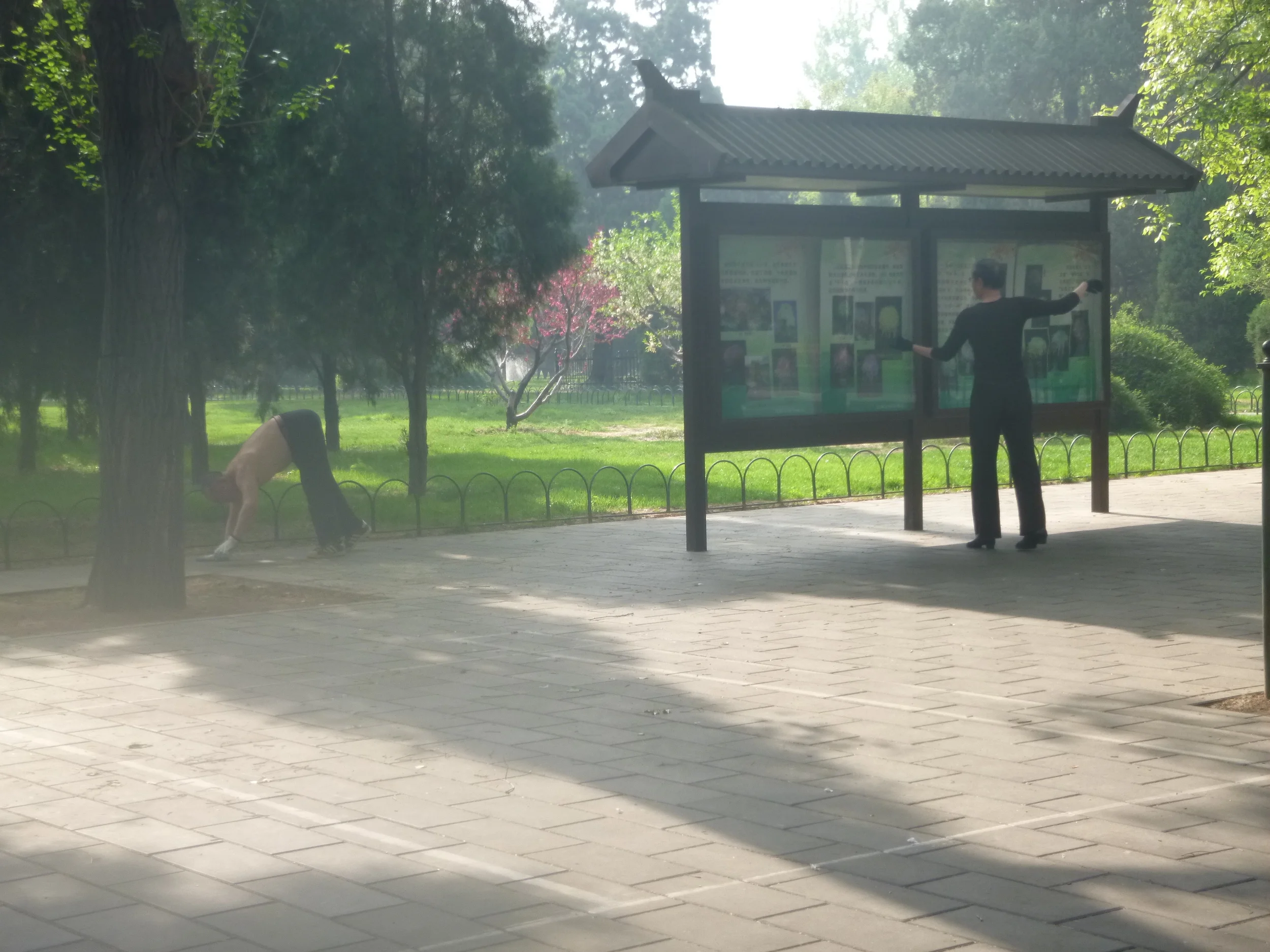
My favorite outing is to the park of the Temple of Heaven on Sunday morning, when the older people gather and participate in unusual activities meant to promote fitness and demonstrate that they’re engaged in the world around them.  Ballroom dancing, yo-yoing, whip cracking, hacky sacking, Tai-chi, badminton—these old folks are doing all this stuff, and doing it well, though sometimes their actions seem bizarre, which causes me to believe this is a very uninhibited culture.  I have mixed feelings—while I admire their unrestrained spirit, I also find it cringe-worthy; I would never be so spontaneous in a public setting.  There’s a man standing by himself under a tree singing at the top of his lungs.  Some other old guy places himself on the edge of an elevated deck and howls, his voice rolling out over the park.  One thin man, dressed all in black, repeats the same polished dance move again and again and again, while nearby a shirtless man slowly crawls along the perimeter of the courtyard in “downward dog” position.  We come across a group of about fifty people all gathered around one ancient character who hollers, “Ho!” and his followers holler, “Ho!”  Then he hollers “Ho-ho!” and they holler “Ho-ho!”  This goes on for as long as it takes us to pass by, and the whole time everybody’s bouncing up and down on the balls of their feet and clapping in rhythm.  We turn a corner and there’s an eighty-year old man rapping out a humorous tale—we know it’s funny because his three-person audience is laughing. 

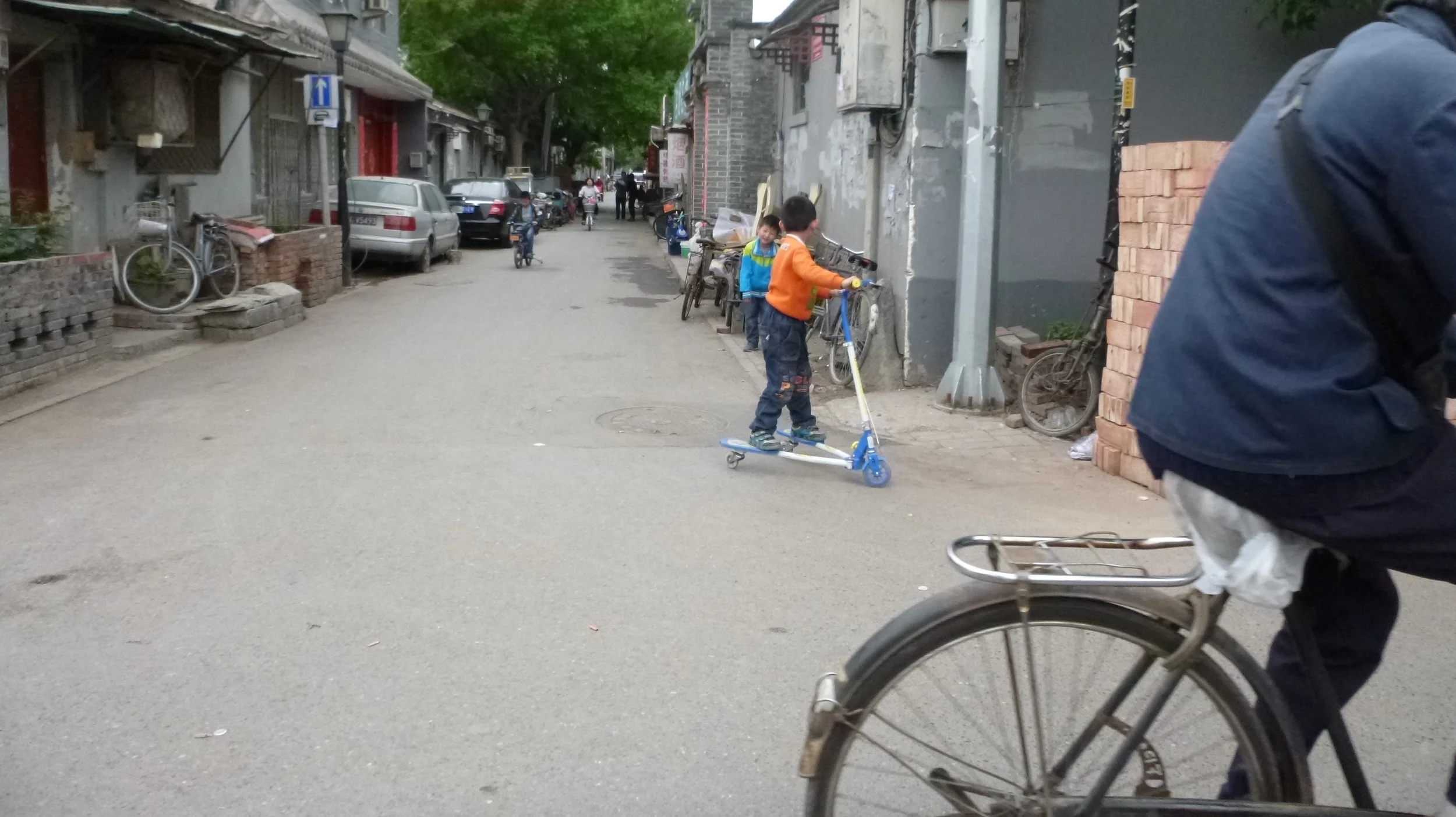
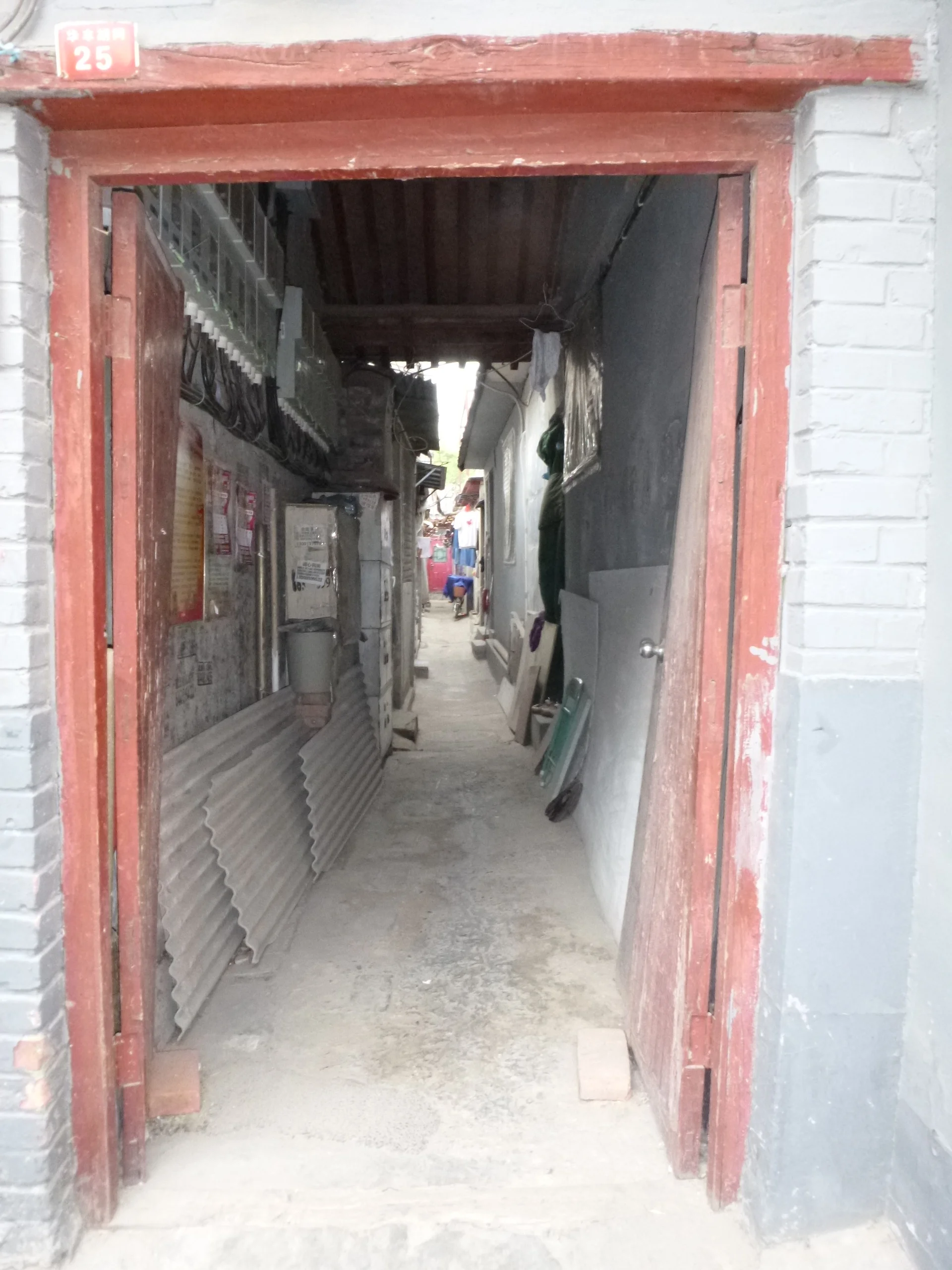
Also worth mentioning are the hutongs.  Hutongs are alleyways—narrow, crowded, smelly mazes that call to mind what Peking must have been like a hundred years ago.  Nice homes and tenement dwellings abut one another.  The cobbled streets are gray and all the walls are gray, and the gracefully sloping low roofs are gray, so it’s difficult to discern beginnings and endings.  Every hundred yards or so there’s a sign pointing toward a public restroom.  When I mention to Sam that I think they do a good job of providing facilities, he explains that these toilets are for the people who live in the area because they have no toilets in their homes.  When he tells me that they are all “open plan”, well of course I have to poke my head in.  And yep, he’s right.  Squatting toilets, no doors—and I have another question answered, which is, how do really old women squat like that?  The reality is—they just do it.  I don’t have the audacity to take a picture. 

Taken from Olympic Park.  The pollution's so thick you can hardly see the IBM sign at the top of the building.
Taken from Olympic Park.  The pollution's so thick you can hardly see the IBM sign at the top of the building.

The man on the left crawls along in Downward Dog while the man on the right performs the same twirl-and-point dance move over and over.  
The man on the left crawls along in Downward Dog while the man on the right performs the same twirl-and-point dance move over and over.  

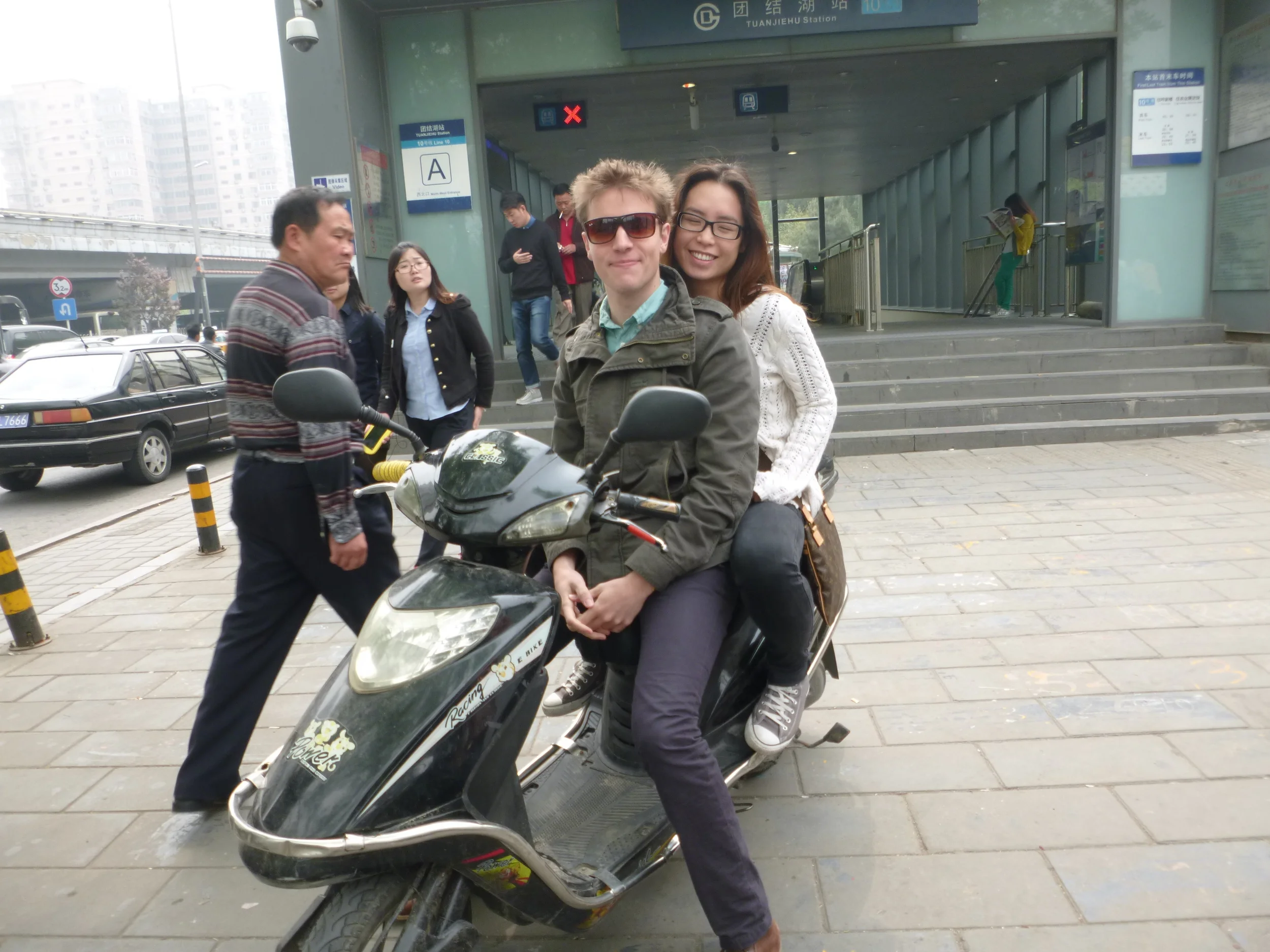
Sam and Julia.  Do you see a helmet?  I don't.  
Sam and Julia.  Do you see a helmet?  I don't.  

The hutongs are clean, but not spacious.
The hutongs are clean, but not spacious.

A doorway in the hutong.  See all the stuff stored at the side?  This can be dangerous when someone's trying to navigate their way home at night.  
A doorway in the hutong.  See all the stuff stored at the side?  This can be dangerous when someone's trying to navigate their way home at night.  

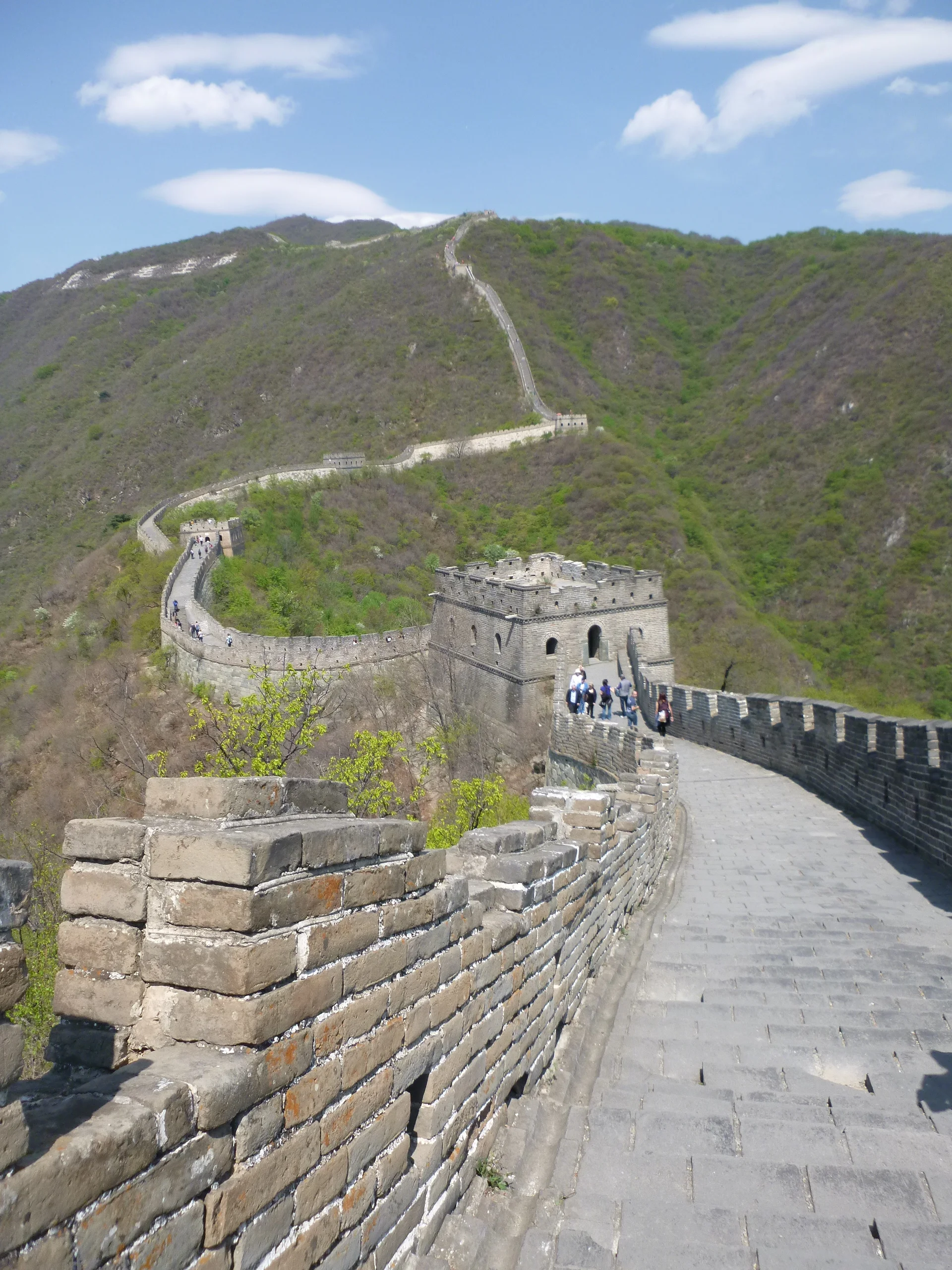
The Great Wall.  For some reason Westeros was on my mind that whole day.   

The Great Wall.  For some reason Westeros was on my mind that whole day.   

Me, on The Wall
Me, on The Wall

The Cave and the River

Michael tells us we’re going to stop at a cave between Sandakan and our next stay, the Myne Resort on the Kinabatangan River.  The cave, Gomantong, is where we’ll find swiftlets’ nests.  He explains that the nests represent a multi-million dollar industry.  We’re unimpressed at the idea of going into a cave, and maybe a little irritated at interrupting the trip for something so mundane.  Birds in a cave—who cares? 

We stop at the visitors’ center before making the trek to the cave.  Here Michael cups a nest in the palms of his hands and tells us that the nest is made of swiftlet saliva.  Each nest holds two eggs.  The nest is harvested and cleaned and sold for twenty-five hundred dollars a kilo.  It’s been used in Chinese cooking—mainly in soup—for four hundred years, and is thought to have health benefits such as relief of asthma, aiding digestion, and improving focus.  (Want sharper concentration?  Eat bird spit.)

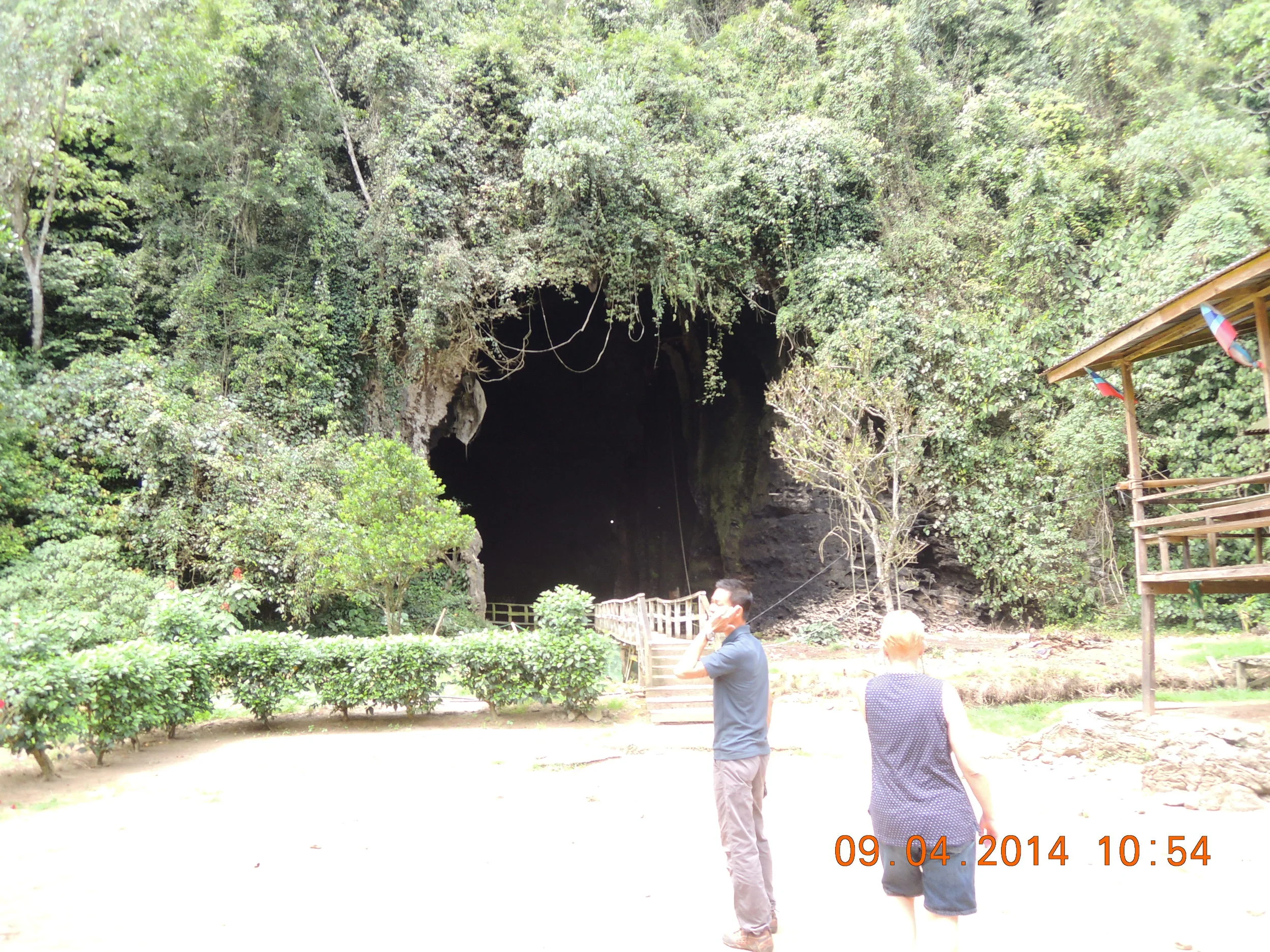
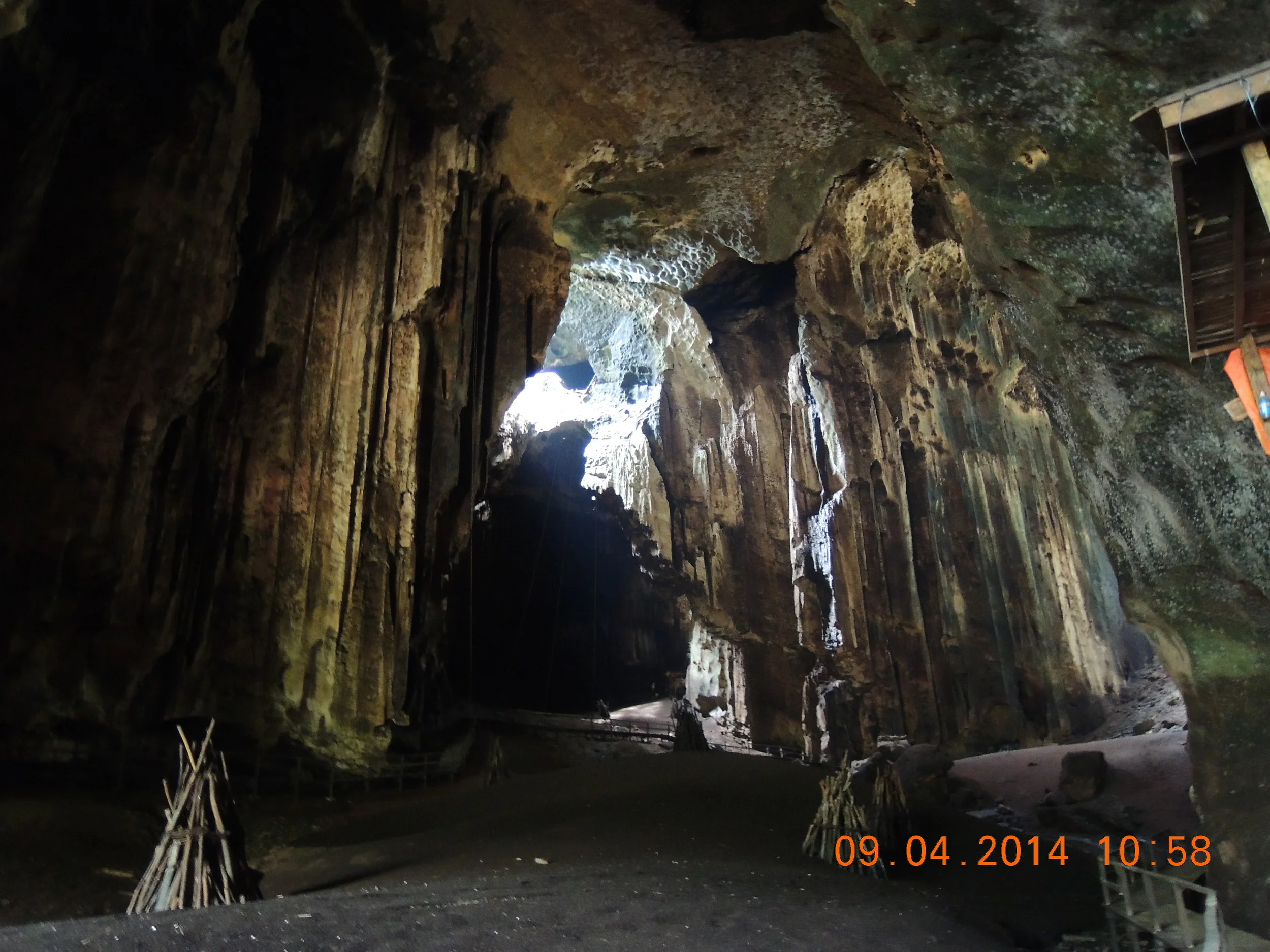
The mouth of the cave is huge and inviting.  Foliage frames the shadowy portal, a picturesque grotto carved into a green hillside.  It’s miserably hot out here in the humidity and scorching sun.  It’ll be cool inside.  People exit wearing hardhats, and this stirs a bit of anxiety—why were they issued head-coverings and we weren’t?  The wooden bridge that leads to the cave crosses over shiny nasty sludge.  We enter a massive chamber that soars to a height of about six stories and extends back about a hundred and thirty meters. 

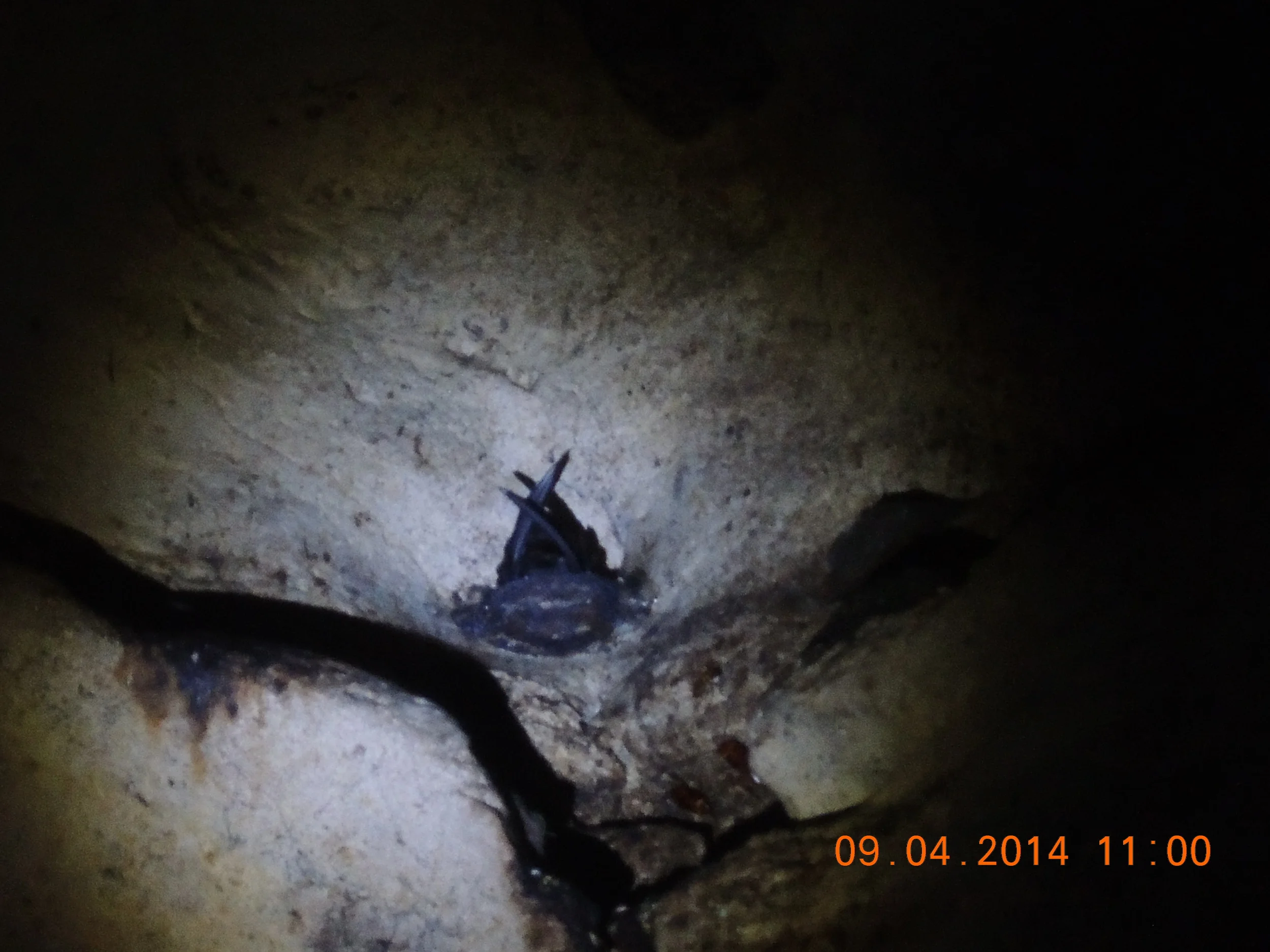
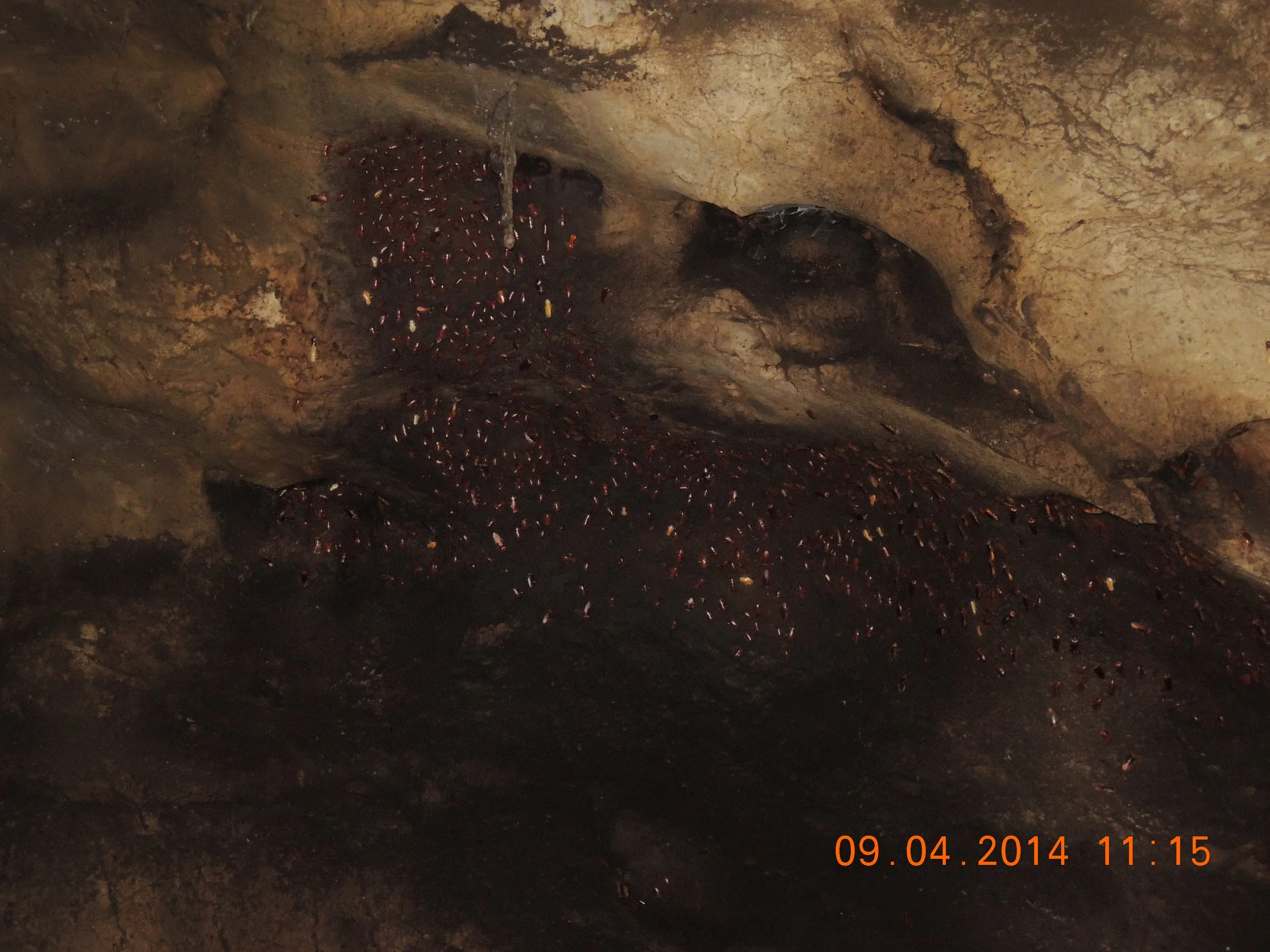
The smell hits.  Bats and birds.  Nasty.  Both creatures are swooping and fluttering high overhead.  With one hand I cover my nose, breathing shallowly.  With the other I cover my head to block the droppings that are visibly raining down.  Imagine the worst thing you’ve ever smelled and multiply it by a thousand.  According to Michael the guano in the middle of the cave is two meters deep.  The handrail, placed thoughtfully because the walkway is slippery, is crawling with two-inch cockroaches.  Don’t touch the rail!  Oh, and look, cockroaches are under our feet too—keep your feet moving or they’ll crawl up your leg!  And they’re all over the walls of the cave.  And the golden glittery movement atop the huge pile of guano?—cockroaches.  

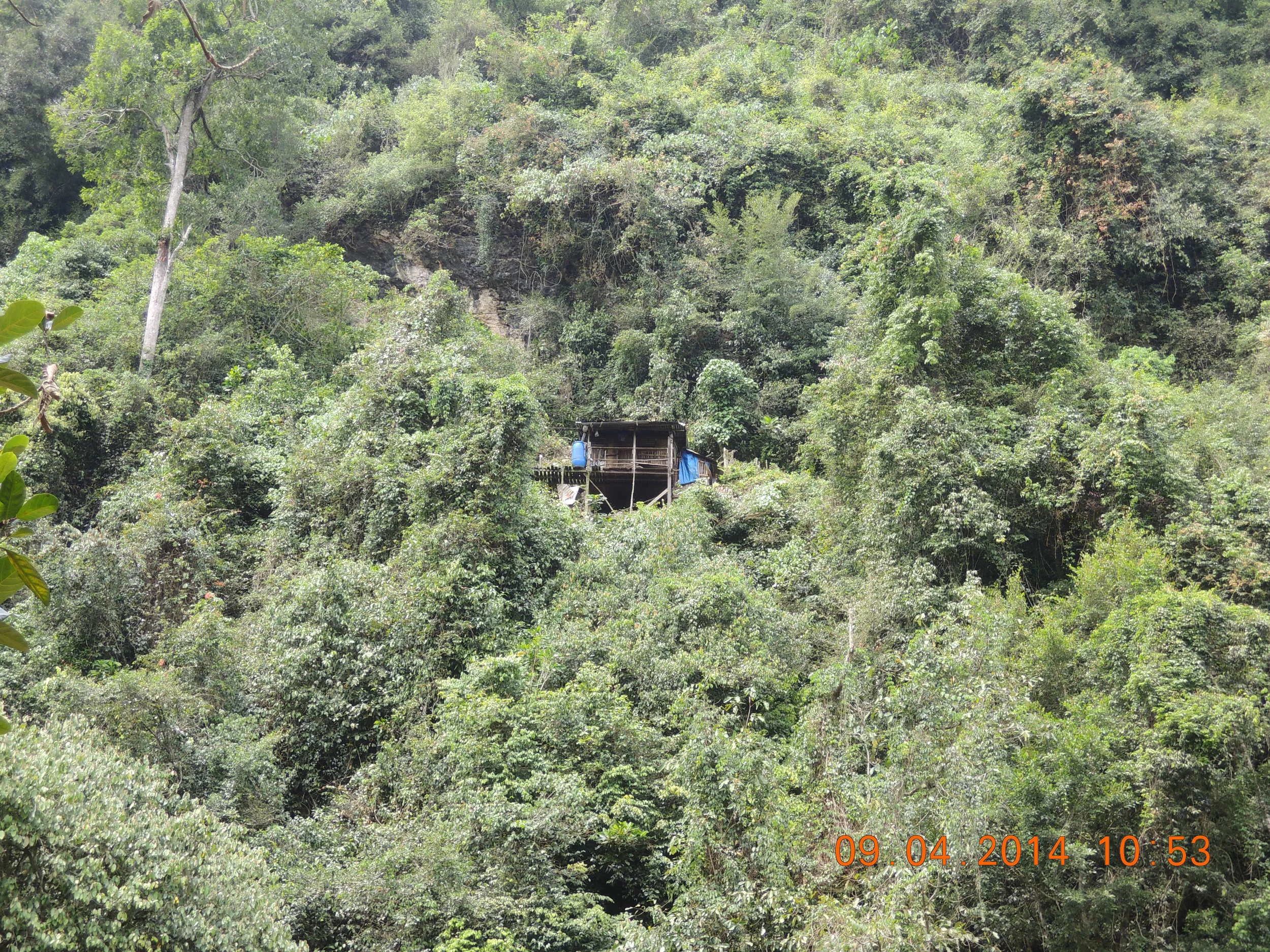
Michael walks us along, talking as though bacteria isn’t rushing in every time he opens his mouth.  He points out rope systems and ladder placement, explaining the harvesting of the nests.  He tells us that the walls of the cave are divided into allotments belonging to families and are passed from generation to generation.  Because the sections are valuable, the family must guard them from interlopers—it’d be easy to sneak a hand over a boundary and grab a nest.  And that is why the owners of the allotments stay nearby, dwelling in shacks on the hillside just outside the cave.  One man is so paranoid that he has built his own little nest in a protected nook of the cave.  We look in and see a counter, a bed, a radio, a lamp.  A little boy is cuddled against his father as they sit on the bed and gaze at us as we pass by.  This is the man’s life.  This is his child’s life.  What good is the money he makes from the birds’ nests if he lives like this? 

We trek back to the SUV.  The drive to the Myne Resort is half an hour.  The place we’ll stay for the next two nights is lovely.  Overlooking the broad Kinabatangan River, the elevated deck offers a breathtaking view of green rain forest and silver water.  Oh, and also, there’s wine, a pleasant robust cab that’ll do me just fine. 

This stay is all about the wildlife to be seen from the river.  Three cruises are scheduled—two in the evening and one in the morning.  It’s hot.  Sunscreen, hats, and drinking water are strongly advised.  I have an excessive love of being carried along in boats—scooting over the water, bouncing along the waves, the clean breeze whipping at my face—being on the water is conducive to clear-thinking and relaxation; it makes me feel one hundred percent content.  So I’m happy to go searching through the area—but I’d be equally happy not to see a single one of the creatures that everybody else seems so keen to spot.  There’s a list of what we’re looking for—orangutans, proboscis monkeys, pygmy elephants, crocodiles, monitors, macaques, snakes, and lots of birds.

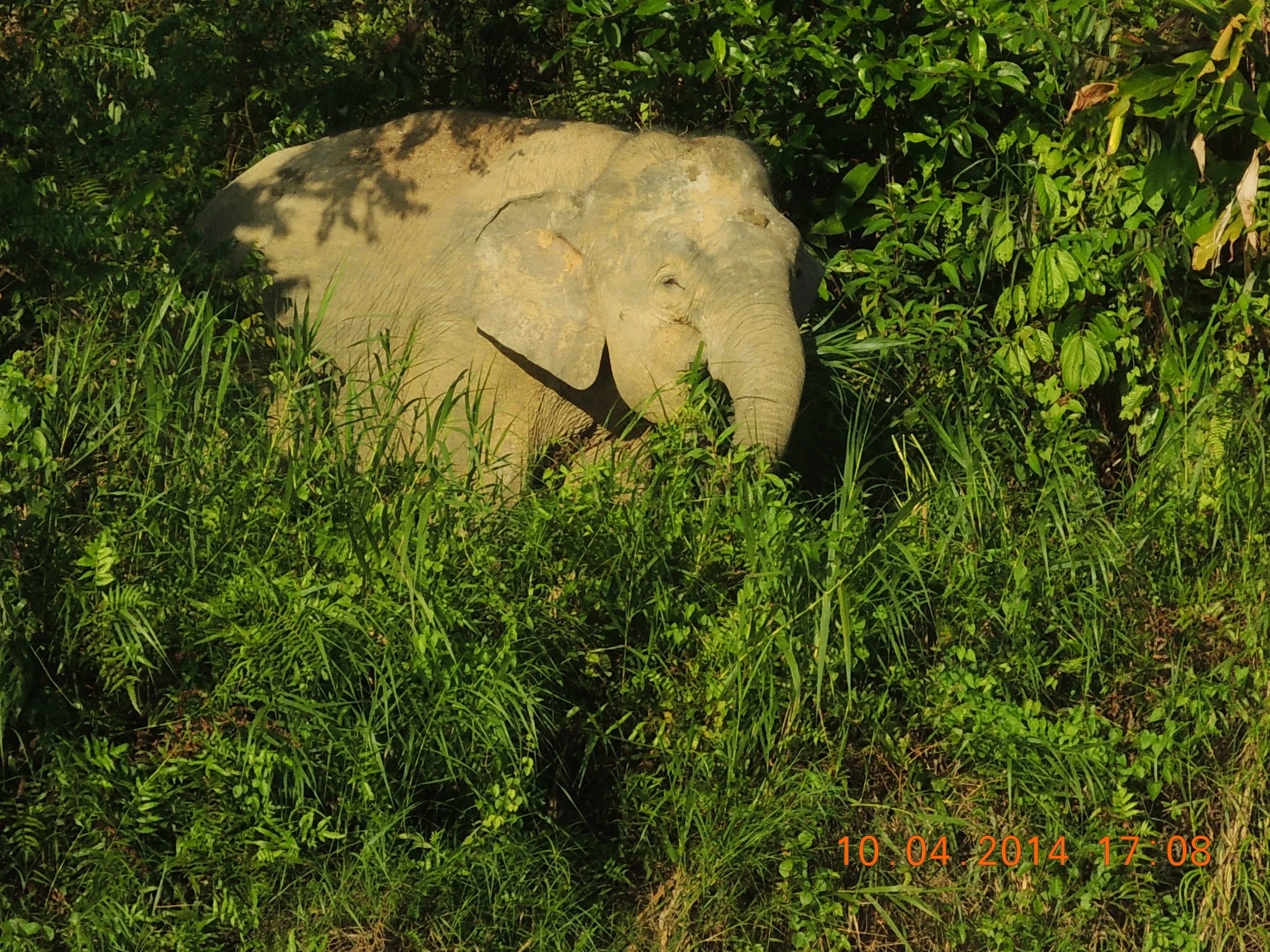
We find them all.  But it’s not like we’re all alone out here looking.  When the pygmy elephants are sighted all the guides along the river communicate the location of the herd and by the time we get there thirty other boats point toward the shore, each filled with up to twenty-four people with their cameras to their faces.  In our boat it’s just David, Leanne, and me—along with Michael and the river pilot.  I had a picture in my head of elephants the size of dogs.  Silly me.  They’re called pygmies because they’re smaller than their African and Indian cousins—but only slightly.  They’re still pretty big.  There are babies with massive ears and tourists exclaim over how cute they are.  According to Michael, such a successful sighting is rare.  But honestly, we sit and watch the beasts chew for over an hour.  They look at us and we look at them.  We’re here for so long that people have lowered their cameras.  There are simply no more pictures to take.  Yet we remain.  The sun is beating on us.  Let’s move on already. 

The morning trip is the best.  We turn into a calm tributary.  No other boats coast through here.  We get up close to a group of macaques, witnessing an intense and dangerous battle for territory.  Lots of screaming and trembling of leaves.  A couple of young males are pushed from high up in a tree.  We find birds, lots of birds, which is a rewarding challenge.  Flashes of blue and red and yellow swish by the boat, flit through green branches, hop about on the ground.  We see a hooded pitta, which Michael tells us is a five-year bird, meaning even if you’re an avid bird-watcher, you’re lucky to sight one every five years.  There are loads of different types of hornbills and eagles and kingfishers (the giant one looks clownish with its exaggerated coloring).  When the pilot turns the boat’s motor off the jungle noises take over—birds shrieking and flapping, monkeys shouting and leaping, insects droning on and on. 

After two days on the Kinabatangan River we’re delivered back to the airport in Sandakan, where we catch a flight to KL, then to Singapore.  My little dog, Trip, is thrilled when we roll our luggage through the door of the flat.  He pulls all his toys from their basket, presenting them proudly.  He wags all over.

People who harvest the nests stay nearby to protect their property.

People who harvest the nests stay nearby to protect their property.

Michael and I approaching the cave.  

Michael and I approaching the cave.  

A lovely cave full of guano and cockroaches.

A lovely cave full of guano and cockroaches.

A swiftlet sitting on its nest.  

A swiftlet sitting on its nest.  

Lots of fat cockroaches.  

Lots of fat cockroaches.  

A young pygmy elephant

A young pygmy elephant

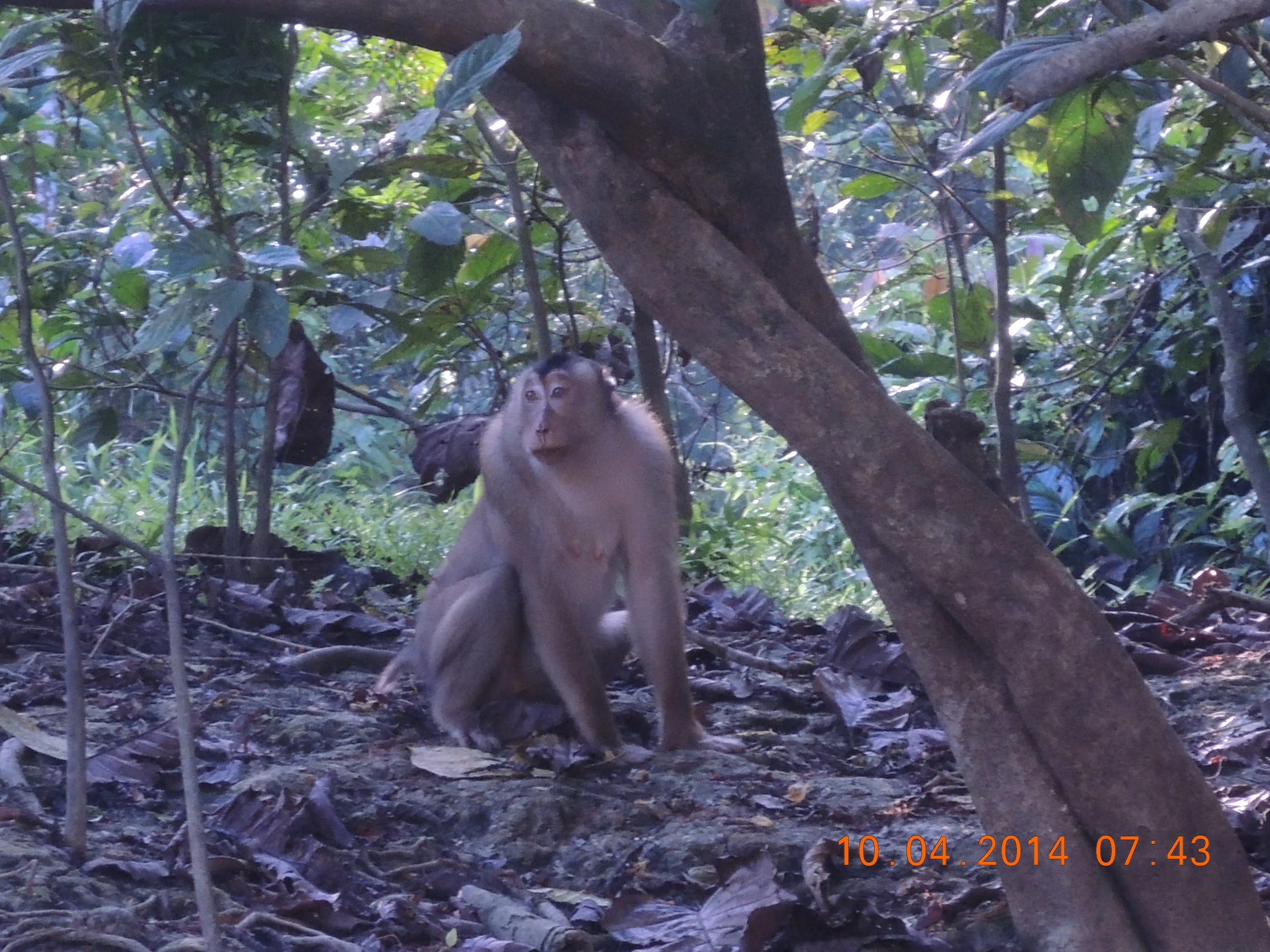
The macaque looks sad, but I honestly don't think there's a lot going on in his head.  

The macaque looks sad, but I honestly don't think there's a lot going on in his head.  

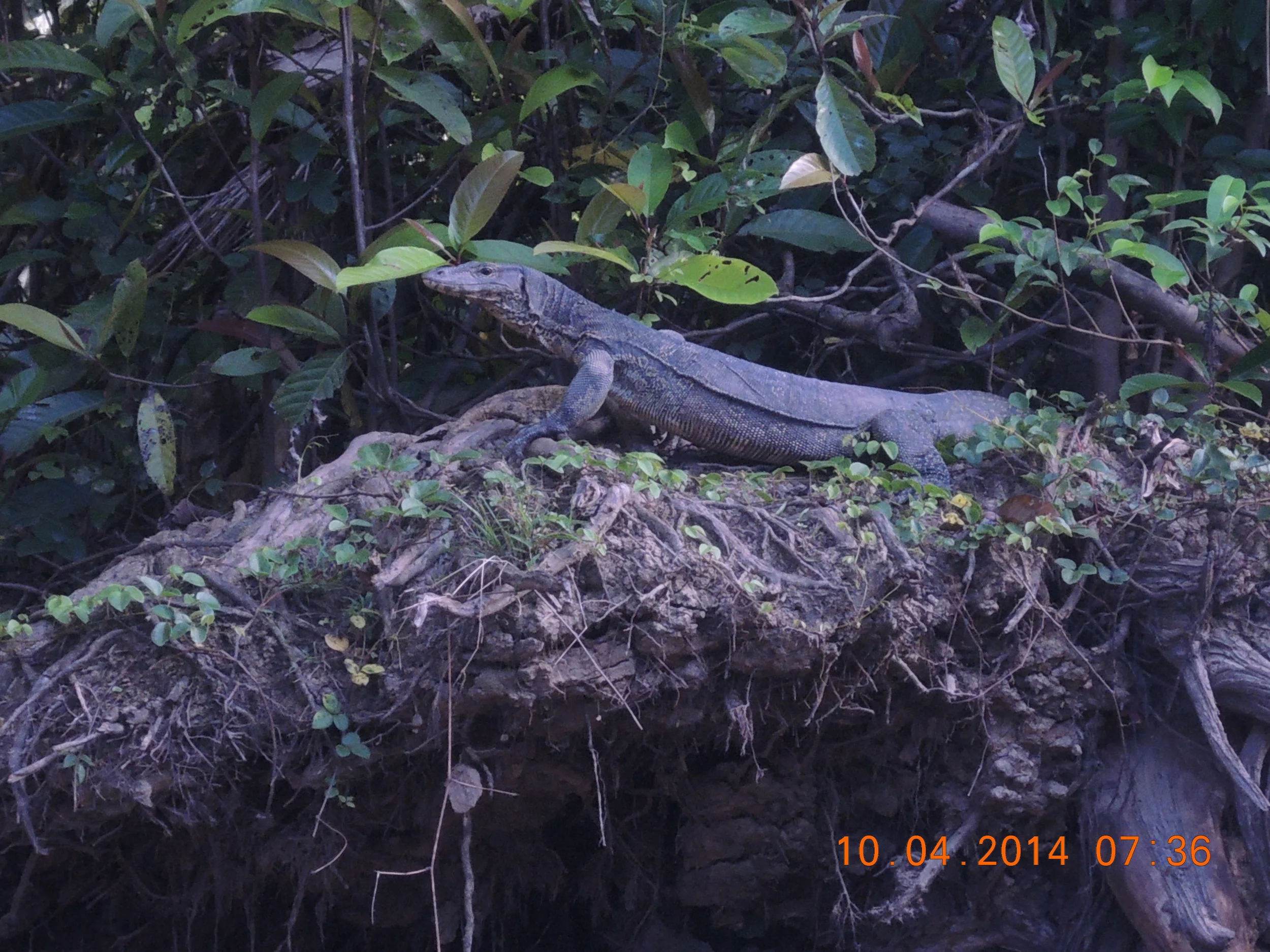
Knowing we'd be leaving the area soon, the monitor was kind enough to strike a pose.  

Knowing we'd be leaving the area soon, the monitor was kind enough to strike a pose.  

Pulau

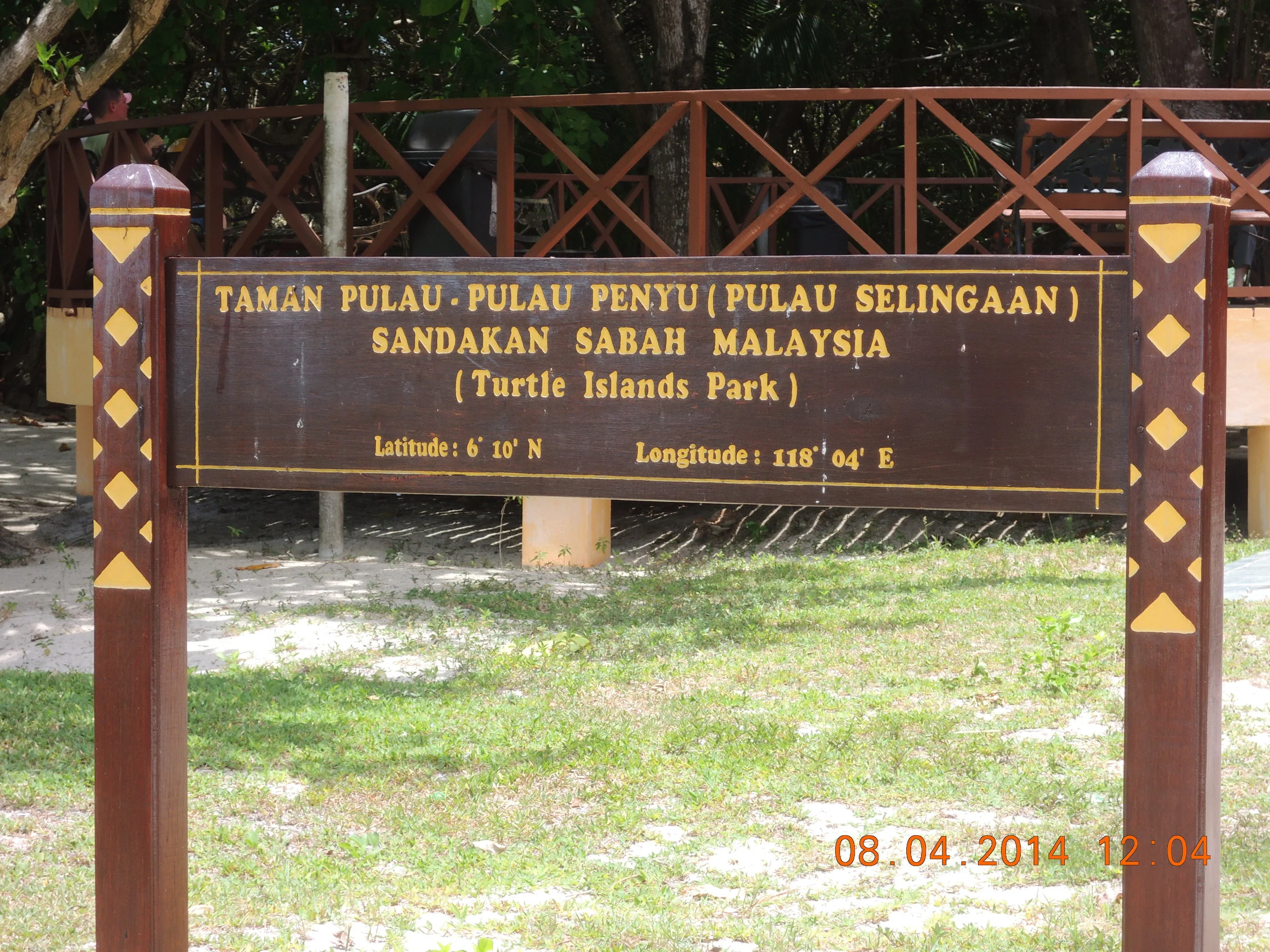
Pulau is a set of three islands off the coast of Borneo where turtles migrate to drop their eggs.  There’s a lodge on the largest island, which is actually not very large at all, where people can stay overnight and observe the turtles as they come ashore.  The lodge only accommodates fifty people, so we got our reservations in early.  David, Leanne, and I arrive at eleven o’clock in the morning.  We’re given basic instructions about meal times and rules, then we’re shown to our rooms.  The room holds two twin beds, a small table, and a thin rough towel.  No desk or chair, and no pictures to lift the spirits of the bedraggled.  Beetles scurry around in the shower area, which consists of a spout extending from high on the wall adjacent to the toilet.  Definitely not luxurious, but there’s air conditioning. 

The egg-laying doesn’t happen until dark, which gives us an afternoon to kill.  We walk the perimeter of the island, which takes about half an hour.  It’s hot, hot, hot, and I feel my pores shrinking and sizzling.  We eat lunch and take a nap.  There’s a pathetically small portion of the beach roped off for snorkeling, so we rent masks.   The near area is murky, so I flop into the water with low expectations, but only a few yards out the water clears and a thriving fish population darts in and around healthy coral.  I don’t venture below the surface because fire coral’s everywhere.  There’s a whole field of massive table formations.  My only unusual sighting is a black and silver sea snake.  Overall the snorkeling is a pleasant way to pass an hour. 

We get cleaned up and head to the cafeteria.  The food at dinner lacks inspiration, and once again, no wine.  But the meals aren’t why we’re here.  After dinner Leanne, David, and I and forty other people are herded into a room and shown a video explaining what we’re soon going to witness firsthand—a turtle dropping her eggs.  Then we troop back down to the cafeteria to await notification from a ranger that a turtle’s getting busy out on the beach.  While we wait David and Leanne attempt to teach me a card game they recall from childhood, Garbage Rummy—more time is spent trying to remember the rules than playing the game. 

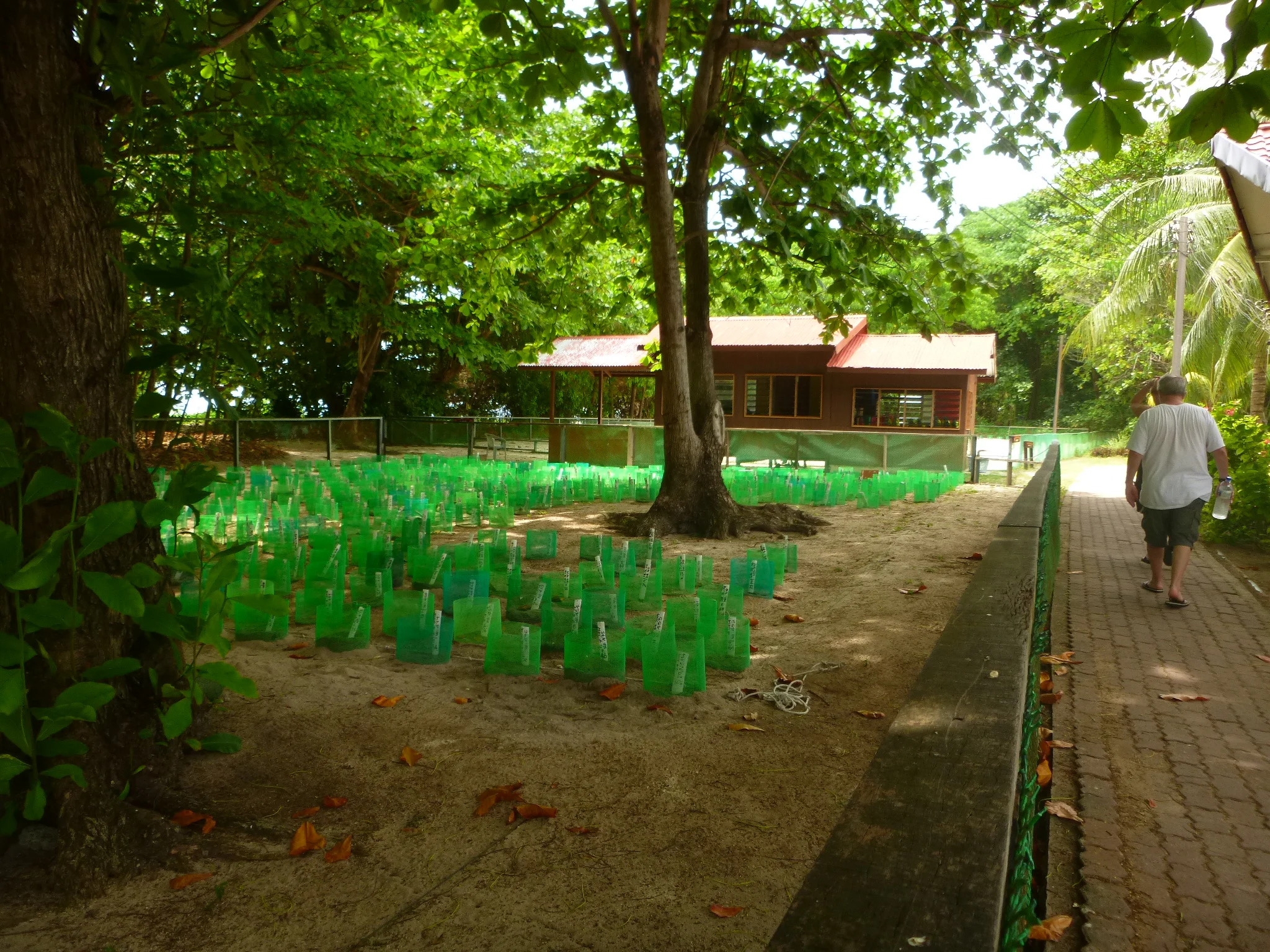
An announcement is relayed from the beach and we all troop from the building, across the football pitch, and out on to the sand.  Rangers point the way and we’re instructed to turn off our flashlights as we approach.  Also, no taking pictures.  Sure enough, a huge turtle has dug a pit for her project in the sand.  All us tourists crowd around her hind quarters and watch as her extended birth canal deposits eggs in pairs.  They’re covered in clear slime and are about the size of golf balls.  As soon as they land, a ranger reaches in, gathers them, and places them in a bucket.  In a little while he’ll replant them in a safer place.  The tourists are surprisingly polite.  They squat and watch, then move back so others can move forward.  The turtle is in a trance.  She just wants to get the job done and get out of there.  She lays a hundred and forty-four eggs.  The rangers seem very proud of her.  When the eggs quit coming we’re led to the hatchery, which is a simple field of sand with protective netting around the nests to keep the monitors out.  We watch as the ranger places the eggs in a hole, records the date, fills the hole in, and places the netting.  When the babies hatch they’ll dig their way to the surface and the rangers will carry them to the water. 

The three of us agree that this egg-laying was a really wondrous thing to see, and we’re glad we made the effort.  When we get back to the room I discover that ants have taken over my bed.  This is because earlier I’d mixed Grey Goose with Sprite (a travesty!) in a water bottle.  When I finished it, I replaced the lid and tossed the empty bottle on the bed.  It never occurred to me that it would attract ants.  Luckily, there’s a spare bed in Leanne’s room.  The boat picks us up at seven in the morning to carry us back to Sabah.  

Welcome to Pulau

Welcome to Pulau

The green net cylinders are the protected nests.   

The green net cylinders are the protected nests.  


This is a stilt village on the coast of Sabah that we passed on the way to Pulau.  

This is a stilt village on the coast of Sabah that we passed on the way to Pulau.  

Sepilok

David, Leanne, and I fly from KL to the Malaysian state of Sabah, on the island of Borneo.  We’re met at the airport by Michael, our guide, who loads us into a van and delivers us to a resort in the Sepilok Rain Forest.  We were told to expect the most basic accommodation, and that’s what we get—water pressure so low it’s barely a trickle, dust on every surface, spider webs in the corners.  There’s a drop of dried blood on the pillow.  I turn the pillow over.  My rough sheets are sprinkled with dead ants.  I brush them off and shut up about it.  Oh, and also, no wine. 

Our first excursion is to the nearby Orangutan Protection Center, a campus dedicated to teaching orphaned orangutans how to fend for themselves in the wild.  The rangers who work there are passionate about baby orangutans, who have sweet faces and are droopy with need.  The heartrending story we get from Michael is that the mother orangutans are killed because hunters want the babies to keep or sell as pets.  But babies that were once cute soon become destructive, and the owners turn them loose.  These little ones have no idea how to get on in the wild, so when some caring sensible rural person finds a young helpless orangutan, he or she notifies the center.  The orphans are brought in, nurtured, and taught how to take care of themselves in their natural habitat.  A success is when a young orangutan grows into a well-adjusted and independent animal.  Eventually the orangutans reach a point where they’re ready to be released into the forest.  When this happens, some stay in the area for a week, or even a month.  Food’s put out for them, but they all eventually fade into the trees.  They’re solitary animals and fruit’s all over the place, so why hang around just to be fed?  The orangutans in this state of almost-wild are the ones the tourists are allowed to observe.  Leanne, David and I, plus a hundred-fifty other tourists, are led to a walkway that overlooks the platform where, twice a day, a ranger puts out food.  When the food appears a few primates clamber languidly down the ropes, eat a few papayas, and aimlessly climb back into the trees.  Then the whole crowd shuffles next door to the newly constructed Sun Bear Protection Center.  These bears are endangered because their livers are thought to stop internal hemorrhaging.  Who comes up with these things?  Some peculiar person, at some point in time, cut open one of these darling little bears, removed its liver, offered it to an ailing friend, and said, “This’ll make you feel better.”  Here, too, we pack ourselves on to a platform where we stare outward for forty minutes at two small brown bears as they snooze in the trees.

Dusk finds us walking the same path we traveled when we saw the orangutans—only this time without the crowd that slumped through the heat earlier in the day.  The three of us are on a private nighttime tour of the rain forest.  We come to a stop on the same platform, but this time instead of turning toward the orangutan feeding platform, the ranger points to the top of a tree behind us.  Dutifully, we turn and gaze upward.  Outlined, on the highest bare branch of a towering tree, is a giant flying squirrel.  Dark gray against the pale gray sky, he’s bigger than any squirrel I’ve ever seen—the size of a full-grown macaque.  Suddenly he spreads his arms and sails from that tall, tall tree to a slightly lower bough on the neighboring tree.  The sight is breathtaking.  We sigh in amazement.  In the surrounding area there are approximately six flying squirrels.  We crane our necks until they ache, watching as they fling themselves through the sky until it’s too dark to see them anymore.  Then we move further into the rain forest.  Trunks, ferns, clinging ivy, and brush surround us.  Geckos bark, frogs chirp, and birds screech.  It’s a surreal environment, black-dark.  If we step off the path the leeches will get us!  

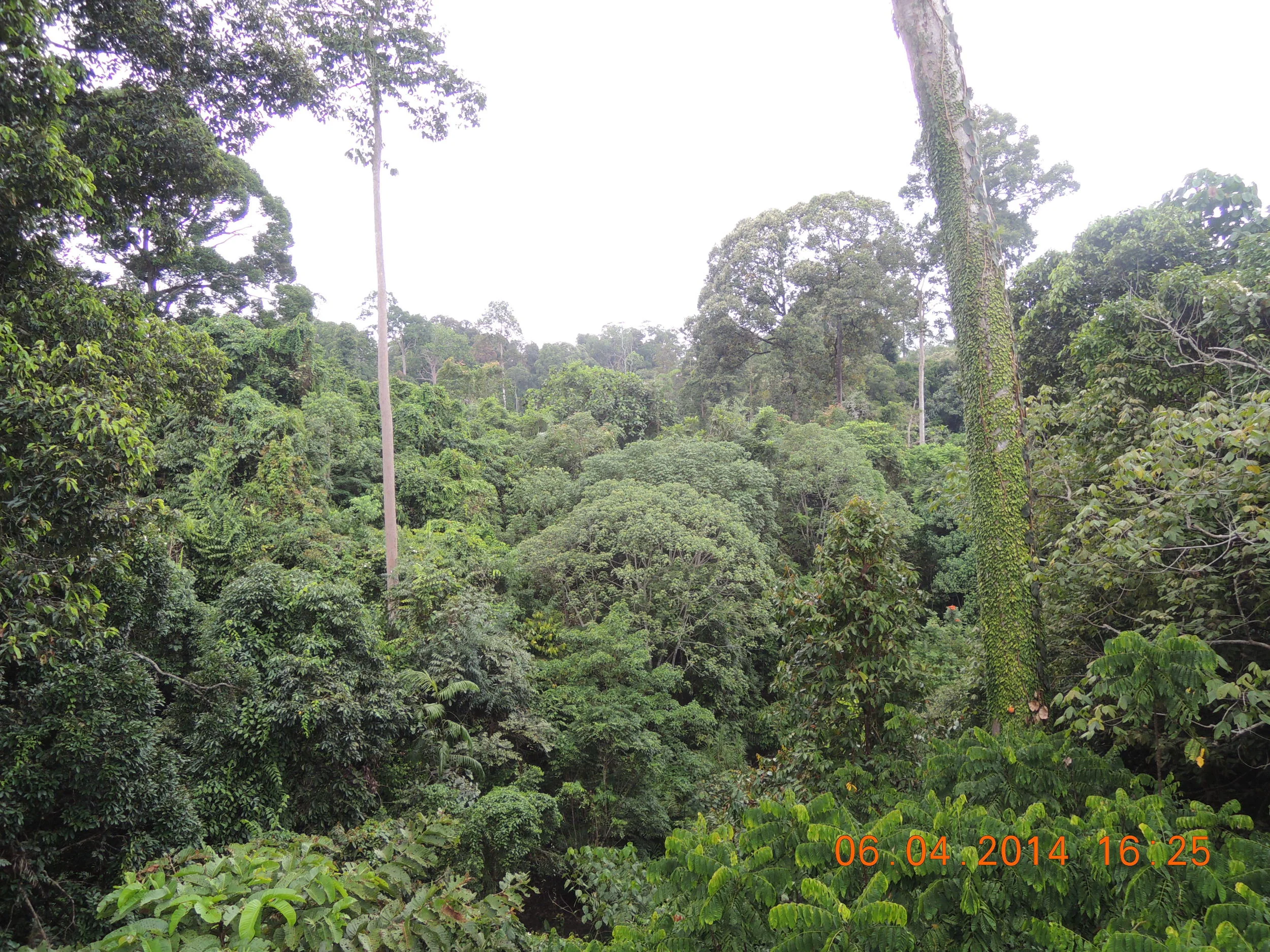
A view from an observation tower in the Sepilok Rain Forest

A view from an observation tower in the Sepilok Rain Forest

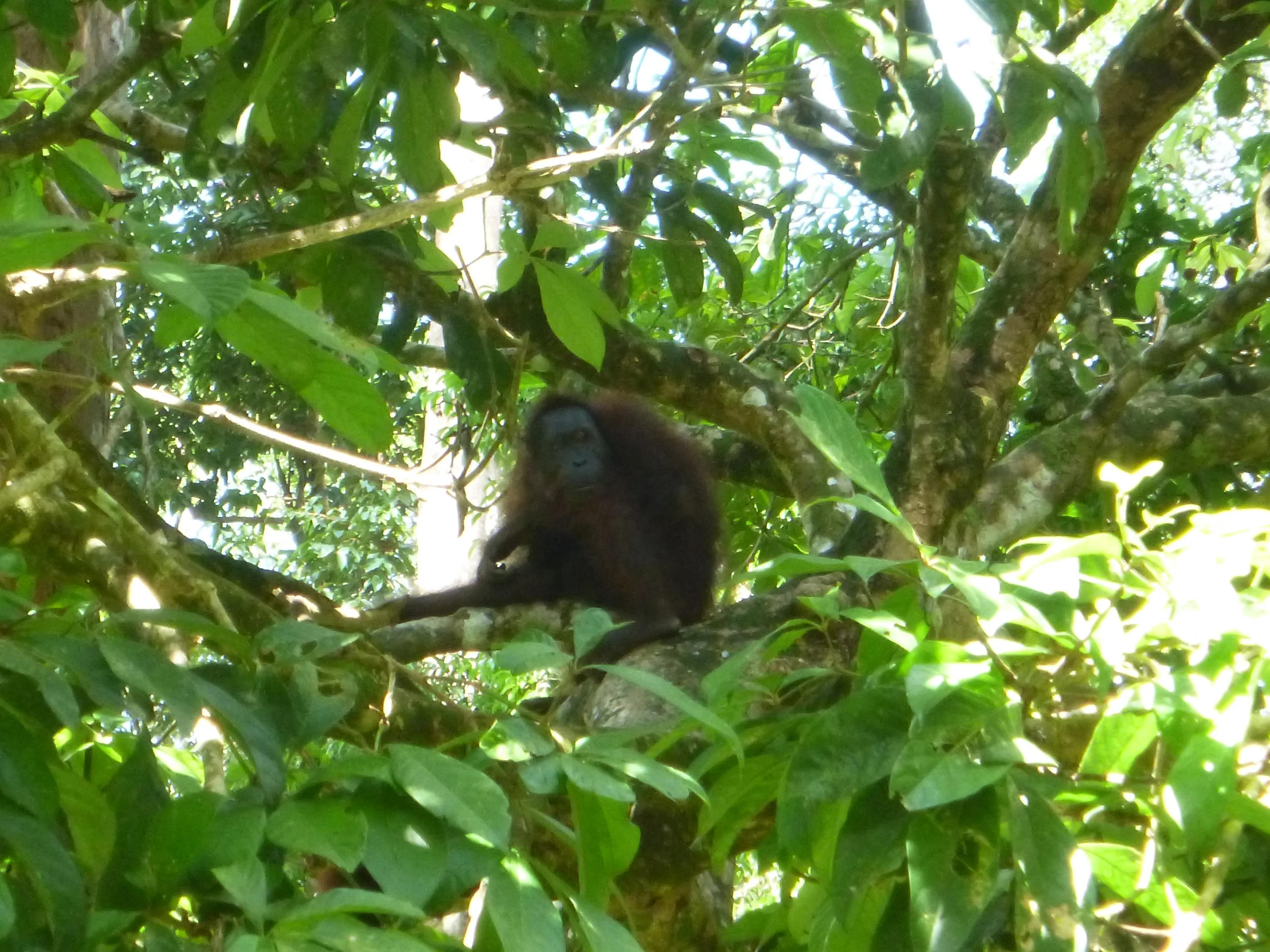
Orangutans are cute.

Orangutans are cute.

A night time creature, a caterpillar.  Don't touch it!  It'll give you a burning rash.  

A night time creature, a caterpillar.  Don't touch it!  It'll give you a burning rash.