Woolf's Words

Virginia Woolf’s The Waves was our book for Readers’ Group this month.  Here’s a summary:  The author follows the lives of three women and three men from childhood to old-age.  Interspersed between the voices of the characters, in italics (which I always find annoying), are rhapsodic passages about waves and the angle of the sun meant to symbolize the characters’ progression. 

Of course that’s not all there is to it.  Donna, who led the discussion, cackled delightedly at salacious humor that was so hidden beneath Words, Words, Words that none of the rest of us caught it.  She spoke ecstatically of imagery and symbolism.  Her eyes twinkled as she pointed out the experimental nature of the piece.  Worshipful in tone, she called it a poem.  I, too, thought the writing was brilliant and inspiring, though not flawless.  The symbolism was heavy-handed and the reader is kept at a distance.  Having said that, I read many phrases several times because genius should be savored.  And how fun—I’ll attempt to relate my rather conflicted assessment in the style of Virginia Woolf:

The Words, lilting, moving, ponderous and feather-light; and light, too, in spectrum, an unblemished arc of luminous Words tracing life’s horizon from sun-birth to sun-demise.  Rich Words, overflowing casks of Words more robust than red, more delicate than white, more perfect than perfection.  A Word bouquet of jasmine-scented roses.  Words and more glorious Wordsy Words exploding with flavor, curling around toes, laden with meaning and double-meaning and hidden meaning; and nestling like an exigent thorn in the guileless helpless souls of six women who, befuddled and daunted, attempt to decipher the Words, the extravagant never-ending profundity of Words.

Look at all those adjectives.  No wonder Virginia Woolf killed herself. 

When it was suggested that the six characters of The Waves were meant to represent the different aspects of a single person, well, I realized that I simply hadn’t given the book the time it deserved.  Unlike Donna, I didn’t approach the work with appropriate gravitas—my two weeks of quick reading hadn’t gotten the job done.  She read it twice and intends to read it again. 

Some comments from the other readers: 

Beth, a new member, says, “There’s so much here that you could study it for a whole semester at university.”  In our one-to-ten rating system, she gave it a six.  Judy, also new, comes from a journalism background.  While she appreciated what Woolf was trying to accomplish, it was too vague to suit her taste.  She likes sentences to sit up and behave.  She gave it a five, as did Sharmila who felt that “Her (Woolf’s) writing was very rich, but a lot of work.”  Kristen gave the book a seven.  She recognized Woolf’s virtuosity, identified with the characters, and admired the use of detail in the descriptions, but admitted that she wouldn’t recommend it to a friend.  I, too, gave it a seven.  I liked it because Woolf’s originality and inimitability inspire me to stretch, to liberate instead of domesticate, to flow instead of craft; on the other hand, I couldn’t give her a higher rating because the subject was banal—follow six unexceptional people through their lives and echo it in the cycle of the waves?  Weak, Virginia, and boring. 

Our readers’ group is in its third year.  Of the original dozen, only Sharmila, Kristen, and I are left.  That’s the ex-pat lifestyle—people come and go.  We get together at the end of every year and decide next year’s list, though some of us may not be here next year, in which case the new batch of readers will inherit our choices, possibly with trepidation, possibly with dismay.  In the last couple of years we’ve read classics like Anna Karenina, East of Eden, House of Mirth, and Wives and Daughters.  We’ve taken on modern literary works like An Artist of the Floating World, And the Mountains Echoed, House of Sand and Fog, and Wolf Hall.  And we’ve had some easy reads, too—Gone Girl, The Devil in the White City, and The Burgess Boys.  Outside of the selected reading, we all follow our own preferences and make recommendations to each other.  Because of this group I’ve enjoyed Where’d You Go, Bernadette? Room, and Burial Rights—all excellent reads.  As a writer I find it helpful to keep the Words churning through.  Words, infinite and burgeoning, Words pregnant with nuance, dark green Words, Words of . . . Virginia, get out of my head!   
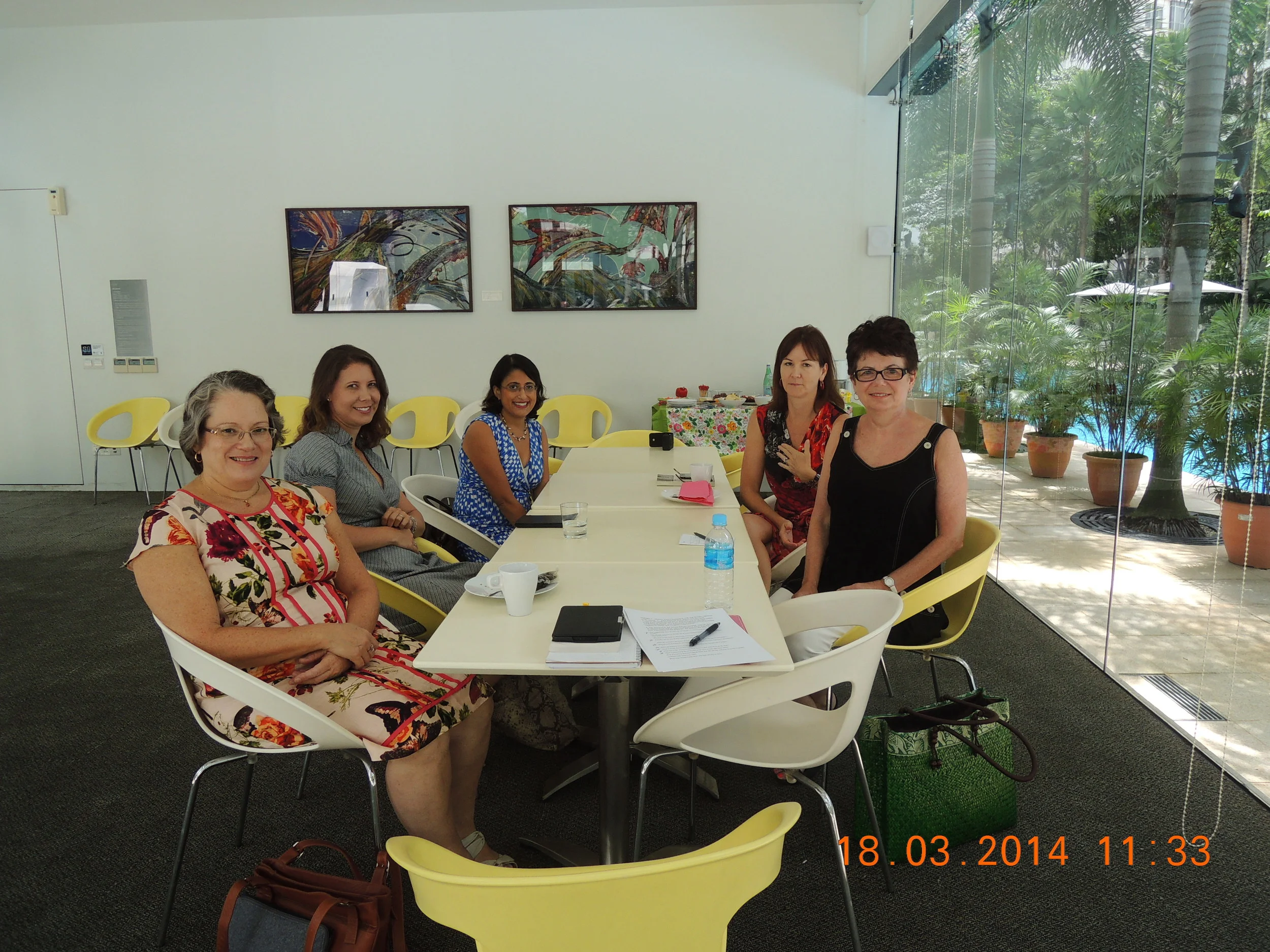
Judy, Beth, Sharmila, Kristen, and Donna--a good picture of you all!  This is the meeting room in Donna's complex.  At the back is a table full of goodies--thanks, Donna.  The green bag on the floor next to Donna is mine.  

Judy, Beth, Sharmila, Kristen, and Donna--a good picture of you all!  This is the meeting room in Donna's complex.  At the back is a table full of goodies--thanks, Donna.  The green bag on the floor next to Donna is mine.  
The Morning Building

Trip and I go for a walk every morning around seven-thirty.  We step out of the elevator.  Jamaliah’s just coming in to work.  She’s a pretty woman, brown hair, clear skin, maybe forty.  It’s her job to keep the open-air lobby and elevators clean.  She says, “Good morning,” and smiles.  I return the greeting and the smile, which most likely conveys irritation.  I don’t like to interact early in the day.  Jamaliah whisks past, heading to the closet where she keeps her uniform.  Next time I see her she’ll be dressed in gray and whipping her broom through the lobby.  She sweeps and mops the front area at least six times a day, and each time I’m in or out we exchange good wishes for whatever time of day it is. 

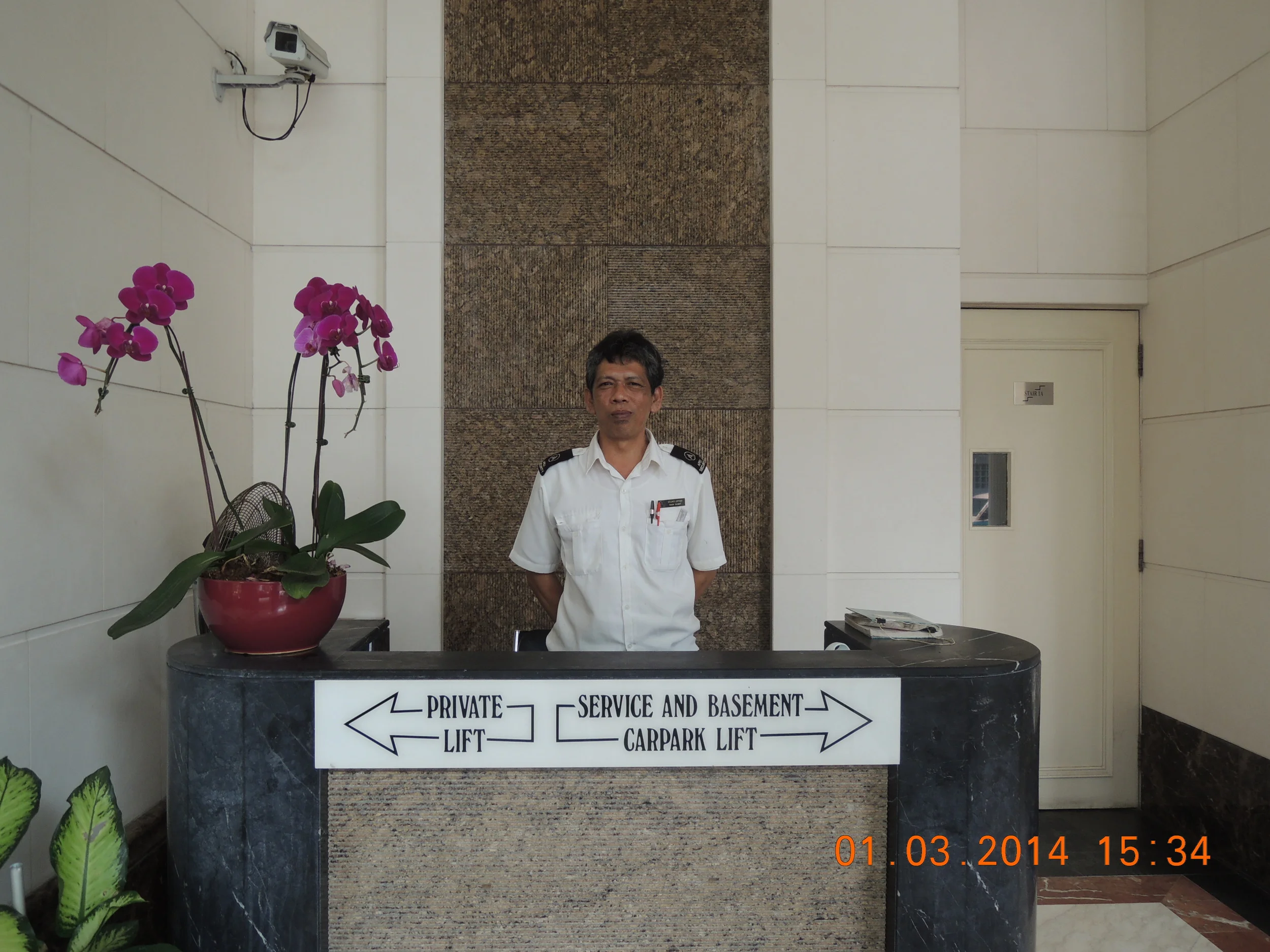
At the front desk is Oathman.  He, too, wishes me a good morning and I say the same to him.  Oathman is here daily from seven to seven.  When I have friends to the flat he walks them to the elevator and pokes the code that calls my floor to let me know they’ve arrived.  Stationed at the front desk, his assigned task seems to be keeping tabs on everybody.  He tells guests where to park and he points delivery people to the service elevator.  He’s a friendly guy and people are always leaning on his counter laughing with him.    

As Trip and I walk down the six steps to the covered driveway, the neighbor’s driver tells me good morning.  He gives a little bow when he says it.  I say good morning to him, too.  He seems like a nice man, Muslim, and while that in itself isn’t offensive, the way he squeals like a terrified sissy is.  What does he think my good-natured little dog is going to do to him?

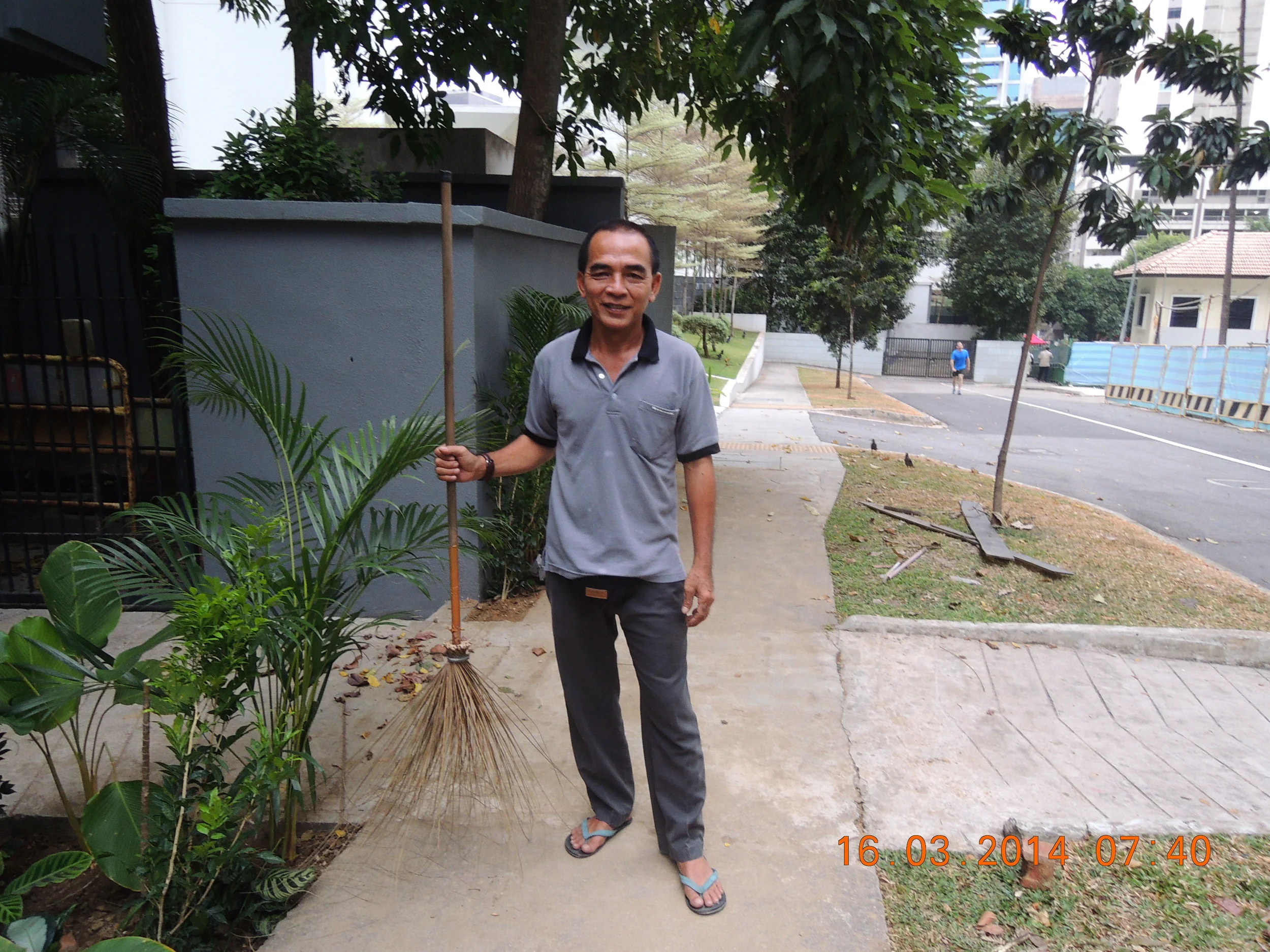
Beyond the wussy driver is Razzah.  He wishes me good morning and I wish it back to him.  In the same way Jamaliah takes care of the interior, Razzah takes care of the grounds.  Keeping the area free of leaves is a never-ending task.  He sweeps with a straw broom that is handmade.  Also, he’s in charge of garbage pick-up and removal, though I question his dedication.  Someone left a banana and a roll on the front fence four days ago and it’s still there.  The banana’s brown and shriveled now, and the bread is moldy.  Shouldn’t he have thrown it away?  Does he think someone’s going to come back and claim it?

As we pass through the gates Stephen is just getting ready to go off duty.  He let me know when I first moved in that if there are any problems, he’s the one I’m to come to.  Stephen watches the entrance from the little guardhouse throughout the night.  He’s told me he doesn’t need sleep.  A retired teacher, he’s eighty years old, has no hair, few teeth, and allows himself only one pack of cigarettes a day.  He calls, “Good morning, Mrs. Waldo.  Have you had your breakfast?”  He asks me the same thing about dinner when I go out in the evening.  In the beginning I thought this was odd and intrusive—why does this hairless little man think my eating habits are his business?  But I later learned that his query is the equivalent of “How are you?” which makes sense as, in this part of the world, people have known hunger.  Asking if someone has had their rice shows concern for their well-being. 

I step through the security gates and on to the sidewalk, where Trip finally gets to sniff and lift his leg.  He takes a long time with the sniffing because, well, he’s a dog.  Robert, Stephen’s replacement, is coming up the hill.  Just like the others, he wears street clothes as he travels to and from work.  He’ll be changed into a uniform by the time I return.  A quiet man, he keeps his head down, giving no greeting as he enters the property.  He’s busy inside his mind.  Robert is my favorite.  

Jamaliah and her smile.

Jamaliah and her smile.

Razzah and his broom.

Razzah and his broom.

Stephen, after a night of watching over the place.  

Stephen, after a night of watching over the place.  

Robert, usually a somber man, put on a big smile when I pulled out the camera.  

Robert, usually a somber man, put on a big smile when I pulled out the camera.  

Siem Reap in Cambodia

Siem Reap is a two hour flight from Singapore.  We’re met at the airport by our guide, Kheleur (pronounced Keller), a handsome young man with a slippery way of saying, “Yesss,” at the end of every phrase.  He will, over the course of the next several days, fill our ears with historic facts about the temples, the politics, and the culture of Cambodia.  He takes us to the hotel (Shinta Mani Resort, very nice) and tells us he’ll pick us up in a couple of hours.  We check in, drop our bags, then make our way to the busy district where we find a spa—gotta take care of the important things first.  David chooses a back, neck, and shoulder massage (10 dollars) and I have a facial scrub (12 dollars).  Then we return to the hotel to meet Kheleur, who takes us to the Angkor Zone, where we see our first ruin, a Buddhist university from the twelfth century. 

Two days later, we’ve scrambled over and through ten temples.  Dramatic, lovely, and mysterious, they deliver a poignant lesson about fallen civilizations and the intractability of time.  Once the walled city surrounding Angkor Thom sheltered a million people; today it’s a scattering of massive jagged walls scattered throughout a forested area where naked children play in mud holes and makak monkeys hunch around like callow thugs.  Kheleur has reeled off so many facts about the ancient Hindus and Buddhists that we’re overwhelmed.  Here’s a spoonful of history:  From 800 to the mid-1200s the temples of Angkor were built by Hindus and Buddhists.  The Thais invaded in 1432 and when the Buddhists drove them out in 1555 the capital was relocated to Phnom Pen.  This all happened so long ago that I’m stretching to find relevance.  I guess it’s relevant because we’ve come to explore the remains.

More interesting than the temples is their current status.  This is the story I get from Kheleur:  The Cambodian Prime Minister sold the Angkor Zone—approximately 200 sq km of breathtaking ruins—to a businessman in Vietnam.  Having sold the country’s greatest asset, the PM promised to spend the money on education and public projects but, due to corruption, no improvements were forthcoming.  The population is angry and, if the maniacal glint in Kheleur’s eye is anything to go by, revolution is in the air.  Also of interest—the Angkor Zone is a UNESCO World Heritage site, and the restoration work and excavating throughout Angkor is supported by different countries—Germany, India, Japan, Switzerland, China, France, and many more.

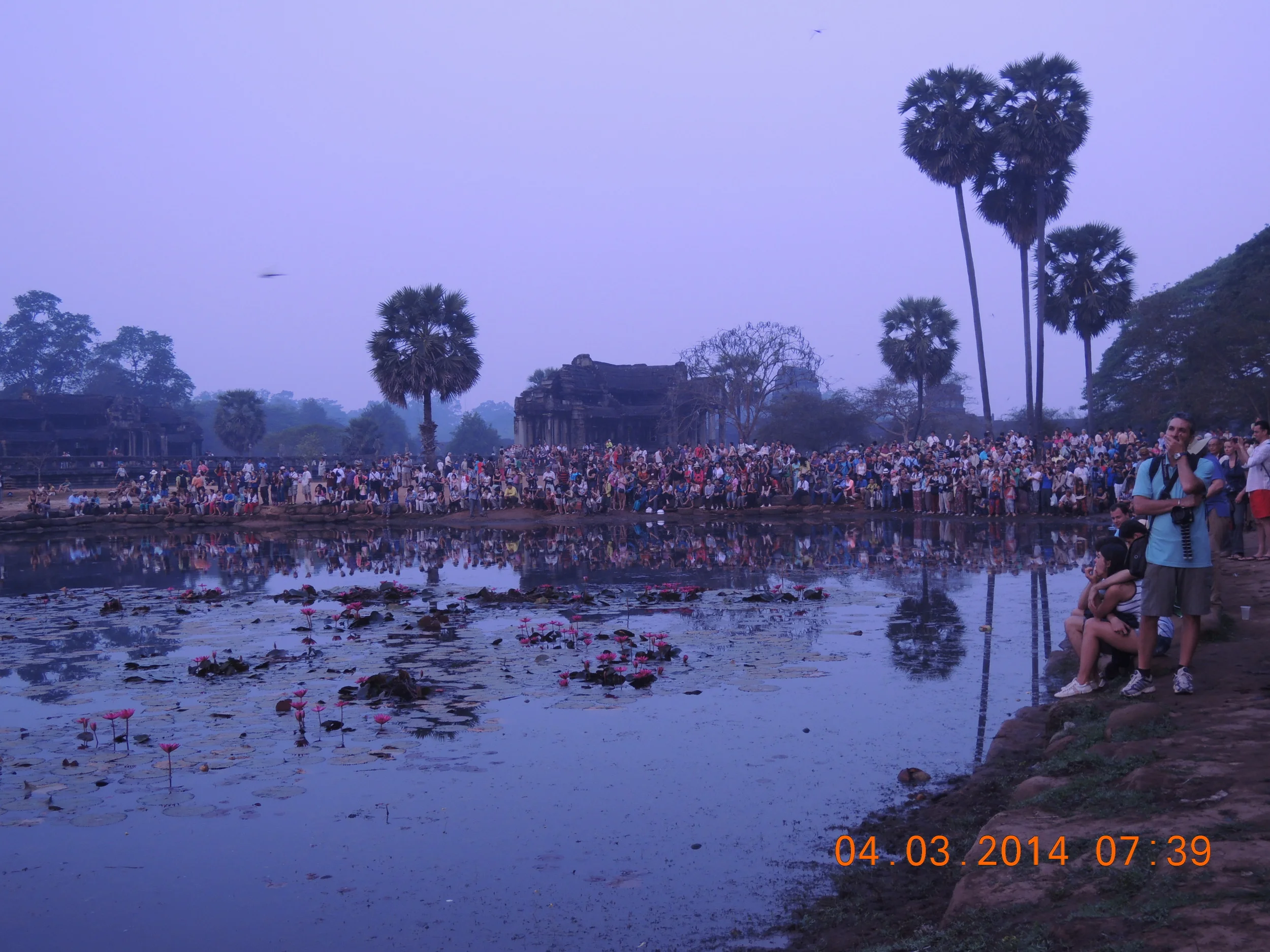
A couple of years ago some witless person decided to check out one of the temples, Angkor Wat, at sunrise.  Apparently the pink orb peeping from behind the rugged ruin was so stunning that he felt compelled to take a picture. This is how stupid traditions are born.  (I’ll never forget the all-night trek to the top of Mt. Sinai—what hell that was!)  So, because it’s expected of tourists, David and I get up and out at five a.m. and go to Angkor Wat in the dark with fifteen hundred other people.  We stand for over an hour with the people behind us coughing and sneezing on our shoulders, cameras snapping all around.  It’s a hazy morning and the sun never shows.  The sky simply goes from dark gray to light gray.  And we all go our separate ways.  Later we go to the Old Market which is smelly with fish and dead chickens and unfamiliar fruits and vegetables.  Flies buzz and small dark people mill and call out.  Further in, past the piles of shiny satin pillow covers and rows of elephant pants, we come upon a booth that sells silk.  Stored in a glass-fronted cabinet, the stacks of colorful fabric are ten feet tall and span the entire back wall of the booth.  Ten dollars a meter!  I don’t know about the Buddhists’ nirvana, but I’ve sure reached mine.  Silk is thirty-five dollars a meter in Singapore.  I buy two meters each of black, green, gray, and pale yellow.  It’s time to go home.

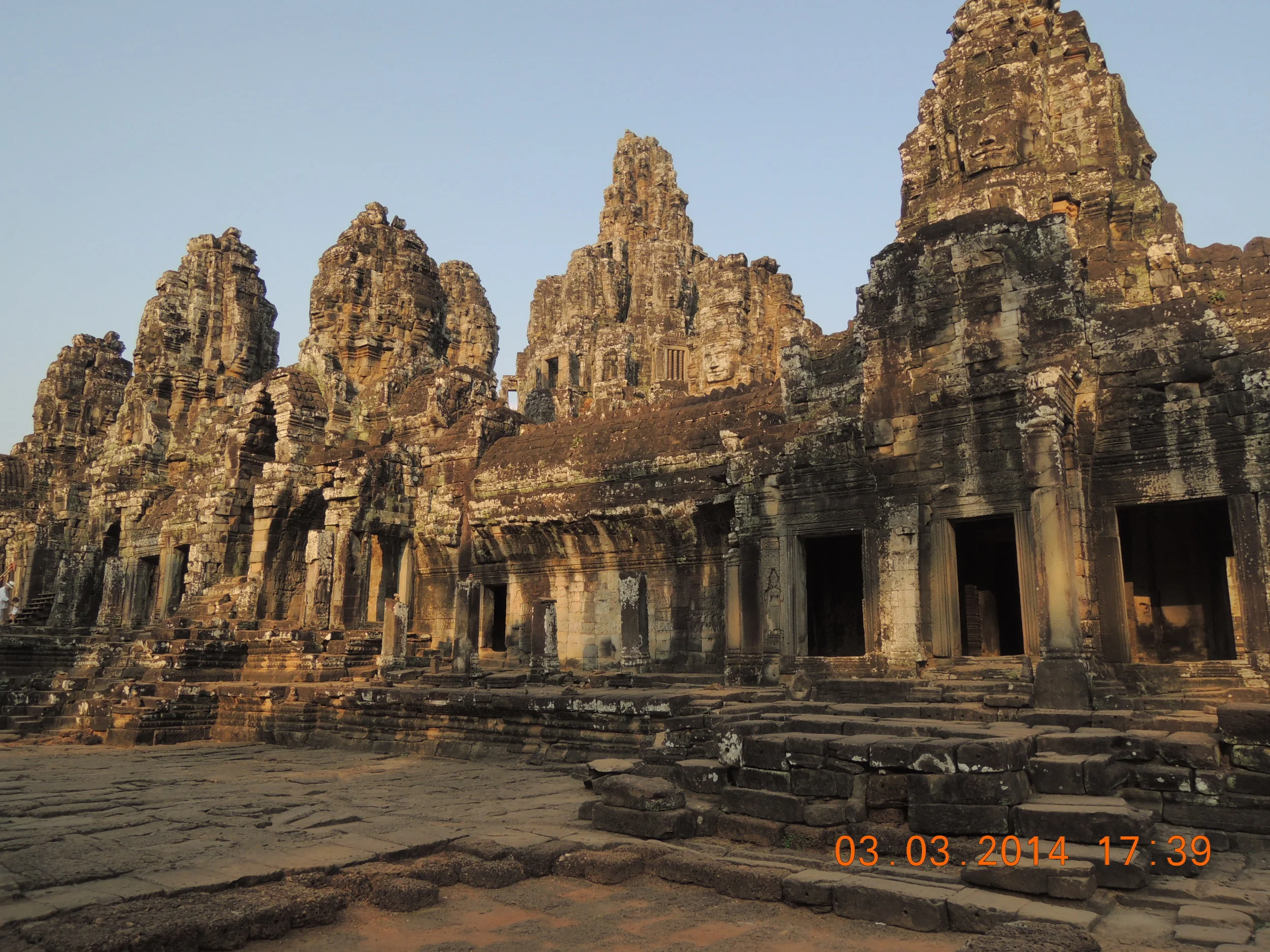
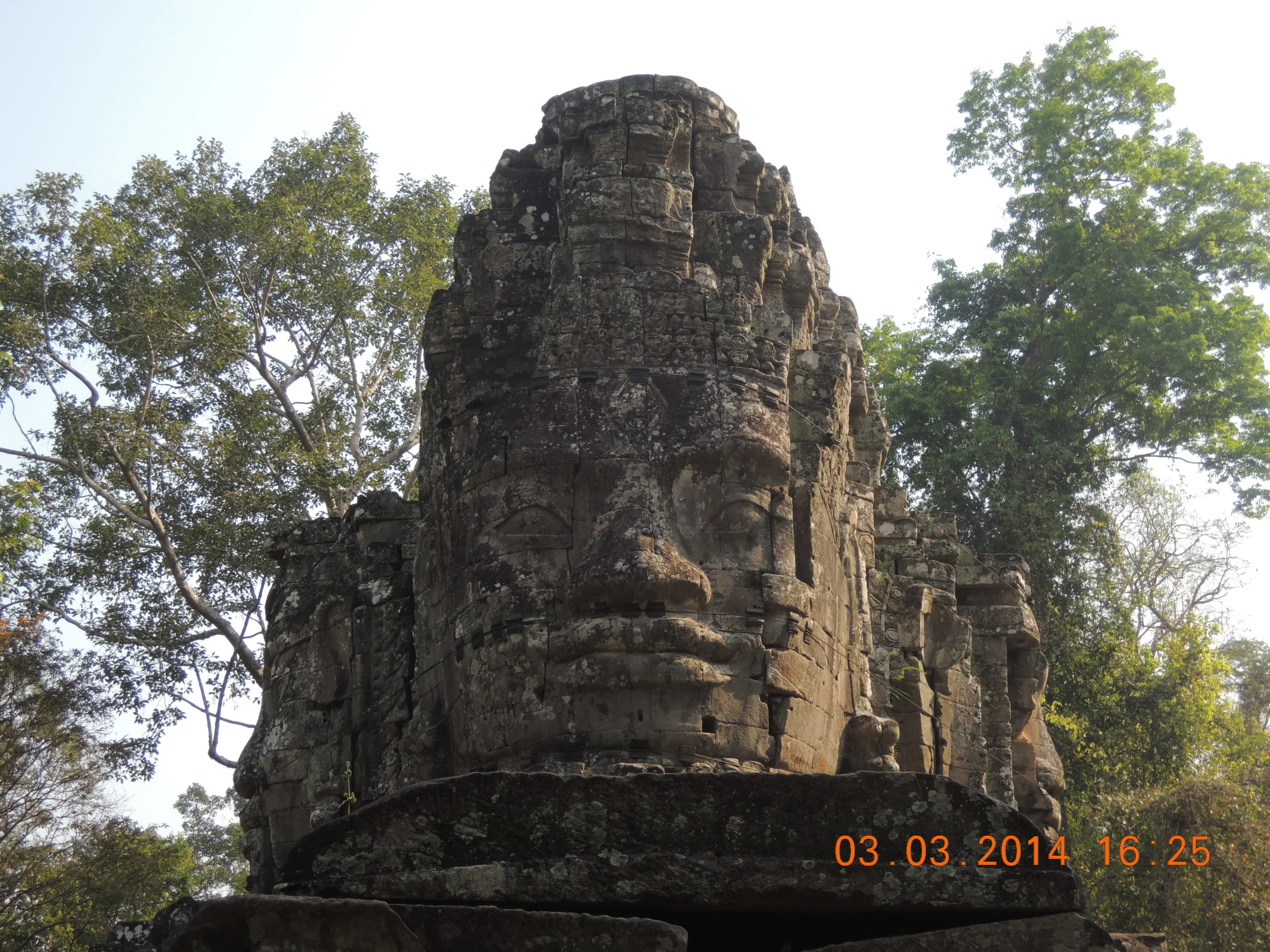
Angkor Bayon

Angkor Bayon

Angkor Wat, the dawn that wasn't.

Angkor Wat, the dawn that wasn't.

The crowd waiting for the sunrise that never happened.

The crowd waiting for the sunrise that never happened.

Kheleur explains while I gaze.

Kheleur explains while I gaze.

Buddahs pop up everywhere in the Angkor Zone.

Buddahs pop up everywhere in the Angkor Zone.

The Old Market is a busy smelly place.

The Old Market is a busy smelly place.

David having a gin and tonic at the end of our day in the Cambodian countryside.

David having a gin and tonic at the end of our day in the Cambodian countryside.

The Official Language

The official language of Singapore is English.  It’s surprising how many people don’t know that.  The signs and notices are English.  Government forms are in English.  Newspapers are in English. 

Because there are so many cultures, most Singaporeans speak two languages—the tongue of their heritage and English.  Because their English is heavily accented, I often ask the Singaporeans to speak slower and louder, explaining that I have difficulty hearing.  I thought this was a clever and tactful solution to a touchy problem until I was discussing the issue with a woman at last month’s readers’ group (The book was Wives and Daughters.  If ever you come across it, run!  Save yourself!) and one of the other women said she did the same thing.  So now we’ve got the Singaporeans thinking Americans have weak ears. 

When I first moved here the English-speaking ex-pats jokingly referred to Singaporean English as “Singlish”—a little too openly, as it turned out, because what seems humorous or charming to one group seems condescending and mean-spirited to another.  So these days, to say someone speaks Singlish is politically incorrect.  Also, the term Singlish implies that the local language is a mixture of English and Singaporean, but there simply isn’t such a thing.  And just because the accent is difficult to understand doesn’t mean the Singaporeans are speaking any language other than English.  The Singaporeans are well-educated with as sizeable a vocabulary and as sharp a grasp of grammar as people from any other English-speaking country.  I can be standing right next to two people who are talking to one another—and I’ll wonder, what language are they speaking?  And then a word will fly past—toaster, car, shops—and I’ll realize they’re speaking English. 

That’s not to say there aren’t a lot of other languages around.  The imported workers are from Indonesia, Malaysia, The Philippines, Bangladesh, Pakistan—oh, and so many others.  And these people speak whatever language they’ve brought with them; plus, in order to come here, they’re required to speak English.  Today I was walking up the hill from Orchard Road (David calls this the Hill of Death.  He’s made up a merry song about it.) when I passed two people who were speaking to one another in their own language.  As soon as they noticed my approach, they switched to English.  This has happened too many times for it to be a coincidence.  Often when I’m on the bus or in the checkout line at the grocery store, people will change from their language to mine without so much as a break in their flow of words.  This is a thoughtful gesture which allows me to listen in on the conversations of strangers, and I appreciate it.     

The sign on the construction across the street. 

The sign on the construction across the street. 

This is Oathman.  He understands what I say, but I hardly ever understand what he says.  

This is Oathman.  He understands what I say, but I hardly ever understand what he says.