Chinatown

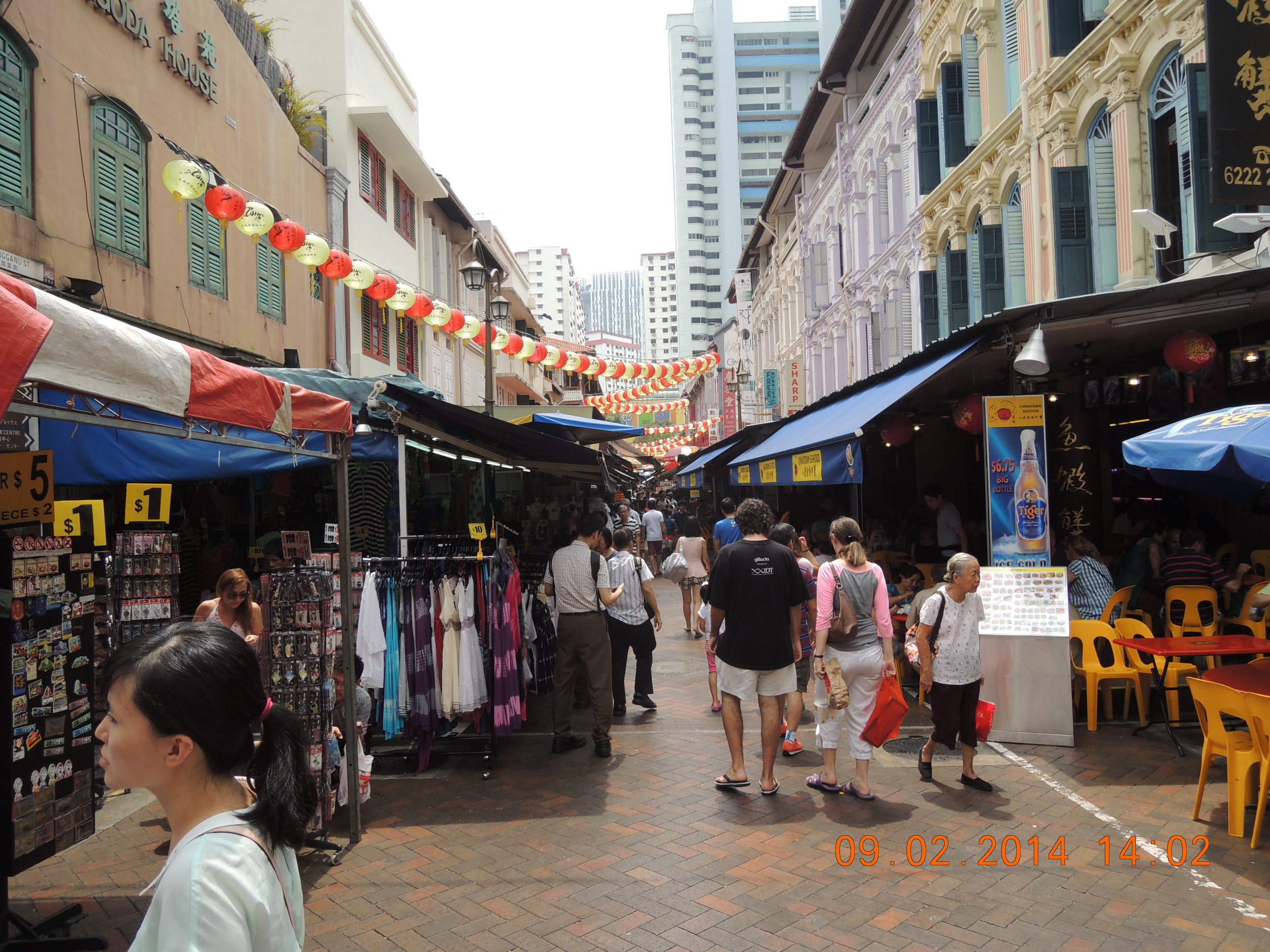
My favorite place to go in Singapore is Chinatown.  It’s a short walk, a short bus ride, then a short metro trip from my home.  Though some hours of the day are less crowded than others, even the quiet times are hopping in Chinatown.  It’s a great place to people-watch.  Tourists are always fun with their bewildered expressions and cameras cradled in their hands.  When a cruise ship is in town the people in its tour group wear matching stickers on their shirts.  Sometimes a school group will come through.  A field trip to Chinatown—how fun!  The kids wear backpacks and stumble over their long feet.  The vendors tend to be cynical—why should the woman sell me the fake antique teapot for ten dollars when someone’ll come along shortly who’ll pay the twenty-five she’s asking, though she and I both know she didn’t pay three bucks for it.  In Chinatown it’s all about profit. 

Chinatown has everything a Chinese person could need—and I find it fascinating to see what other cultures regard as necessity.  There’s a hawker center for an inexpensive meal, but be careful what you order because if you ask for pork you may get tripe, and fish stew could mean fish eyes floating in your bowl.  Also, there’s a wet market for fresh produce and meat.  The produce is often unfamiliar, but the woman behind the counter is happy to tell you what it is and how to prepare it.  The reason it’s called a wet market is because animals are slaughtered here, and fish are cleaned here, and at the end of the day the vendors hose the place down, washing the whole gooey mess down the drain in the center of the floor. 

Out on the streets what look like stalls turn out to be deep shops.  Red paper lanterns bop the taller customers on their heads as they pass beneath and between awnings.  Clothes stores offer inexpensive lightweight shirts and skirts from India, Thailand, Viet Nam, and China.  Tea shops are stacked from floor to ceiling and back to front with yellow, red, and green canisters.   Apothecaries sell Chinese remedies like Tiger Balm, Ma Huang Tang (cure for a wind cold), and white flower oil.  Handbags, jewelry, calligraphy brushes, Mahjong sets, pashminas, chopsticks, wooden combs—all are on display, along with more cheap souvenirs than a sane person would ever want.    

My favorite area is the fabric market.  Walk past the man who repairs shoes on the curb, beyond the juice stand, and up the escalator that never works.  Up here are two low-ceilinged hallways lined with shops that are stuffed with rolls of richly colored fabric.  Chest-high bolts fall from the shops, leaning on each other, and blocking the walkway.  A couple of shops specialize only in men’s shirt fabric.  Several hold only material for women’s formal wear—transparent or heavy silk, and lace.  The proprietors who sell cotton know me and I know them.  When they see me coming they rush out, calling me “Madam, come see our new, come see our new.”  They point out their latest goods, which are always Japanese and more expensive than any of the other cotton.  Though all the stalls have the same fabric because it all comes from the same places and it was all brought in on the same boat, I always spread the money around, carefully buying a meter from this one, a meter from that one, a meter from another one.  They all know when I’m starting a new quilt.

Welcome, Year of the Horse.  And horses are everywhere in Chinatown.  
Welcome, Year of the Horse.  And horses are everywhere in Chinatown.  

Doesn't this look like fun?  

Doesn't this look like fun?  

Here's a quilt I made from fabric I bought in Chinatown.  

Here's a quilt I made from fabric I bought in Chinatown.  

Live-ins

Off our kitchen is an open-air utility room.  On the right side of this room is a back door, the live-in’s entrance.  Opposite this door, left of the kitchen, is a tiny room that’s intended to house a live-in.  The live-in is usually a domestic helper, although one of the families in the building has a live-in male driver and also a live-in helper—and two children as well, so I’m curious how four adults and two kids share the same amount of space that sometimes makes David and me feel crowded.  How they manage in such close quarters is absolutely none of my business—but really, who wouldn’t want to know?

The live-in’s room is large enough for a single cot.  Beyond the room is a cramped bathroom with an undersized sink mounted in the corner, a toilet that’s half the size of the others in the flat, and a plastic nozzle hooked to the wall at waist-height—not a proper shower at all.  We use this bedroom and bathroom for storage.  I’ve never considered having a live-in because I prefer only the people who love me to have a close-up of my imperfections.  I drink too much, eat too much, play too much spider solitaire—why would I want an outsider watching me?  I’m not the only one who feels this way.  I have a friend who, when she’s going to play bridge, tells her helper that she’s going to a charity meeting.  “I want her to think I’m doing important things,” my friend says.  “I don’t want her to know I’m spending the entire afternoon playing a game.” 

Rumors about the live-ins abound in the ex-pat community.  The most common is how the ex-pat wife takes the kids back home for the summer, leaving her husband in the care of the domestic helper; and during the wife’s absence, the helper makes a move on the husband.  This is an oft-repeated story, intended as a warning among friends—and though I’ve met people who know people who know someone it’s happened to, I have yet to actually meet anyone whose marriage has been endangered in this way. 

Another tale that’s been making the rounds ever since I got here is the one about the vindictive cleaner.  In Singapore a live-in must have a sponsor—someone who provides a home and regular employment.  The live-in must not work for anyone but this sponsor and, likewise, it’s against the rules to hire someone whom you’re not sponsoring, which leads to the scary story of how, when an under-the-table cleaner was let go because the woman she was working for on a part-time basis found someone cheaper, the one who’d been let go turned her ex-employer in to the authorities—and no one wants to get on the wrong side of the Ministry of Manpower.  I’ve heard this account from four difference sources.  How much retelling is required before a story becomes urban legend? 

Another story that flows from mouth-to-ear and mouth-to-ear is the one about the live-in who’d been working here for five years, sending money back to the Philippines to support her husband and children.  When she went home for a visit, she discovered that her husband had dumped the kids with her parents and taken a mistress.  A sizeable portion of the live-in’s earnings had gone to support the mistress.  This story has a different slant in that the victim is the Filipina.  As far as I can see, there’s no reason why this teapot drama is so popular among the ex-pat women, except that they seem to find malicious satisfaction in telling it, which I find puzzling. 

Live-ins are a colorful and ubiquitous entity.  They’re in front and behind me in the grocery store line.  They’re up and down the street constantly, walking the dogs.  They take toddlers to the pre-school at the bottom of the hill and fetch them home again three hours later.  Some smile and some are surly.  Some like the people they work for and some don’t.  They all have people back home that they miss.  And they all need the money they earn working far from their families. 

This is Mary, the live-in from the seventeenth floor.  

This is Mary, the live-in from the seventeenth floor.  

This is the space that's intended for the live-in.

This is the space that's intended for the live-in.

Carrying the groceries up the hill from the grocery store.  

Carrying the groceries up the hill from the grocery store.  

On Sundays the domestic helpers meet their friends on Orchard Road.

On Sundays the domestic helpers meet their friends on Orchard Road.

This picture of me playing with Trip has nothing to do with the posting--but I thought it was funny that I'm squatting like the wiry street workers do when they're on break.  Can you squat like this?  

This picture of me playing with Trip has nothing to do with the posting--but I thought it was funny that I'm squatting like the wiry street workers do when they're on break.  Can you squat like this?  

Mahjong in the Afternoon


I don’t care for games.  Board games, card games, word games, games that involve chasing or seeking—I don’t like any of them.  I tend to avoid competition in all its forms, probably due to a lack of self-confidence or a fear of failure, or some other unattractive flaw in my flaw-riddled psyche. 

So, if I don’t like games, why do I like Mahjong? 

Mahjong is a tile game involving skill, strategy, and luck.  A take-and-discard game, the point is to match the tiles on your rack to a specified grouping—a clear objective that, for some reason, makes me eager to hop out of bed on game days. 

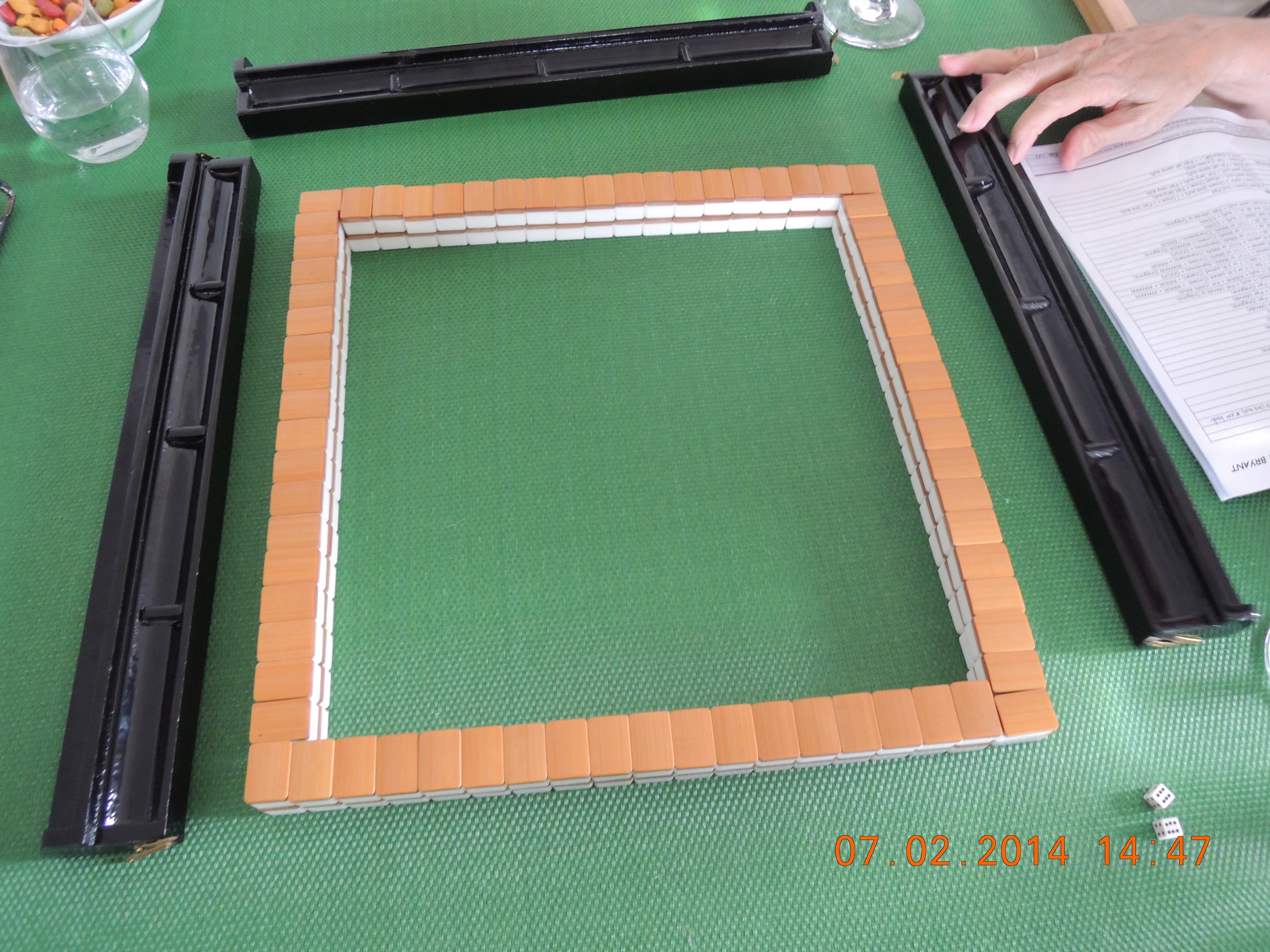
Each game offers me a variety of challenges—discerning and pursuing the most likely hand, estimating my chances of getting a necessary tile, the flexibility to change direction once the hand I already committed to is out of play.  There are elaborate procedures for setting up, dealing, and winning.  For example, before we can actually commence, four walls from which to draw the tiles must be built.  The sides of my wall must match the end of my left neighbor’s wall on the outside, while abutting my neighbor-to-the-right’s wall on the inside, which forms a perfect square.  This tight construction is important because, traditionally, the closed wall keeps the evil spirits out.  I’ve known sticklers who wouldn’t distribute the tiles if there was a gap at a corner.  In play, the rules are complex, the action is strict and orderly, and expletives form word clouds above the table.  When I’m one away from Mahjong, I must announce this by saying the word “fishing”—and while it makes sense to warn the others that I’m fixing to tromp all over the hands they’ve come to love, the word itself feels jarring to me, incongruent with the other evocative designations of the game, like Guardian Dragons, Unique Wonder, and Confused Gates.

I sink intensely into every round, bonding with my tiles, absorbing the targeted combination into my soul like it’s the key to happiness.  I thrill each time I add a tile that’ll get me closer.  Ordinarily a passive person with an encouraging mien, when I play Majhong, I grow impatient, bossy, and vengeful.  I’ve been known to hold a weeks-long grudge against someone for holding on to a tile I needed.  If I lose I’m in a bad mood for several days.  If I win I’m giddy. 

And none of this explains why I enjoy Mahjong.  It’s fun, that’s why.  Learn to play it and you’ll see.  

 This is our starting square.  


This is our starting square.  

Etta, Janine, and Judith, yesterday afternoon.  The winning hand, displayed, is mine.  

Etta, Janine, and Judith, yesterday afternoon.  The winning hand, displayed, is mine.  

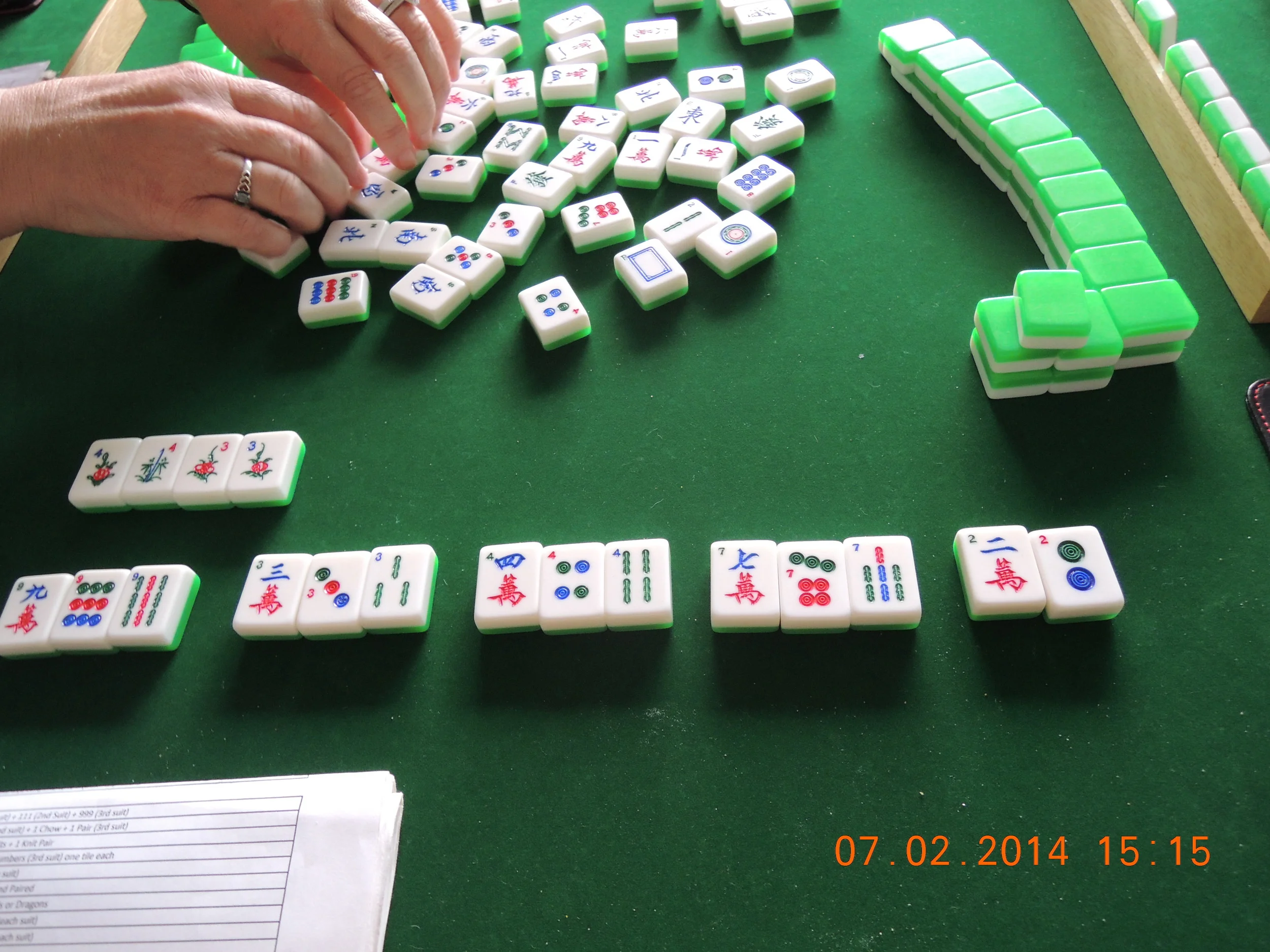
Jane's winning hand, Triple Knitting

Jane's winning hand, Triple Knitting

Isa, Jane, Linda, and Helen--Thanks, Jane, for hosting

Isa, Jane, Linda, and Helen--Thanks, Jane, for hosting

Walking in Singapore

Here are some cultural generalizations that are irrefutable:  Egyptians are good-hearted and hard-working.  The English have a resentful way of looking at things.  Kuwaitis are stingy to the point of dishonesty.  Germans go crazy when they’re on holiday.  And the Singaporeans are unable to walk in a straight line. 

No matter what social strata, everybody here walks.  Well, except for the rich and the really rich, who employ drivers.  The public transit system is good at moving the populace from one place to another, but most people don’t live near a bus stop, and they don’t work across from the MRT.  So quite a bit of walking is involved. 

I walk a lot.  I don’t amble and I don’t stroll.  I lack the patience.  A quick-paced stride is the way I get from here to there and back again.  But, as there are a lot of other people in Singapore who also walk, the crowd dictates the pace and progress is often more wish than reality.  Which is why it makes no sense that people wander sideways instead of going straight.  For instance, I’m walking.  The woman next to me is also walking.  We’re heading in the same direction.  And before I know it, she’s sliding over, pressing into my space, placing her ankle across mine; then she's directly in front of me and she slows, inviting me to crash into her back.  Which I have done on occasion. 

Also, there’s the difficult act of passing.  Imagine a lull in foot traffic.  The sidewalk is medium-width, certainly broad enough for two people to walk side-by-side without brushing; and no one else is on it except for me and one other person, a man, who’s in front of me—and the man is moving slower than I am, and I’d like to get by, get ahead, get there already.  When my decision to pass is made, the guy is to the left, so I angle to pass on the right.  But as soon as I aim myself in that direction, he also shuffles right.  The same thing’ll happen again when I make an attempt at the left flank. 

Scoff, you might.  But I’m telling the full truth about this.  This happens every time I go a-walking.  Every time.  The Singaporeans don’t walk straight.  One of the world’s mysteries.