Backyard Thug

Seven o’clock a.m. For the last couple of hours I’ve been working on my current project, Clarence’s Wheelbarrow. It’s my habit to leave myself something to ponder and a vague plan about what I’ll write tomorrow. Today the prompts I’ve left on the screen are Where is Caroline Rush? and Does Grace really drink too much?

That’s enough to get me started. Hopefully by tomorrow morning I’ll know where Caroline is. Not sure what to do about Grace’s drinking though. The people who know her best tell her she drinks too much but, stubbornly oblivious, she thinks she drinks just the right amount. 

Pushing back from the desk, I go into the kitchen and put my empty water glass in the sink. Then I shuffle to the back window to look outside because it’s always best to let the sunrise give you an idea of what the day will hold.

There’s an animal grazing beneath the birdfeeder. Because it’s that time of day when everything is shadowy and gray, my vision isn’t clear. It’s one of the woodland creatures that are of a certain size. Here’s what it could be: skunk, raccoon, rabbit, armadillo, badger, possum, or feral cat. Here’s what lives in this area that it’s definitely not: bird, coyote, deer, fox, snake, feral hog. 

I go into the bedroom where David’s just kicking back the covers.

“There’s an animal in the backyard,” I tell him, “and I can’t tell what it is.”

Pulling on a sweatshirt, he follows me out to the living room. Because our house is still torn up from the Shower Disaster of 2019, we must make our way around a dresser, a chest, and a couple of tables. In the murky light we bump into things. 

And at the window we stand, squinting. 

“I don’t know what it is,” he says. “Let Dilly out.”

He says it to get a rise. He knows I’d never purposely let my delicate magnolia blossom confront a beast of nature. 

“I’m going out,” I say, fearful yet brave.

“Don’t let it get you.”

I step out on to the porch, drawing the animal’s attention so that it turns and shows me its face, which is almost elegant. A long snout, markings around its eyes that run up and down enhancing the elongated snout; and an exaggerated widow’s peak that adds to the overall vertical appearance. 

“Too bad about your goofy ears and pink nose,” I tell it. “They’re ridiculous.”

I go back inside. 

“Possum.”

“You didn’t scare it away. It’s still out there.”

 “It’s mangy and its tail is hideous.”

Mange is a pestilence I’ve had experience with. There were mangy foxes in England and our then dog, Charlie, got it just from hanging out in the yard. He lost almost all of his hair and was tragically humiliated. 

Now I have that to worry about. 

I also worry about Grace’s drinking. She’s too young to be drinking so much and so regularly. In her early thirties her favorite thing to do is drink wine while watching her favorite shows on television. She recently resigned from teaching so she no longer has that social outlet. And now, isolated, she spends her days looking forward to her first gulp of Malbec. She’s been depressed and experiencing panic attacks so her few friends think she’s self-medicating; and I agree. 

How am I going to find humor in a young woman sinking into the abyss of alcoholism? How could this possibly be funny? For the amusement factor I look to her neighbors, an absurd chorus of elderly do-gooders who are determined to see Grace through.  

As her creator the problem I’ve run into is that I must be true to her character. She loves her wine so why would she give it up? Yet giving it up is a must if this story is going to end on a hopeful note. 

So I’ve decided to give her something she wants more than wine. Also there must be some sort of wakeup call, a fright of some sort. 

But what will she love more than her TV and her drink? And what traumatic event must take place in order for her to realize that she needs to make a change?

This is what I ponder as I glare at the stupid possum who has laid claim to our backyard. He’s out there every time Dilly needs to go out. I have to chase him off just so she can pee and believe me, this backyard thug doesn’t move fast. How do I get it to go away? 

Too bad the foxes left. A couple of years ago they were plentiful. I can still remember the heartrending scream at dusk when a fox got the last rabbit. At that point, because the food supply was gone, the foxes moved on. At least the rabbits were cute. Homely and waddling, this beast has an inexplicable sense of entitlement. It thinks it owns Dilly’s backyard. 

I am very mad at it. 

How do I make it go away?

How do I make it go away?

Travertine 2019

Because we’re having old carpet pulled up and tile installed, we decide to take a little holiday, Monday through Friday, and leave the guys to it. We hear it will be a dusty venture. We’re not familiar with the Corpus Christi/Port Aransas area so we decide to spend a few days there. We hear that the Padre Island beaches are nice. 

Don, the contractor is claiming that the work will be done by Friday, but David and I have doubts. It’s a large area to cover—four bedrooms, three bathrooms, a large den, and the kitchen. We get away noonish and the trip is uneventful, three and a half hours on mostly good road, though San Antonio’s highways are a disgrace. We’re staying in Corpus Christi, at The Residence Inn, a Marriot offshoot, which proves to be nicer than we expect, with two desks, two comfortable bedrooms with bathrooms, three TV’s, and a kitchen/dining area. 

On Monday evening we take a walk along the water, have dinner at Landry’s, then turn in early. On Tuesday morning we look forward to going for a walk along the beach out on the island. But as we’re preparing to leave David gets a call. He goes still and I can tell by his dreadful calmness that something bad has happened. 

“That’s the last thing I wanted to hear,” he replies to whatever’s been said. 

Once again he goes silent, leaving me curious and trepidacious. 

“What’s the next step?” he asks. 

More of the caller talking while David holds the phone to his ear. At last, obviously troubled, he gives a good-bye and ends the call.

“Who was it? What’s wrong?”

“The tear-out exposed a water leak in the shower of the master,” he tells me. 

I replay the grandiose phrase in my head. The Shower of the Master. My imagination interrupts my anxiety. What does the Master’s shower look like? Is it bedecked in gemstones and gold? What has the Master done to deserve this magnificent shower? Does his possession of this shower create resentment amongst the staff that must keep it free from mildew and lime deposits? 

I return to reality. This is terrible. But Don assured David that, though his crew can’t do any further work in the master until the leak is fixed, they will do the other rooms and return after the shower has been deconstructed and rebuilt.

We drive to Port Aransas through the thickest fog either one of us has ever seen. Visibility is no more than a hundred feet. The island town is still rebuilding from Hurricane Harvey. Crumbling walls and rotting roofs stand shoulder-to-shoulder with the pristine new-builds. 

The beach is as great as we’ve been led to believe. Broad and flat with firm sand. Very clean. I never thought I’d see a beach comparable to the beaches of Goa, but the beach outside of Port Aransas is that nice. Also, much easier to get to. 

David’s on the phone for the whole walk. He calls a friend of his who knows a contractor and then he calls the contractor. He calls a neighbor and asks him please to stop by the house, take a look, and let us know if it’s really as serious as Don says it is. He gets a call from Don telling us that it’s worse than he originally thought. They think the pan is compromised. The water’s been standing for a long time. There will be mold. Poor David is hardly getting to enjoy the beach.

While he’s handling the situation I watch people play with their dogs and I wave to men who take their fishing seriously; and I judge the dozing geezers in their lounge chairs whose bare abdomens rise high like round mountains. 

Our plan is to stay in Corpus for a couple of days, then spend a night in a hotel along the River Walk in San Antonio, where we’ll drink bloody marys and wonder about the people who stroll by; and after that, a night at a multi-starred B&B in Fredericksburg. Home on Friday. But the next morning the report we receive from Don is even more dire than yesterday’s. The wall and floor of the bedroom that abuts the shower has also sustained damage.

Together we sigh a sad sigh. 

“We’re going to have to go home and see for ourselves.”

“Our house, our responsibility.”

“What was supposed to take a week is going to take two months.”

“It’s going to cost at least twenty thousand.”

“If we hadn’t decided to retile we never would have known.”

We turn into the neighborhood at around two. Trucks line our driveway. The interior of our home is a construction site. Floors are torn up. Dust coats everything. Pieces of furniture have been taken from places that make sense and scattered willy-nilly throughout the house. We have a working toilet in one bathroom and a working sink in another. The toilet in the master leans at a precarious angle in the tub. The refrigerator is in the middle of the kitchen and the stove has been moved to the dining room, along with a mattress, a chest, three office chairs, a desk, and tons of other stuff. Our formal living area, which ordinarily holds a couch, a chair, and a central table now holds sixteen pieces of furniture, all crammed together and I can’t get to any of them. 

We’re advised not to take any action toward repair until we talk to our insurance agent, who ignores our calls for two days. When we finally hear from him he tells us he can’t get out here for five days. We can’t get started on the work until he does his assessment. Also, it’ll take time to find a contractor. What we thought would be a two-month ordeal is going to turn into a three-month ordeal. 

I don’t do well in chaos.

MacDaddy’s, tasty food for lunch in Port Aransas.

MacDaddy’s, tasty food for lunch in Port Aransas.

The bar draped in plastic. Can you tell how dusty it is? That much dust is everywhere.

The bar draped in plastic. Can you tell how dusty it is? That much dust is everywhere.

The dining room.

The dining room.

The front room.

The front room.

An Afternoon in Coppell

You do what you have to do to get where you want to be.

I start the three and a half hour drive to Coppell at eight-thirty. I don’t need to be there until one-fifteen or so, but delays can happen on the road and after going to the trouble to write and practice this speech, I don’t want to let Adrienne, the organizer of this event, or myself, down.

I’m on my way to read a few chapters from both my books and then to share my experience of taking a book from the first sentence to publication. Apparently hearing authors read their own work is a treat for the readers, though I’ve never been happy with the way I talk so fast or my silly accent. It’s surreal that there are people fond enough of my books to want to hear me read from them.

On my mind as I cover the miles is the novelty of my own ambition. For a quarter of a century I told David that my dream was for someone to like one of my books well enough to publish it. Just one. In my fantasy I was humble. And how embarrassing it was to tell people I was a writer but I had no publisher to stand behind my work. 

And now two novels have been published and it’s not enough. I want an entire library shelf loaded with books that bear my name. How bizarre it is that at sixty-one I’ve become consumed by aspiration. I’m just beginning when others are winding down. I’ve completed three installments of my mystery series and I want someone to love it as much as I do. 

Meet my main character:

I’m Fran Furlow and I work in a dermatologist’s office. Thankfully I have no part in handling the oozing sores and flakey moles that walk through the door. That’s for Dr. Hamm and his nurse, Hazel, to do. I’m the receptionist, a job that carries very little responsibility and leaves me free to attend my support groups and take care of my friends. 

Don’t you love her already? She’s out in the world now, getting looked over by others who will make decisions about what happens to her. And the reason I’m obsessing over her is because when I get to the end of this drive I’m expected to stand in front of many people and give a talk. And I don’t want to think about that. Nevertheless—

I use my family for inspiration. Curtis deposes witnesses and argues in court. Sam lectures at universities, sits on panels, and interacts with Chinese people on Chinese TV in what is evidently fluent Mandarin. Where did this self-assurance come from? And David, also, was always giving technical presentations to strangers. 

Aloud, I tell myself, “If the boys I raised and the man I’m married to can do it, so can I.”

I’m met at the Cozby Library in Coppell by Adrienne, Frank, and Steve, who represent the Friends of the Library. They’ve all read Old Buildings in North Texas, the book I’m here to publicize. (Honestly, I feel like I’ve been publicizing it forever. This is what happens when books get released twice—once in the UK and now in the states. Why Stuff Matters will be out here in June and then it’ll be another round of here we go again.)

The three of them tell me how much they enjoyed the book, which makes me grateful that they gave it a chance. People telling me that they like my books is a huge thrill. On the other hand, I’m a quiet person, not used to being the center of attention. As their guest author, I must temporarily put aside my reticent ways. 

I’m introduced to the audience, about thirty people, a respectable number. As OBiNT was discussed at their library’s book group this month, most are familiar with it. 

The reading goes well, with laughter in the appropriate places and only a few tongue stumbles. The prepared talk—well, I get through it. I make plenty of eye contact and have interesting stories to tell. And what is unusual is that as I’m speaking my mind divides into two halves; and one of these halves is really nervous and the other says slow down, stay calm, you’re doing fine. I believe this is the first time I’ve ever experienced this two-headed phenomenon. Thank you, the nervous half of my brain says to the encouraging half. 

The Q & A is the fun part because the book is funny, so the audience assumes that I am also funny, which I am. One woman asks me to expound on the experience of working with an editor and another gives me kudos for leading her to enjoy a self-centered and devious protagonist. The pleasure these people found in the novel is one big stroke for my ego. 

Never in a million years did I see myself doing what I’m doing right now. I have another one of these talk-and-reads in April and I think it will be easier and I’ll do better. Like I said, you do what you have to do to get where you want to be.

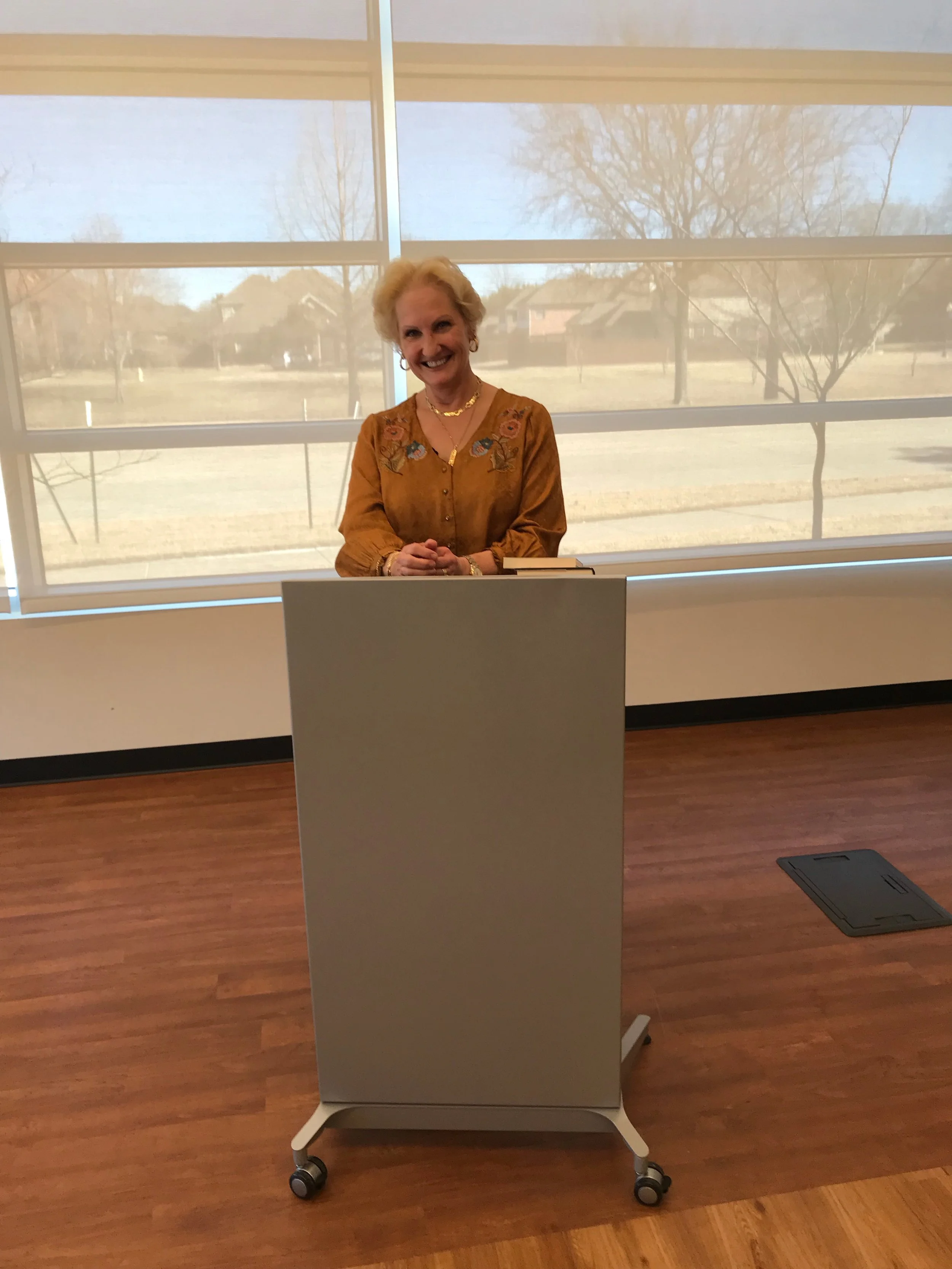
How professional I look!

How professional I look!

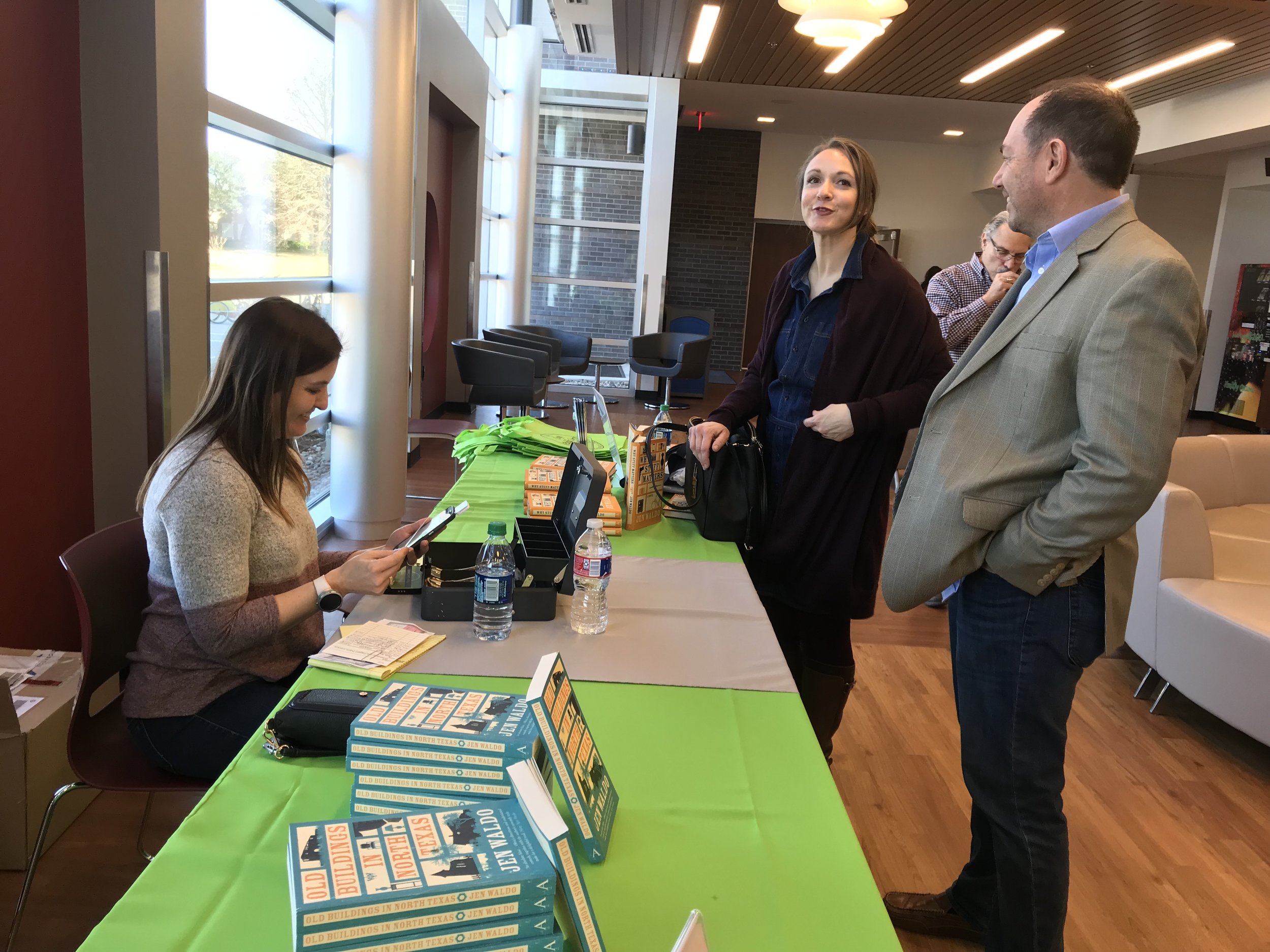
The Friends of the Library set up my books and sold quite a few. The woman standing up is Adrienne. I’m grateful that she organized this event to help publicize my novels. I was at a table over in the corner signing the purchased copies.

The Friends of the Library set up my books and sold quite a few. The woman standing up is Adrienne. I’m grateful that she organized this event to help publicize my novels. I was at a table over in the corner signing the purchased copies.

Coppell was a lovely suburb north of Dallas. Their library is a lovely facility. It’s shameful that it’s been several years since I’ve been in a library. Usually I order and download from Amazon.

Coppell was a lovely suburb north of Dallas. Their library is a lovely facility. It’s shameful that it’s been several years since I’ve been in a library. Usually I order and download from Amazon.

Paul Waldo 1958-2018

Husband, father, brother, friend. 

Everyone’s favorite.

Died of a heart attack on Sunday morning. Sixty years old. Unexpected and devastating.  

The first characteristic that comes to mind when I consider Paul is that he was charming; in a good way, not a calculating way. Everyday he told his wife, Betty, that he loved her and that she was beautiful and desirable. It sounds corny, but he made it work. 

Also, he was mannerly towards women. He held doors and watched his language, gestures that might be considered old-fashioned, but I always appreciated them. If he saw me carrying something, even if it was a little thing like a cake or a shopping bag, he’d rush forward with a “Here Jenny, let me get that.”

He had an uncanny knack for discerning and complimenting the one thing that a person valued most or had put the most effort into. Once when he, David, and I were grabbing Chinese in Houston, he gazed thoughtfully at me across the table and told me that he’d never seen teeth as perfect as mine. Another time when I was wearing one of my favorite sweaters, he told me that the color looked great on me. How was he able to so accurately pinpoint the source of my vanities? And he was this insightful with everyone, not just me. He could meet a person for the first time and immediately perceive what she or he held most dear. 

I’m not sure how accurate it would be to call him the last of the wildcatters, but that’s the way I thought of him. I know he loved his work and, as he was materially successful and so very personable, I’m certain he was highly respected and will be missed by his peers.

Once, at one of our many Waldo gatherings, David complained that people came to business meetings with their minds closed, which led to arguments, shouting matches, and hurt feelings; and Paul offered this advice: 

“I have a trick for when a meeting gets noisy. I cross my arms over my chest, lean away from the discord, and keep my mouth shut until someone asks for my opinion. Then all eyes turn to me. The quiet man wins every time.”

“But that’s manipulation,” I said, indignant because a person should be authentic. 

“If crucial information isn’t being heard because people are acting like baboons, the reasonable response is to create a calm environment where communication can take place.”

So in this way Paul taught me that, though handling people and manipulating people carry essentially the same meaning, they’re not the same thing at all. Being able to handle someone is an admirable gift while manipulating someone implies a selfish or even dishonest agenda. He was indeed a wise man. 

He never made an enemy and he never lost a friend. I never heard him insult anyone. He was never cruel or impatient. He didn’t judge harshly and generously took family members into his home when they were down on their luck. 

He and David talked on the phone at least once a week. He was more than a brother; he was a cherished friend. 

He was one of the best of us and we are heartbroken. 

Rest in Peace Brother Paul

Rest in Peace Brother Paul