Maudlin

Here’s a snippet my father enjoyed telling: When he was around twelve years old his mother invited him to go to a movie with her. 

“It’s one of the greatest movies ever made,” she told him. In fact, she loved it so much that she had already been to see it twice. 

Thinking that a film that earned such high praise and repetitive watching was surely worth seeing, he agreed; and was dismayed when his mother spent the last half of the movie mopping at her tear-soaked face. At this point in the telling he would mop at his face and make sobbing sounds. 

“What was good about it if it made her cry?” he would ask. “And, knowing that it made her cry, why would she choose to see it again and again?”

He gave a snide chuckle, obviously thinking his mother was silly. Apparently he didn’t understand women at all. 

Spoiler alert: Barbara has died.

For those of you who don’t watch BBC’sCall the Midwife,Barbara was the daughter of a vicar, the wife of a vicar, and the encouraging force behind half the births in the East End in the sixties. She was spunky and funny and cute, a charming character who was so sincerely good that I had trouble liking her. 

And yet last night when it became clear that she was a very sick young woman—a diagnosis of meningitis coupled with septicemia—and her handsome husband and all her broken-hearted friends gathered around her hospital bed as she sank into death, I cried like my German grandmother—copiously and with gusto.

I cry through that damn show every week. 

The next day I talk to my friend, Jane, who also follows the show. 

“They killed off Barbara!” I tell her indignantly

“Yes. I think she wanted off the show.”

“Then why didn’t the BBC do what they usually do with these drawn out period dramas—send her to Australia and bring on a new character?”

I often cry over books and movies. I can still remember crying at the end of Bridges of Madison County. Why? It was known to be a soppy novel and I saw the ending coming from the first page. I should have been ready for it, yet it got to me. Those two people so in love, living their lives apart. How tragic.

Having called the book mawkish, I admit to being incapable of writing anything that would make someone cry. I simply couldn’t do it. 

Full disclosure—also, I cried at the end of Toy Story 3. But who wouldn’t? Andy gave Woody away and was going off to college. Just thinking about it makes me feel gooshy and sentimental. 

That I cry over stories, but seldomly over real-life tragedies makes me question my humanity. 

For instance, one of our yoga instructors has recently been diagnosed with terminal brain cancer. So now she’s at home, dying. My friends whisper her names in hushed tones. 

At yoga, when it was announced that this woman would no longer be with us, women started crying. A box of tissues was passed around. 

Impatient, I looked at my watch. This carrying-on ate up twenty minutes of our class. 

How is it that I was prepared for it when no one else was? The woman was quite old. She’d been repeating herself, forgetting words and the names of the positions; and often, when she turned around, she was surprised to see us all standing there, awaiting her instruction. 

And here’s my pragmatic assessment: she will be missed. But I’m more worried about the husband she’ll be leaving behind. The two of them have been married for fifty-seven years. How will he cope? He won’t know how to navigate without her by his side. 

Now that’s something to cry about. 
Because I needed a picture to put here. 

Because I needed a picture to put here. 

Cabo!

Arrived in Cabo San Lucas yesterday afternoon. I froze all day getting here, so the thaw was welcome. We’re staying in a two-bedroom villa at The Westin, which looks toward the ocean. The coastal formations are dramatic and the surf is fierce. David wonders why no one’s in the water, but from what I see, a swimmer runs the risk of getting bashed into the rocks.

It’s difficult to slip into vacation mode when my mind’s focused elsewhere.  

Old Buildings in North Texas is being released this month in the US. This is exciting and intimidating. I was welcomed with enthusiasm in the UK market. The British readers found the main character, Olivia, to be self-aware and self-absorbed, which she definitely is; but they sympathized with her predicament and enjoyed her sense of humor.

It’s an unusual book and if people knew about it I’m sure copies would fly from Amazon to Kindles by the thousands. 

And on this matter, I’m adrift. Arcadia’s in-house publicist’s ideas are good, but they have yet to materialize. My agent said I should contact the independent bookstores in Austin and set up readings. She envisioned a whole scenario where I get a mediator (one of my friends, she said. In my whole life I’ve never had a friend I would impose upon in this way) to glowingly introduce the novel and me. Then I’d read an excerpt, after which the mediator would ask me questions, and then this mediator would invite the audience (How many people? Three? And how did they find out about this reading?) to discuss and ask questions.

If this were an organized event I’d be happy to do it. I’d stand where I was told to stand, do the reading, answer queries about the creative process, and sign the many books (and where do these books come from?) people were standing in line to buy. But it’s beginning to seem that not only am I expected to be the star of the event, I’m expected to organize it and populate it as well. I haven’t got a clue how to go about this.

David just got up. He has trouble getting the coffee maker going. Frustration with cursing. He figures it out. The waves outside are crashing on the beach, one of my favorite sounds. We’re going for a walk later. Then to the steam room. I slept in an awkward position and woke up with a crick in my neck, so I’m hoping the heat will relax the kink.

This afternoon, reading by the pool. What am I reading? A guilty pleasure. I’ll never in a million admit that I read this author.

After OBiNT was published, it was surprising how many friends and strangers worriedly asked about my personal experience with drug addiction.

Here’s one response I gave:

“I haven’t ever been addicted, but I sympathize because I form habits, which hound me to the point of obsession. Back when I smoked cigarettes I’d check my purse for my pack at least five times before allowing myself to walk out the door. And these days, I don’t feel comfortable unless the wine rack is full.” 

To a good friend who should know better, another response:

“Do you think I’m incapable of imagining drug addiction without actually having gone through it? I’m a fiction writer. Writing about things I know nothing about is what I do!”

My experience with drugs is limited to smoking pot in high school and college. Surprisingly, considering that it was illegal then as it still is in Texas, the thought of getting caught was not a deterrent. In every other aspect I was the consummate goodie-goodie; but, when it came to marijuana, in a decision contrary to my values, I chose to ignore the law because it was stupid. And now, as its legitimacy spreads from state to state, my heart hurts for people who were born too early. Lives were ruined because of pot.

Oh. I see that Curtis, my oldest, has sent me an article listing five cool bookstores in Austin. Two look suitable for a reading. The others—one presents itself as a trendy new-style bookstore, but it’s really an old-fashioned book mobile; another is dedicated exclusively to science fiction and fantasy; and a third is only interested in selling books that link politics to conspiracy theories. Huh.

The publicist in the UK has suggested that, because of the addiction aspect of the book, I write a posting about drugs in the US. So I look up statistics and try to write an informative piece, but my heart isn’t in it. I’m not Fareed Zakaria, and no one wants to know what a fiction writer from Texas has to say about this critical issue.

I do have a rather simple opinion, which is that as a population we’re both impatient and gullible. If we’ve got a pain or a twinge, we take a pill. I pop two Ibuprofen every morning. Just because.

And if the television tells me I might have inflammatory bowel disease or thyroid cancer, I take it seriously. If someone has asthma and there’s an advertisement for a new medication claiming to work better than what they’re currently taking, they run to the doctor and demand that drug.

The other day I counted six one-after-the-other pharmaceutical commercials.

I know four people who have been on anti-depressants for years. Tragic things happen, but doesn’t it make more sense to join a support group instead of taking pills forever? And isn’t it healthier to process painful emotions in a natural state rather than an artificial one?

Olivia, the main character in Old Buildings in North Texas, is a product of this drug culture. All her friends used, so she did, too. She was raised to be the best she could be. She was held to a high standard. Her mother discouraged detours and didn’t understand failure. Yet somehow, with her mother’s voice always in her head, and while living her successful professional life, Olivia succumbed to addiction. Rehab was a humiliating backward step, which she handled with determination and equanimity.

And OBiNT is funny, too. Who wouldn’t want to read a comedy about addiction recovery? It’s just a question of getting that lovely book cover in the public eye . . .

Breakfast is delicious—a buffet. I’ll make a list: fruit, pancakes and waffles, cold meats and cheeses (Brie!), poached eggs, potatoes, yogurt, sausage, cereals, pastries; and an omelet bar, too!

Off for our beach walk.

Nothing solved.

See? Quite dynamic.

See? Quite dynamic.

The resort from the beach.

The resort from the beach.

From the interior. 

From the interior. 

Another beach shot.

Another beach shot.

Agave Requiem

The blue bonnets have begun to bloom. In a couple of weeks the entire countryside will be dressed in shades of periwinkle. Friends and family who’d like to visit us, three weeks from right now is when you want to come. 

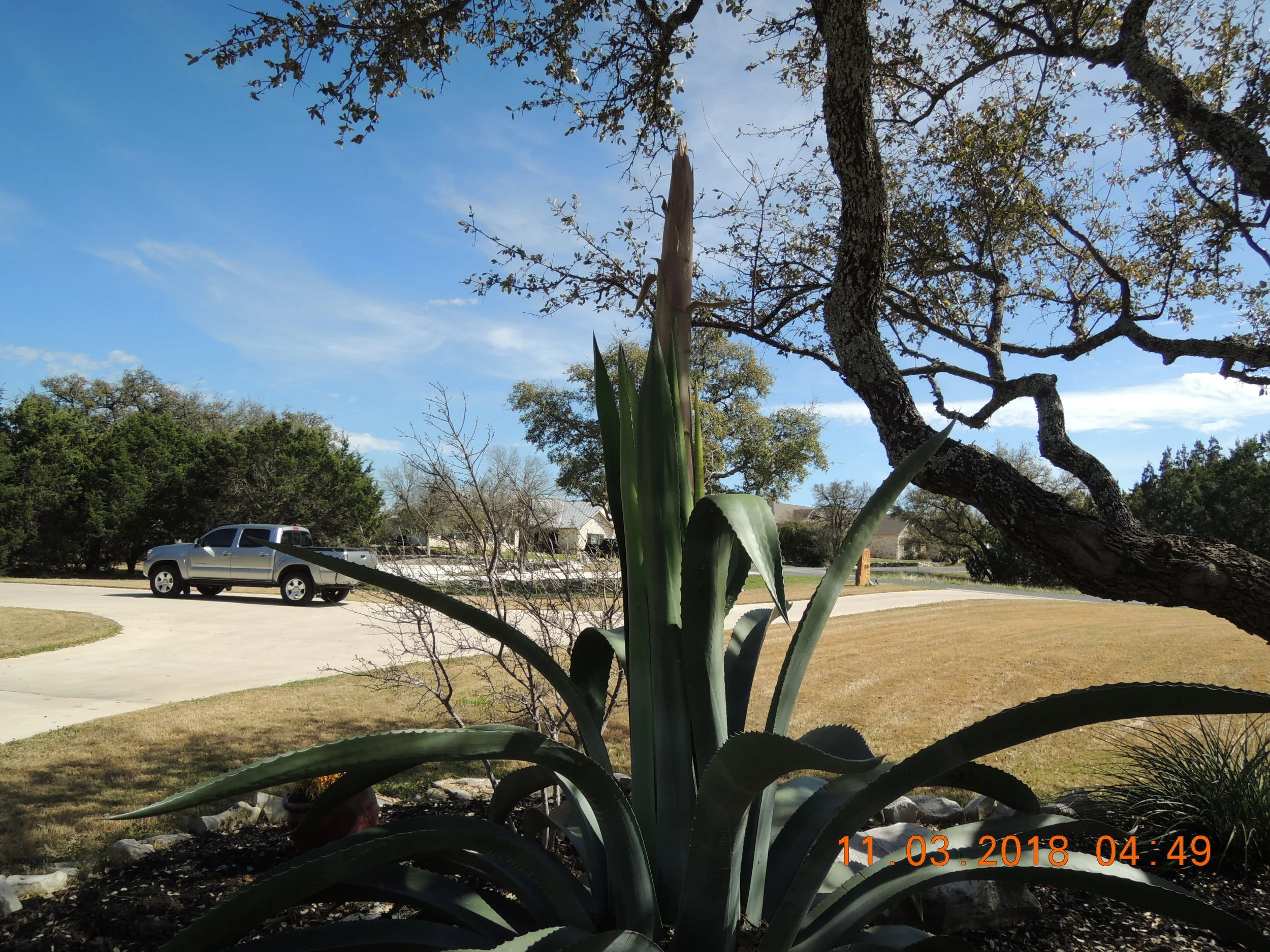
Last year about this time one of the two huge agaves out front bit the dust. Now the other one is in the first stage of its demise, which was inevitable. I don’t know the names of plant parts so I’ll just say that when it’s time for one of these agaves to die it shoots up an impressive phallic stalk. When the first one stopped growing, its stalk had risen through the branches and above the canopy of a good-sized oak tree, a height of about thirty-five feet. People stopped by to comment.

“You know when it does that, it’s fixing to die, right?” This from the fourth neighbor who wanted to educate us.

Sadly, we did know. When the obelisk lost its upward momentum, and all the elegantly curved leaves at the base had turned to brown mush, the problem became how to get the rotting thing out of there. It had once been a grand and dominating fixture, drawing admiration from everyone. But when it was fully expired the whole area was soggy and smelly from the decaying leaves.

Ordinarily a dead agave is simply left to dry out because the root ball is densely fibrous and staggeringly heavy. But our house is the first one people see when they enter the cul-de-sac; and as such, our front area is appropriately kempt. Leaving the stalk to turn brownish gray and list slowly sideways until it collapsed was out of the question. It would take years.

So David climbed a ladder and sawed across the stalk, creating vulnerably between top and bottom. As strategic advisor, it was my responsibility to repeatedly remind him to Be careful up on that ladder! He tied a rope around the top part, tied the other end of the rope to his truck, climbed in, and pressed the accelerator. And as the truck rolled forward the top of the stalk rattled and shook, then snapped off with a mighty crack! It fell through the branches, landing hard and pointing straight up; then falling over and almost hitting me because I was stupid enough to be standing right there. 

David hacked off the putrid leaves and sawed at the bottom portion of the stalk until all that remained was the base, which weighed a couple of hundred pounds. He fastened a chain around it and, hooking the chain to the truck, pulled the mass out of the ground and on to the driveway, where, to my house-proud horror, it stayed for two weeks, which is how long it took to find someone willing to haul it off.  

The whole process, from the time the stalk first appeared, to disposing of it, took about four months. And now we’re going to have to go through the same thing again. At least we know what we’re getting into.

Did the majestic agaves influence our decision to buy this house? It’s a possibility. They were certainly a magnificent element of the big picture. And I fear no plants will ever be worthy of replacing them.

Here’s an unusual snippet:  A couple of years ago David was clearing the area around the agaves of the babies, several of which sprouted on a weekly basis. One of the needles pierced the back of his leather glove and pricked his hand. He immediately pulled the glove off and studied the painful area; but he couldn’t see a needle, though the swelling was immediate.

A few days later the hand was still swollen. He went to the doctor who looked at it and poked at it, and then said she was pretty sure there was no foreign object in there. She put David on antibiotics, but the hand continued to bother him—hurting and swelling until the skin of the whole hand was purple and strained.

This went on for several weeks, until suddenly it settled down. Fast forward eight months or so, when the palm of David’s hand became tender and inflamed—and then one day the tip of the needle popped out of his palm. This is all kind of gross, but it’s kind of cool, too, to ponder the inherent tenacity of the needle in remaining imbedded for that length of time, and maintaining its original integrity and purpose in what, to it, was an alien environment.

Good-bye, agave. We’re glad we got to enjoy you for a while.   

Another one bites the dust. Day one.

Another one bites the dust. Day one.

Day two. That's about a foot of growth in a single day. 

Day two. That's about a foot of growth in a single day. 

Of course he kept it. It's part of him now.

Of course he kept it. It's part of him now.

This little lime sizzler will never live up to the agave. 

This little lime sizzler will never live up to the agave. 

Solitude

David’s gone to Port Aransas for a few days to help with hurricane cleanup. Originally I thought that maybe, while he was gone, I’d go to Houston to help my sister move. But when she pointed out that, as she’s between homes, she would be unable to offer comfortable accommodation, I chose comfort over being helpful. I’m not like David, who beats me hands down when it comes to helping others.

So, because I was dithering about the Houston trip, I ended up with no plans at all, which isn’t always a bad thing.

I spend the afternoon getting my sewing room in order. The scraps that’re too small to use outnumber usable fabric. While sorting, I watch a movie called Glory Road, about the NCAA championship game between Texas Western University in El Paso and the University of Kentucky, arguably the best game in the history of all games since the beginning of time; and it changed, literally, the future face of basketball. I’m not fond of sports but I love sports movies. One of my many endearing paradoxical quirks.

Ever since a month ago, when David decided to go on this trip, I’ve been looking forward to a period of solitude. When he’s not around I sing loudly, trailing cheerful tunes as I move through the house. It’s not because his presence is oppressive, it’s because my voice is too horrible to inflict on another person. Another thing I tend to do when he's not home is stay up later and drink more. It's good that he's not gone often. 

Also, we’re too much in each other’s business. We comment on one another’s activities to an absurd extent.

“Washing light clothes?” he’ll ask as I carry the laundry basket full of light clothes to the laundry room.

“Going to the gym?” I ask as he stuffs his workout clothes into his gym bag.

After organizing my fabrics I feel the need to get out of the house for a while. Though I recently vowed to stop buying stuff I don’t need, I’m in the mood to walk up and down the colorful aisles of either Dress for Less or Tuesday Morning. Both are jumble stores, with good deals to be had if you’re willing to dig through tons of ugly useless items in order to find treasure. For my purposes, Dress for Less is more about clothes, though they also have household items, perfume, and luggage; while Tuesday Morning is more geared toward kitchen paraphernalia and festive paper plates; although, come to think of it, I found one of my favorite articles of clothing at Tuesday Morning—a white undershirt that’s so soft and cozy that I wear it all winter. I’m wearing it now.

I choose Dress for Less. I’m offended when I take a top to the try-on area and the clerk takes it from me, hangs it on her rack, and tests the anti-theft device to make sure it’s secure. The clothes in this store are so cheap that they practically pay the customers to buy them, and yet they must have had a rash of shoplifting; why else would some higher-up instigate such a petty policy? In the end, Dress for Less renders nothing I want or need. I leave having relearned what I already know, which is that if you want to be treated with respect you should shop at a respectable store. Oh well, it was a place to go.

Later, as I’m walking through the house to fetch a glass of wine, I glance into the backyard. There are six deer out there. I like to see which plants the deer are devouring, so I stop at the window to enjoy their presence for a while. Every evening at this time a fox meanders through, so I’m not surprised when he appears stage left, strolling along comfortably, head held high like he owns the place (it belongs to humans, silly fox). He comes to an abrupt stop when he realizes that he’s surrounded by deer. The deer have halted their munching and are watching him with snooty disdain.

Now I comprehend where the phrase “high-tail it out of there” comes from, because the fox does exactly that. In addition, I’ve learned that foxes prefer not to be surrounded by deer. I decide to include this wildlife incident in a blog so my friends will be equally informed.

Tomorrow I’ll go to the new HEB, which opened its doors for the first time this morning. This store has been the main topic of conversation amongst Marble Fallians for at least a year. It apparently has curbside service and ready-to-prepare meal kits. Over the last month, as the old store emptied out, anticipation has grown to a preposterous level. Some of the women in yoga were there when the door opened at six a.m. They spent the first few minutes of our time praising the layout, the bright lights, the cooking demonstrations at every juncture, and the thoughtful provision of maps.  

Get a grip, people. It’s a grocery store.

An excellent winter shirt to be worn under sweaters for soft warmth. 

An excellent winter shirt to be worn under sweaters for soft warmth. 

You can't tell it from this picture, but this shopping cart is twenty feet tall. Things are CRAZY at the new HEB.

You can't tell it from this picture, but this shopping cart is twenty feet tall. Things are CRAZY at the new HEB.

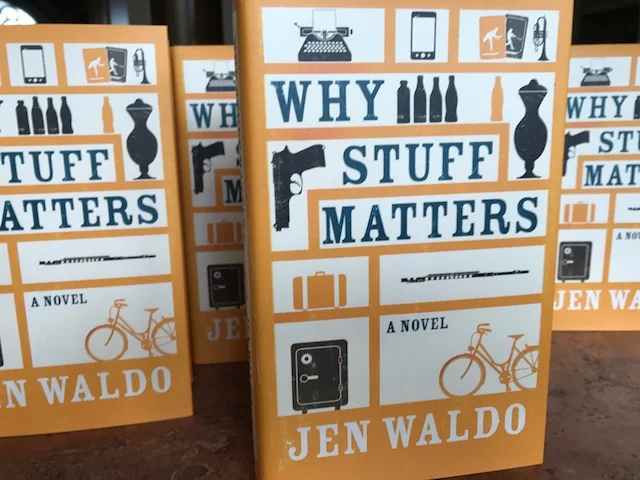
I got a nice email from a reader in New Zealand today. She picked up Old Buildings at the library and loved it so much that she ordered Why Stuff Matters online. It feels weird that my work is in the library in Christchurch, but it's not available h…

I got a nice email from a reader in New Zealand today. She picked up Old Buildings at the library and loved it so much that she ordered Why Stuff Matters online. It feels weird that my work is in the library in Christchurch, but it's not available here; a situation which will be remedied in April.