Pulau

Pulau is a set of three islands off the coast of Borneo where turtles migrate to drop their eggs.  There’s a lodge on the largest island, which is actually not very large at all, where people can stay overnight and observe the turtles as they come ashore.  The lodge only accommodates fifty people, so we got our reservations in early.  David, Leanne, and I arrive at eleven o’clock in the morning.  We’re given basic instructions about meal times and rules, then we’re shown to our rooms.  The room holds two twin beds, a small table, and a thin rough towel.  No desk or chair, and no pictures to lift the spirits of the bedraggled.  Beetles scurry around in the shower area, which consists of a spout extending from high on the wall adjacent to the toilet.  Definitely not luxurious, but there’s air conditioning. 

The egg-laying doesn’t happen until dark, which gives us an afternoon to kill.  We walk the perimeter of the island, which takes about half an hour.  It’s hot, hot, hot, and I feel my pores shrinking and sizzling.  We eat lunch and take a nap.  There’s a pathetically small portion of the beach roped off for snorkeling, so we rent masks.   The near area is murky, so I flop into the water with low expectations, but only a few yards out the water clears and a thriving fish population darts in and around healthy coral.  I don’t venture below the surface because fire coral’s everywhere.  There’s a whole field of massive table formations.  My only unusual sighting is a black and silver sea snake.  Overall the snorkeling is a pleasant way to pass an hour. 

We get cleaned up and head to the cafeteria.  The food at dinner lacks inspiration, and once again, no wine.  But the meals aren’t why we’re here.  After dinner Leanne, David, and I and forty other people are herded into a room and shown a video explaining what we’re soon going to witness firsthand—a turtle dropping her eggs.  Then we troop back down to the cafeteria to await notification from a ranger that a turtle’s getting busy out on the beach.  While we wait David and Leanne attempt to teach me a card game they recall from childhood, Garbage Rummy—more time is spent trying to remember the rules than playing the game. 

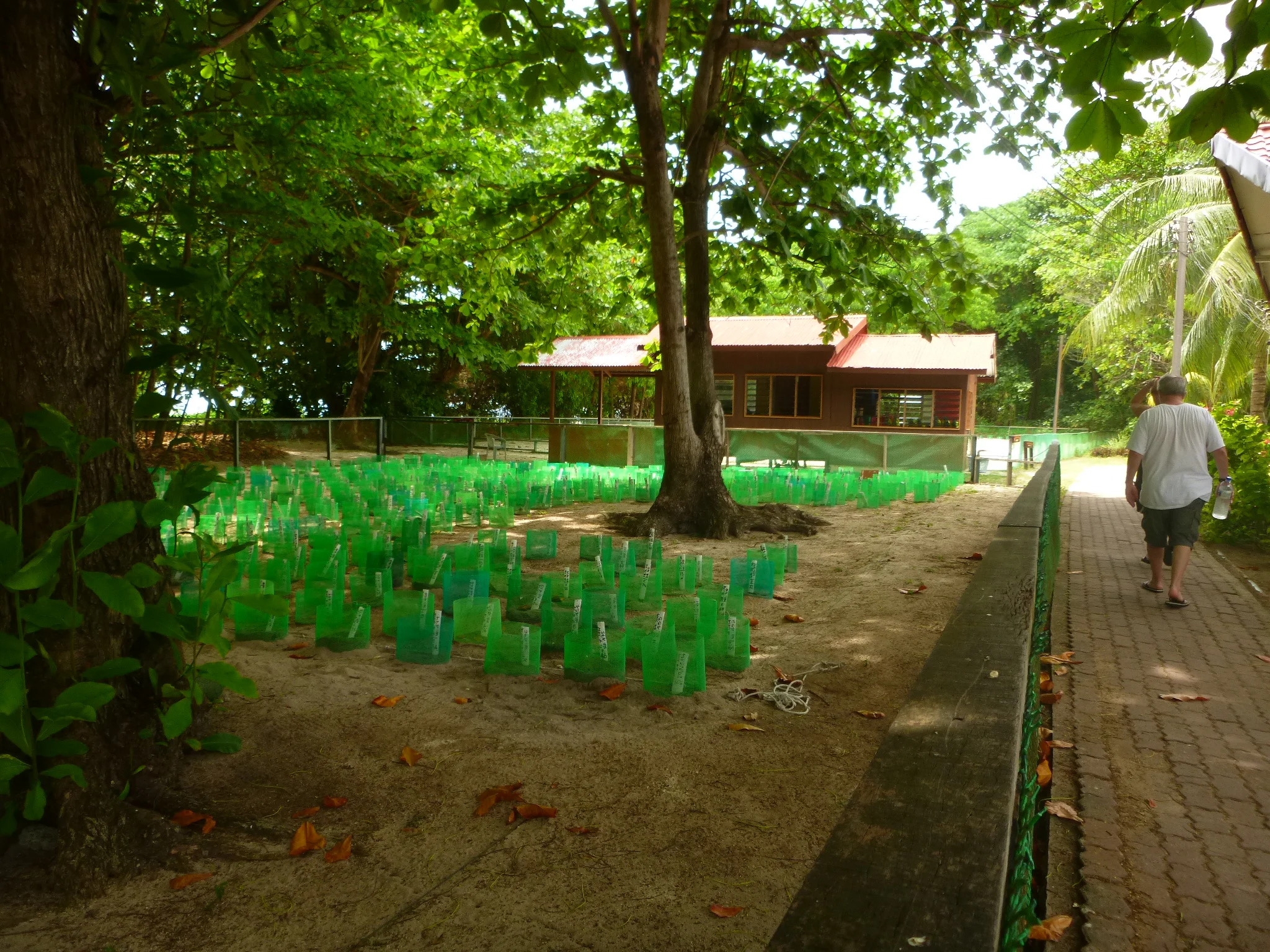
An announcement is relayed from the beach and we all troop from the building, across the football pitch, and out on to the sand.  Rangers point the way and we’re instructed to turn off our flashlights as we approach.  Also, no taking pictures.  Sure enough, a huge turtle has dug a pit for her project in the sand.  All us tourists crowd around her hind quarters and watch as her extended birth canal deposits eggs in pairs.  They’re covered in clear slime and are about the size of golf balls.  As soon as they land, a ranger reaches in, gathers them, and places them in a bucket.  In a little while he’ll replant them in a safer place.  The tourists are surprisingly polite.  They squat and watch, then move back so others can move forward.  The turtle is in a trance.  She just wants to get the job done and get out of there.  She lays a hundred and forty-four eggs.  The rangers seem very proud of her.  When the eggs quit coming we’re led to the hatchery, which is a simple field of sand with protective netting around the nests to keep the monitors out.  We watch as the ranger places the eggs in a hole, records the date, fills the hole in, and places the netting.  When the babies hatch they’ll dig their way to the surface and the rangers will carry them to the water. 

The three of us agree that this egg-laying was a really wondrous thing to see, and we’re glad we made the effort.  When we get back to the room I discover that ants have taken over my bed.  This is because earlier I’d mixed Grey Goose with Sprite (a travesty!) in a water bottle.  When I finished it, I replaced the lid and tossed the empty bottle on the bed.  It never occurred to me that it would attract ants.  Luckily, there’s a spare bed in Leanne’s room.  The boat picks us up at seven in the morning to carry us back to Sabah.  
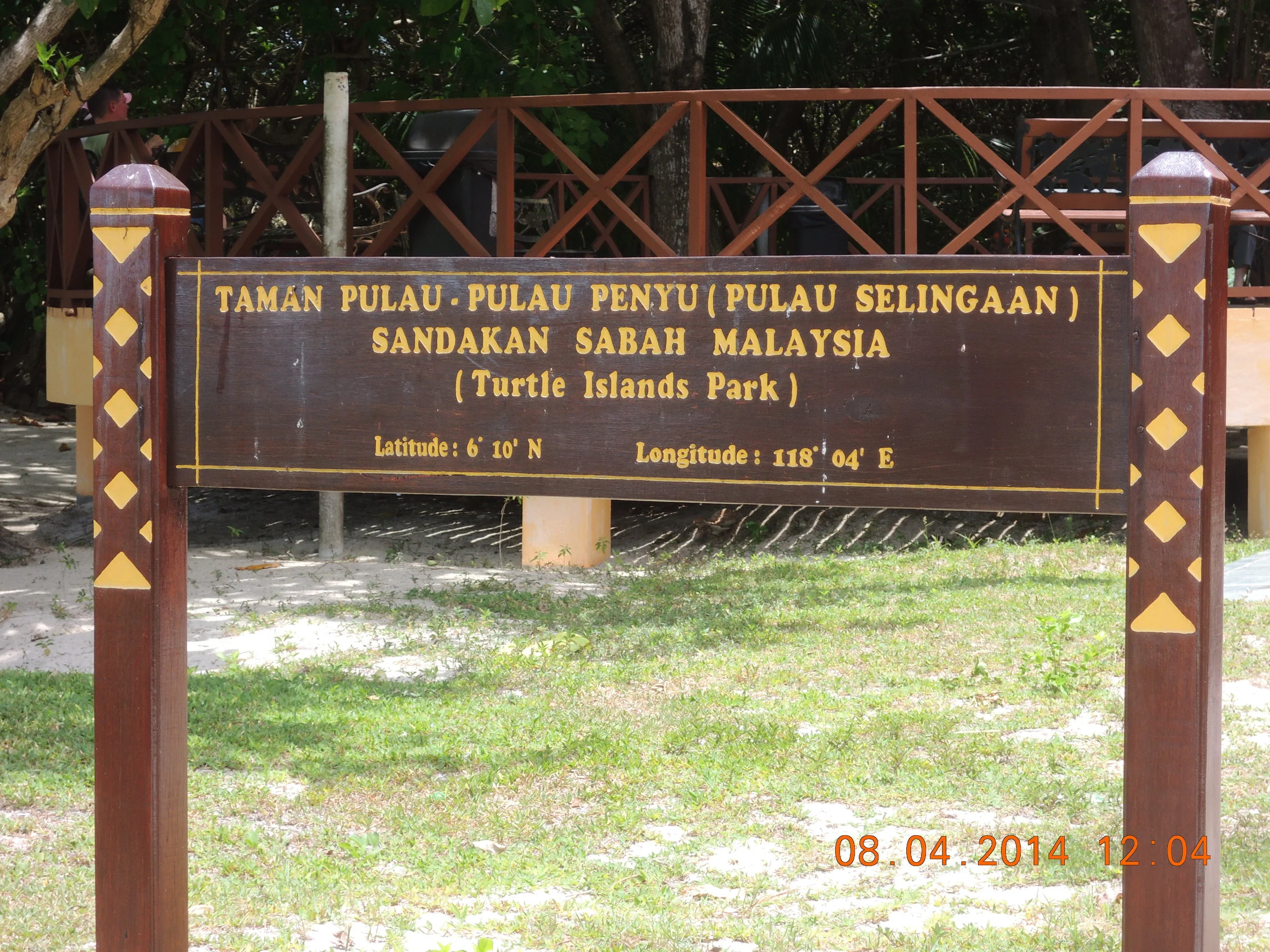
Welcome to Pulau
Welcome to Pulau

The green net cylinders are the protected nests.   

The green net cylinders are the protected nests.  


This is a stilt village on the coast of Sabah that we passed on the way to Pulau.  
This is a stilt village on the coast of Sabah that we passed on the way to Pulau.  
Sepilok

David, Leanne, and I fly from KL to the Malaysian state of Sabah, on the island of Borneo.  We’re met at the airport by Michael, our guide, who loads us into a van and delivers us to a resort in the Sepilok Rain Forest.  We were told to expect the most basic accommodation, and that’s what we get—water pressure so low it’s barely a trickle, dust on every surface, spider webs in the corners.  There’s a drop of dried blood on the pillow.  I turn the pillow over.  My rough sheets are sprinkled with dead ants.  I brush them off and shut up about it.  Oh, and also, no wine. 

Our first excursion is to the nearby Orangutan Protection Center, a campus dedicated to teaching orphaned orangutans how to fend for themselves in the wild.  The rangers who work there are passionate about baby orangutans, who have sweet faces and are droopy with need.  The heartrending story we get from Michael is that the mother orangutans are killed because hunters want the babies to keep or sell as pets.  But babies that were once cute soon become destructive, and the owners turn them loose.  These little ones have no idea how to get on in the wild, so when some caring sensible rural person finds a young helpless orangutan, he or she notifies the center.  The orphans are brought in, nurtured, and taught how to take care of themselves in their natural habitat.  A success is when a young orangutan grows into a well-adjusted and independent animal.  Eventually the orangutans reach a point where they’re ready to be released into the forest.  When this happens, some stay in the area for a week, or even a month.  Food’s put out for them, but they all eventually fade into the trees.  They’re solitary animals and fruit’s all over the place, so why hang around just to be fed?  The orangutans in this state of almost-wild are the ones the tourists are allowed to observe.  Leanne, David and I, plus a hundred-fifty other tourists, are led to a walkway that overlooks the platform where, twice a day, a ranger puts out food.  When the food appears a few primates clamber languidly down the ropes, eat a few papayas, and aimlessly climb back into the trees.  Then the whole crowd shuffles next door to the newly constructed Sun Bear Protection Center.  These bears are endangered because their livers are thought to stop internal hemorrhaging.  Who comes up with these things?  Some peculiar person, at some point in time, cut open one of these darling little bears, removed its liver, offered it to an ailing friend, and said, “This’ll make you feel better.”  Here, too, we pack ourselves on to a platform where we stare outward for forty minutes at two small brown bears as they snooze in the trees.

Dusk finds us walking the same path we traveled when we saw the orangutans—only this time without the crowd that slumped through the heat earlier in the day.  The three of us are on a private nighttime tour of the rain forest.  We come to a stop on the same platform, but this time instead of turning toward the orangutan feeding platform, the ranger points to the top of a tree behind us.  Dutifully, we turn and gaze upward.  Outlined, on the highest bare branch of a towering tree, is a giant flying squirrel.  Dark gray against the pale gray sky, he’s bigger than any squirrel I’ve ever seen—the size of a full-grown macaque.  Suddenly he spreads his arms and sails from that tall, tall tree to a slightly lower bough on the neighboring tree.  The sight is breathtaking.  We sigh in amazement.  In the surrounding area there are approximately six flying squirrels.  We crane our necks until they ache, watching as they fling themselves through the sky until it’s too dark to see them anymore.  Then we move further into the rain forest.  Trunks, ferns, clinging ivy, and brush surround us.  Geckos bark, frogs chirp, and birds screech.  It’s a surreal environment, black-dark.  If we step off the path the leeches will get us!  

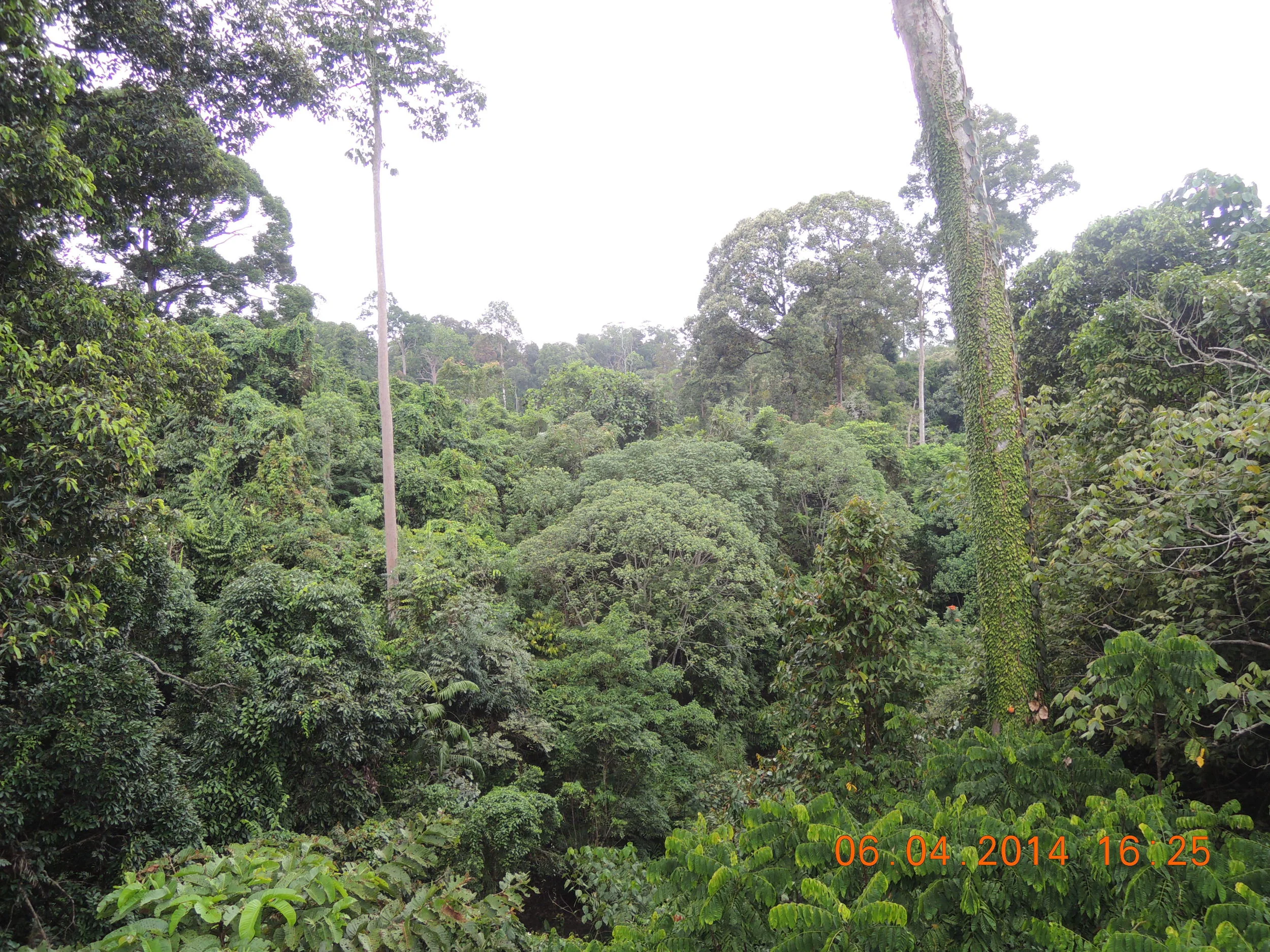
A view from an observation tower in the Sepilok Rain Forest

A view from an observation tower in the Sepilok Rain Forest

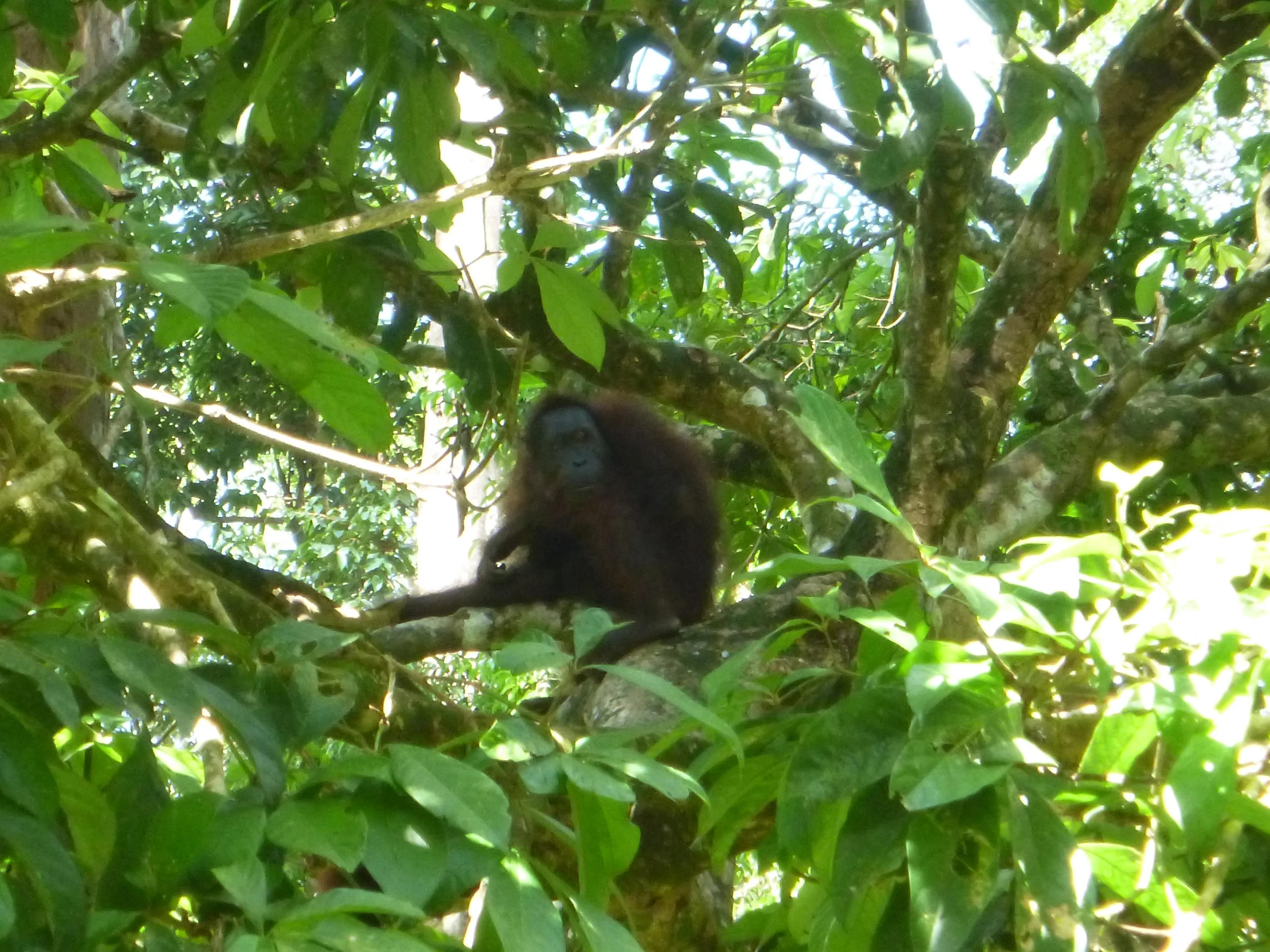
Orangutans are cute.

Orangutans are cute.

A night time creature, a caterpillar.  Don't touch it!  It'll give you a burning rash.  

A night time creature, a caterpillar.  Don't touch it!  It'll give you a burning rash.  

Woolf's Words

Virginia Woolf’s The Waves was our book for Readers’ Group this month.  Here’s a summary:  The author follows the lives of three women and three men from childhood to old-age.  Interspersed between the voices of the characters, in italics (which I always find annoying), are rhapsodic passages about waves and the angle of the sun meant to symbolize the characters’ progression. 

Of course that’s not all there is to it.  Donna, who led the discussion, cackled delightedly at salacious humor that was so hidden beneath Words, Words, Words that none of the rest of us caught it.  She spoke ecstatically of imagery and symbolism.  Her eyes twinkled as she pointed out the experimental nature of the piece.  Worshipful in tone, she called it a poem.  I, too, thought the writing was brilliant and inspiring, though not flawless.  The symbolism was heavy-handed and the reader is kept at a distance.  Having said that, I read many phrases several times because genius should be savored.  And how fun—I’ll attempt to relate my rather conflicted assessment in the style of Virginia Woolf:

The Words, lilting, moving, ponderous and feather-light; and light, too, in spectrum, an unblemished arc of luminous Words tracing life’s horizon from sun-birth to sun-demise.  Rich Words, overflowing casks of Words more robust than red, more delicate than white, more perfect than perfection.  A Word bouquet of jasmine-scented roses.  Words and more glorious Wordsy Words exploding with flavor, curling around toes, laden with meaning and double-meaning and hidden meaning; and nestling like an exigent thorn in the guileless helpless souls of six women who, befuddled and daunted, attempt to decipher the Words, the extravagant never-ending profundity of Words.

Look at all those adjectives.  No wonder Virginia Woolf killed herself. 

When it was suggested that the six characters of The Waves were meant to represent the different aspects of a single person, well, I realized that I simply hadn’t given the book the time it deserved.  Unlike Donna, I didn’t approach the work with appropriate gravitas—my two weeks of quick reading hadn’t gotten the job done.  She read it twice and intends to read it again. 

Some comments from the other readers: 

Beth, a new member, says, “There’s so much here that you could study it for a whole semester at university.”  In our one-to-ten rating system, she gave it a six.  Judy, also new, comes from a journalism background.  While she appreciated what Woolf was trying to accomplish, it was too vague to suit her taste.  She likes sentences to sit up and behave.  She gave it a five, as did Sharmila who felt that “Her (Woolf’s) writing was very rich, but a lot of work.”  Kristen gave the book a seven.  She recognized Woolf’s virtuosity, identified with the characters, and admired the use of detail in the descriptions, but admitted that she wouldn’t recommend it to a friend.  I, too, gave it a seven.  I liked it because Woolf’s originality and inimitability inspire me to stretch, to liberate instead of domesticate, to flow instead of craft; on the other hand, I couldn’t give her a higher rating because the subject was banal—follow six unexceptional people through their lives and echo it in the cycle of the waves?  Weak, Virginia, and boring. 

Our readers’ group is in its third year.  Of the original dozen, only Sharmila, Kristen, and I are left.  That’s the ex-pat lifestyle—people come and go.  We get together at the end of every year and decide next year’s list, though some of us may not be here next year, in which case the new batch of readers will inherit our choices, possibly with trepidation, possibly with dismay.  In the last couple of years we’ve read classics like Anna Karenina, East of Eden, House of Mirth, and Wives and Daughters.  We’ve taken on modern literary works like An Artist of the Floating World, And the Mountains Echoed, House of Sand and Fog, and Wolf Hall.  And we’ve had some easy reads, too—Gone Girl, The Devil in the White City, and The Burgess Boys.  Outside of the selected reading, we all follow our own preferences and make recommendations to each other.  Because of this group I’ve enjoyed Where’d You Go, Bernadette? Room, and Burial Rights—all excellent reads.  As a writer I find it helpful to keep the Words churning through.  Words, infinite and burgeoning, Words pregnant with nuance, dark green Words, Words of . . . Virginia, get out of my head!   

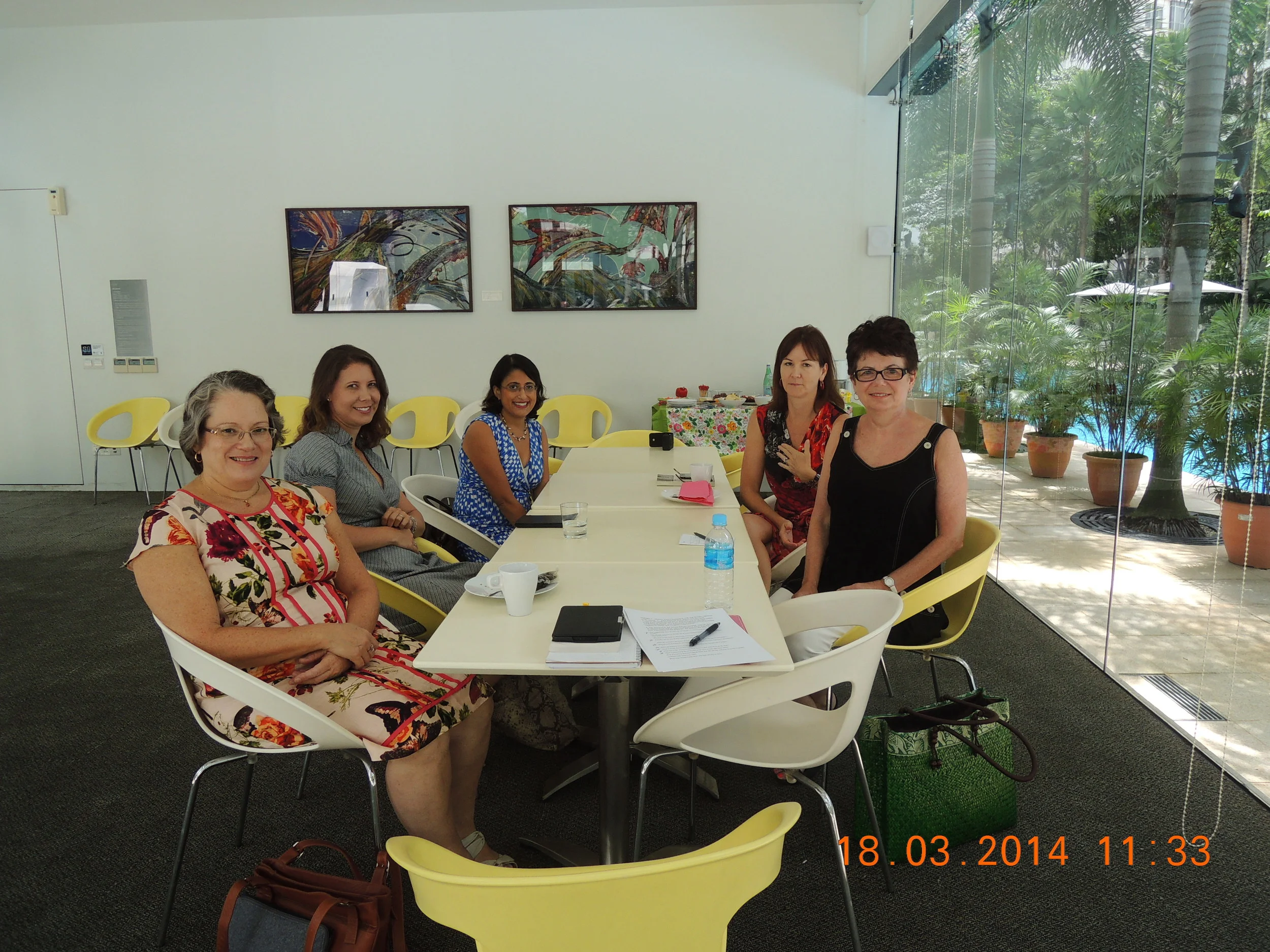
Judy, Beth, Sharmila, Kristen, and Donna--a good picture of you all!  This is the meeting room in Donna's complex.  At the back is a table full of goodies--thanks, Donna.  The green bag on the floor next to Donna is mine.  

Judy, Beth, Sharmila, Kristen, and Donna--a good picture of you all!  This is the meeting room in Donna's complex.  At the back is a table full of goodies--thanks, Donna.  The green bag on the floor next to Donna is mine.  

The Morning Building

Trip and I go for a walk every morning around seven-thirty.  We step out of the elevator.  Jamaliah’s just coming in to work.  She’s a pretty woman, brown hair, clear skin, maybe forty.  It’s her job to keep the open-air lobby and elevators clean.  She says, “Good morning,” and smiles.  I return the greeting and the smile, which most likely conveys irritation.  I don’t like to interact early in the day.  Jamaliah whisks past, heading to the closet where she keeps her uniform.  Next time I see her she’ll be dressed in gray and whipping her broom through the lobby.  She sweeps and mops the front area at least six times a day, and each time I’m in or out we exchange good wishes for whatever time of day it is. 

At the front desk is Oathman.  He, too, wishes me a good morning and I say the same to him.  Oathman is here daily from seven to seven.  When I have friends to the flat he walks them to the elevator and pokes the code that calls my floor to let me know they’ve arrived.  Stationed at the front desk, his assigned task seems to be keeping tabs on everybody.  He tells guests where to park and he points delivery people to the service elevator.  He’s a friendly guy and people are always leaning on his counter laughing with him.    

As Trip and I walk down the six steps to the covered driveway, the neighbor’s driver tells me good morning.  He gives a little bow when he says it.  I say good morning to him, too.  He seems like a nice man, Muslim, and while that in itself isn’t offensive, the way he squeals like a terrified sissy is.  What does he think my good-natured little dog is going to do to him?

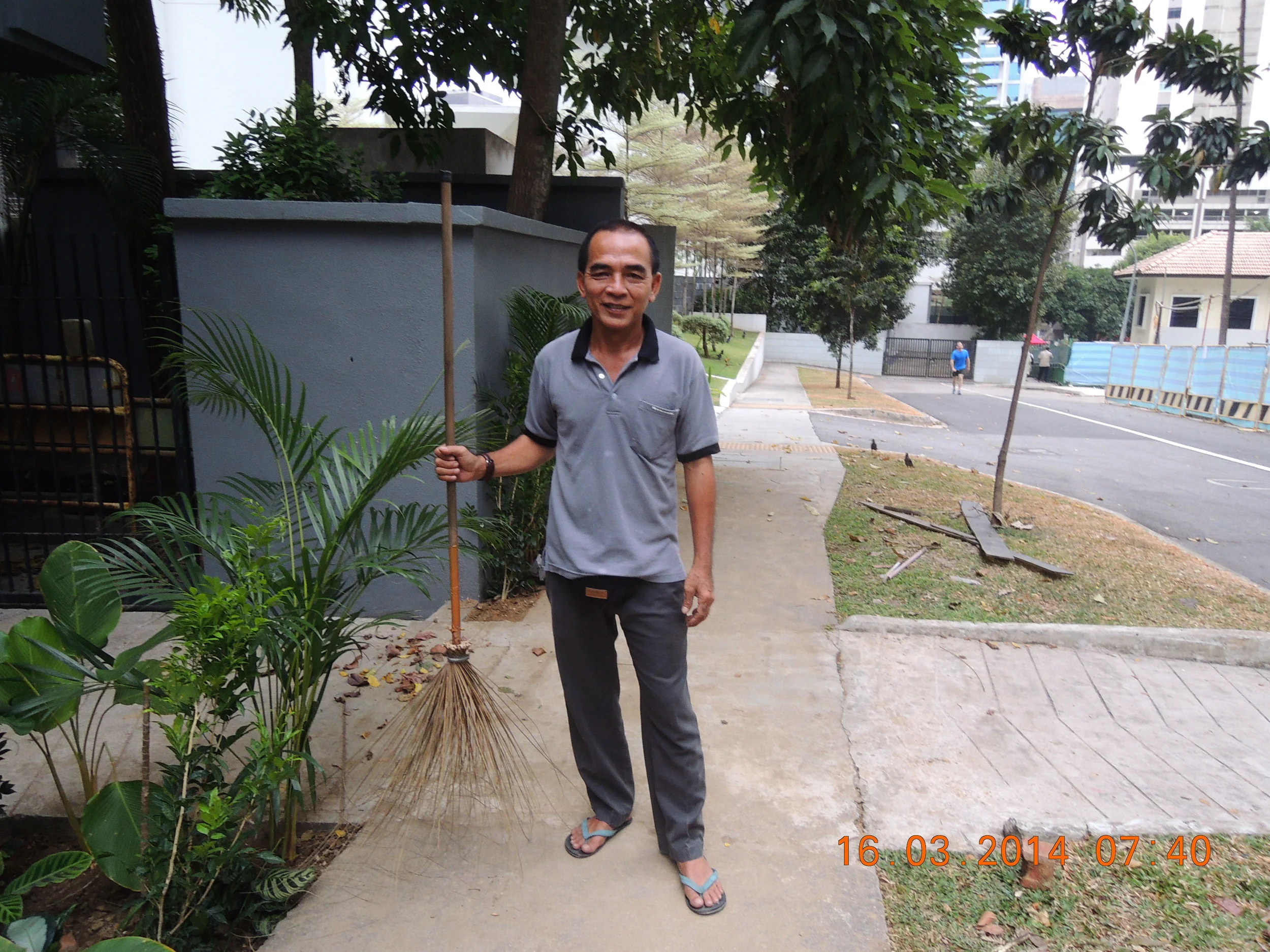
Beyond the wussy driver is Razzah.  He wishes me good morning and I wish it back to him.  In the same way Jamaliah takes care of the interior, Razzah takes care of the grounds.  Keeping the area free of leaves is a never-ending task.  He sweeps with a straw broom that is handmade.  Also, he’s in charge of garbage pick-up and removal, though I question his dedication.  Someone left a banana and a roll on the front fence four days ago and it’s still there.  The banana’s brown and shriveled now, and the bread is moldy.  Shouldn’t he have thrown it away?  Does he think someone’s going to come back and claim it?

As we pass through the gates Stephen is just getting ready to go off duty.  He let me know when I first moved in that if there are any problems, he’s the one I’m to come to.  Stephen watches the entrance from the little guardhouse throughout the night.  He’s told me he doesn’t need sleep.  A retired teacher, he’s eighty years old, has no hair, few teeth, and allows himself only one pack of cigarettes a day.  He calls, “Good morning, Mrs. Waldo.  Have you had your breakfast?”  He asks me the same thing about dinner when I go out in the evening.  In the beginning I thought this was odd and intrusive—why does this hairless little man think my eating habits are his business?  But I later learned that his query is the equivalent of “How are you?” which makes sense as, in this part of the world, people have known hunger.  Asking if someone has had their rice shows concern for their well-being. 

I step through the security gates and on to the sidewalk, where Trip finally gets to sniff and lift his leg.  He takes a long time with the sniffing because, well, he’s a dog.  Robert, Stephen’s replacement, is coming up the hill.  Just like the others, he wears street clothes as he travels to and from work.  He’ll be changed into a uniform by the time I return.  A quiet man, he keeps his head down, giving no greeting as he enters the property.  He’s busy inside his mind.  Robert is my favorite.  

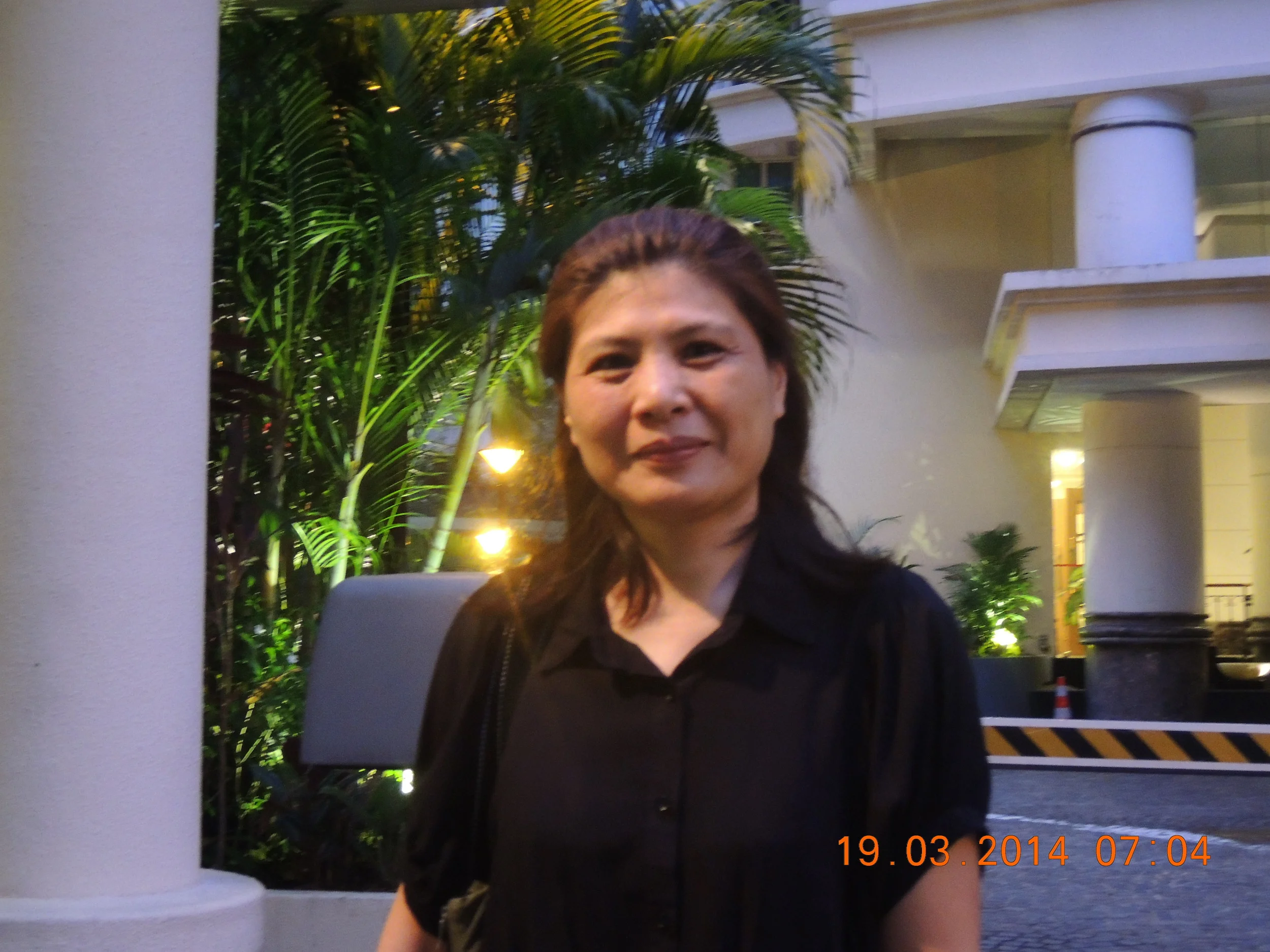
Jamaliah and her smile.

Jamaliah and her smile.

Razzah and his broom.

Razzah and his broom.

Stephen, after a night of watching over the place.  

Stephen, after a night of watching over the place.  

Robert, usually a somber man, put on a big smile when I pulled out the camera.  

Robert, usually a somber man, put on a big smile when I pulled out the camera.