Siem Reap in Cambodia

Siem Reap is a two hour flight from Singapore.  We’re met at the airport by our guide, Kheleur (pronounced Keller), a handsome young man with a slippery way of saying, “Yesss,” at the end of every phrase.  He will, over the course of the next several days, fill our ears with historic facts about the temples, the politics, and the culture of Cambodia.  He takes us to the hotel (Shinta Mani Resort, very nice) and tells us he’ll pick us up in a couple of hours.  We check in, drop our bags, then make our way to the busy district where we find a spa—gotta take care of the important things first.  David chooses a back, neck, and shoulder massage (10 dollars) and I have a facial scrub (12 dollars).  Then we return to the hotel to meet Kheleur, who takes us to the Angkor Zone, where we see our first ruin, a Buddhist university from the twelfth century. 

Two days later, we’ve scrambled over and through ten temples.  Dramatic, lovely, and mysterious, they deliver a poignant lesson about fallen civilizations and the intractability of time.  Once the walled city surrounding Angkor Thom sheltered a million people; today it’s a scattering of massive jagged walls scattered throughout a forested area where naked children play in mud holes and makak monkeys hunch around like callow thugs.  Kheleur has reeled off so many facts about the ancient Hindus and Buddhists that we’re overwhelmed.  Here’s a spoonful of history:  From 800 to the mid-1200s the temples of Angkor were built by Hindus and Buddhists.  The Thais invaded in 1432 and when the Buddhists drove them out in 1555 the capital was relocated to Phnom Pen.  This all happened so long ago that I’m stretching to find relevance.  I guess it’s relevant because we’ve come to explore the remains.

More interesting than the temples is their current status.  This is the story I get from Kheleur:  The Cambodian Prime Minister sold the Angkor Zone—approximately 200 sq km of breathtaking ruins—to a businessman in Vietnam.  Having sold the country’s greatest asset, the PM promised to spend the money on education and public projects but, due to corruption, no improvements were forthcoming.  The population is angry and, if the maniacal glint in Kheleur’s eye is anything to go by, revolution is in the air.  Also of interest—the Angkor Zone is a UNESCO World Heritage site, and the restoration work and excavating throughout Angkor is supported by different countries—Germany, India, Japan, Switzerland, China, France, and many more.

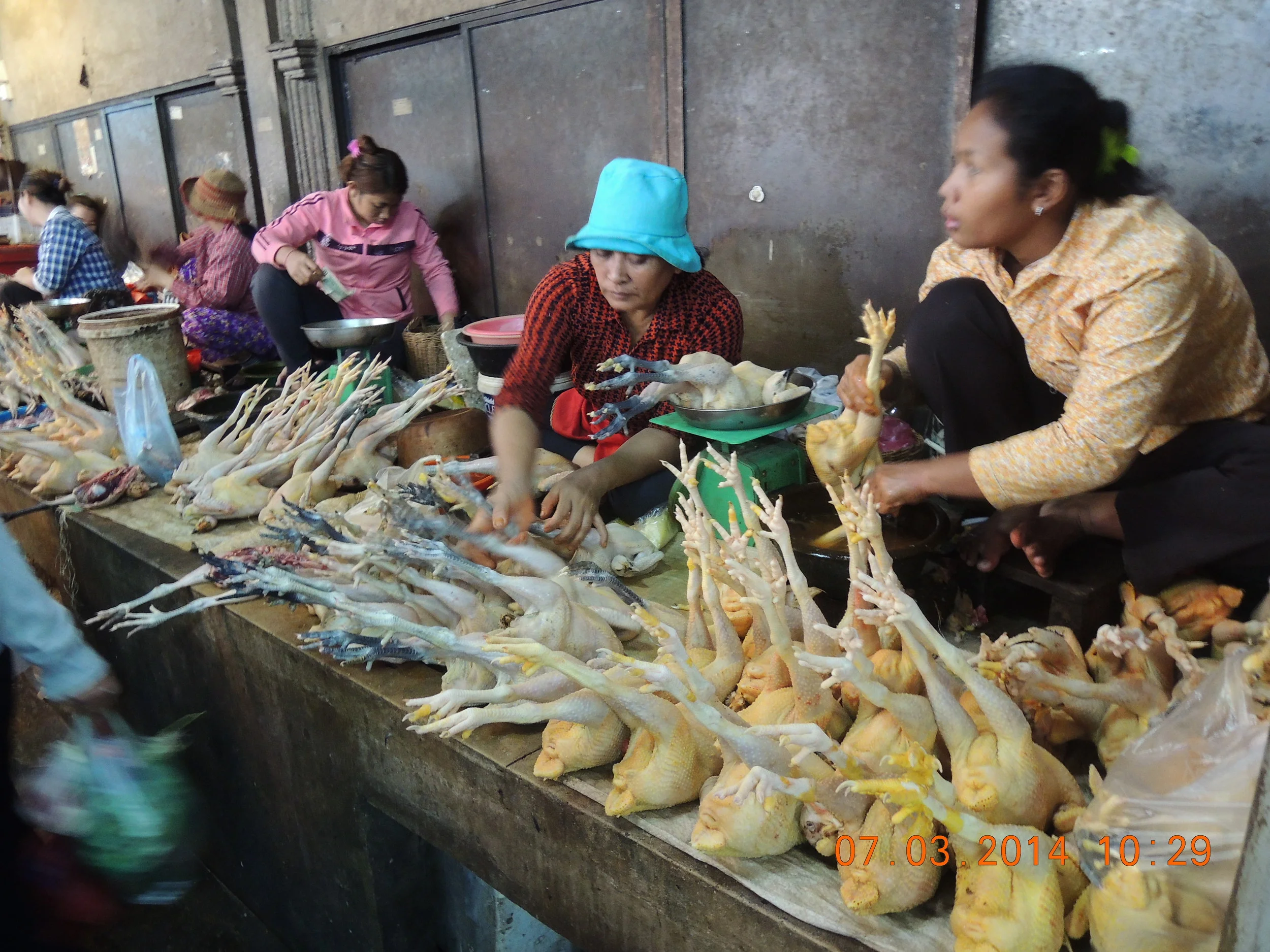
A couple of years ago some witless person decided to check out one of the temples, Angkor Wat, at sunrise.  Apparently the pink orb peeping from behind the rugged ruin was so stunning that he felt compelled to take a picture. This is how stupid traditions are born.  (I’ll never forget the all-night trek to the top of Mt. Sinai—what hell that was!)  So, because it’s expected of tourists, David and I get up and out at five a.m. and go to Angkor Wat in the dark with fifteen hundred other people.  We stand for over an hour with the people behind us coughing and sneezing on our shoulders, cameras snapping all around.  It’s a hazy morning and the sun never shows.  The sky simply goes from dark gray to light gray.  And we all go our separate ways.  Later we go to the Old Market which is smelly with fish and dead chickens and unfamiliar fruits and vegetables.  Flies buzz and small dark people mill and call out.  Further in, past the piles of shiny satin pillow covers and rows of elephant pants, we come upon a booth that sells silk.  Stored in a glass-fronted cabinet, the stacks of colorful fabric are ten feet tall and span the entire back wall of the booth.  Ten dollars a meter!  I don’t know about the Buddhists’ nirvana, but I’ve sure reached mine.  Silk is thirty-five dollars a meter in Singapore.  I buy two meters each of black, green, gray, and pale yellow.  It’s time to go home.
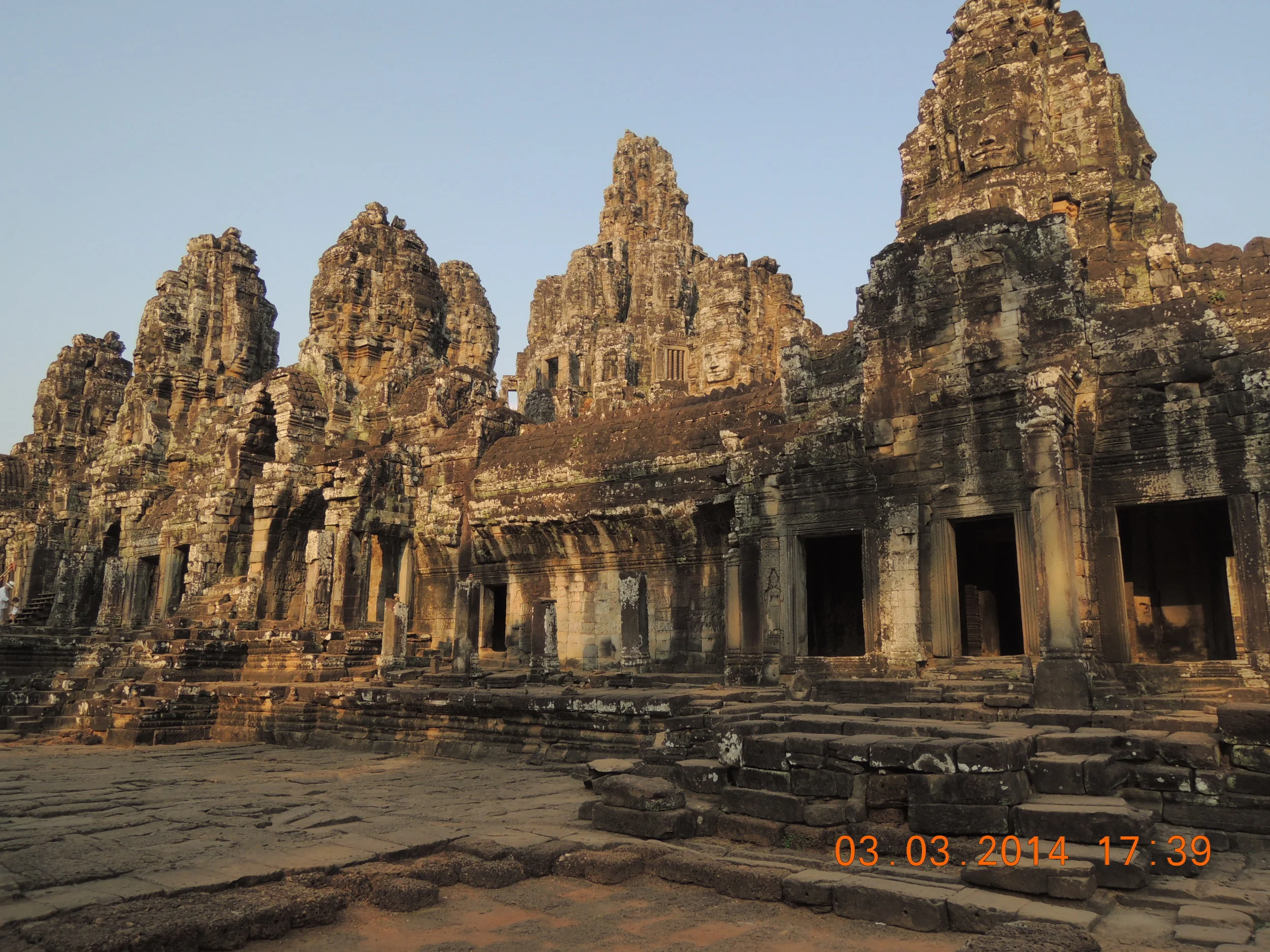
Angkor Bayon

Angkor Bayon

Angkor Wat, the dawn that wasn't.
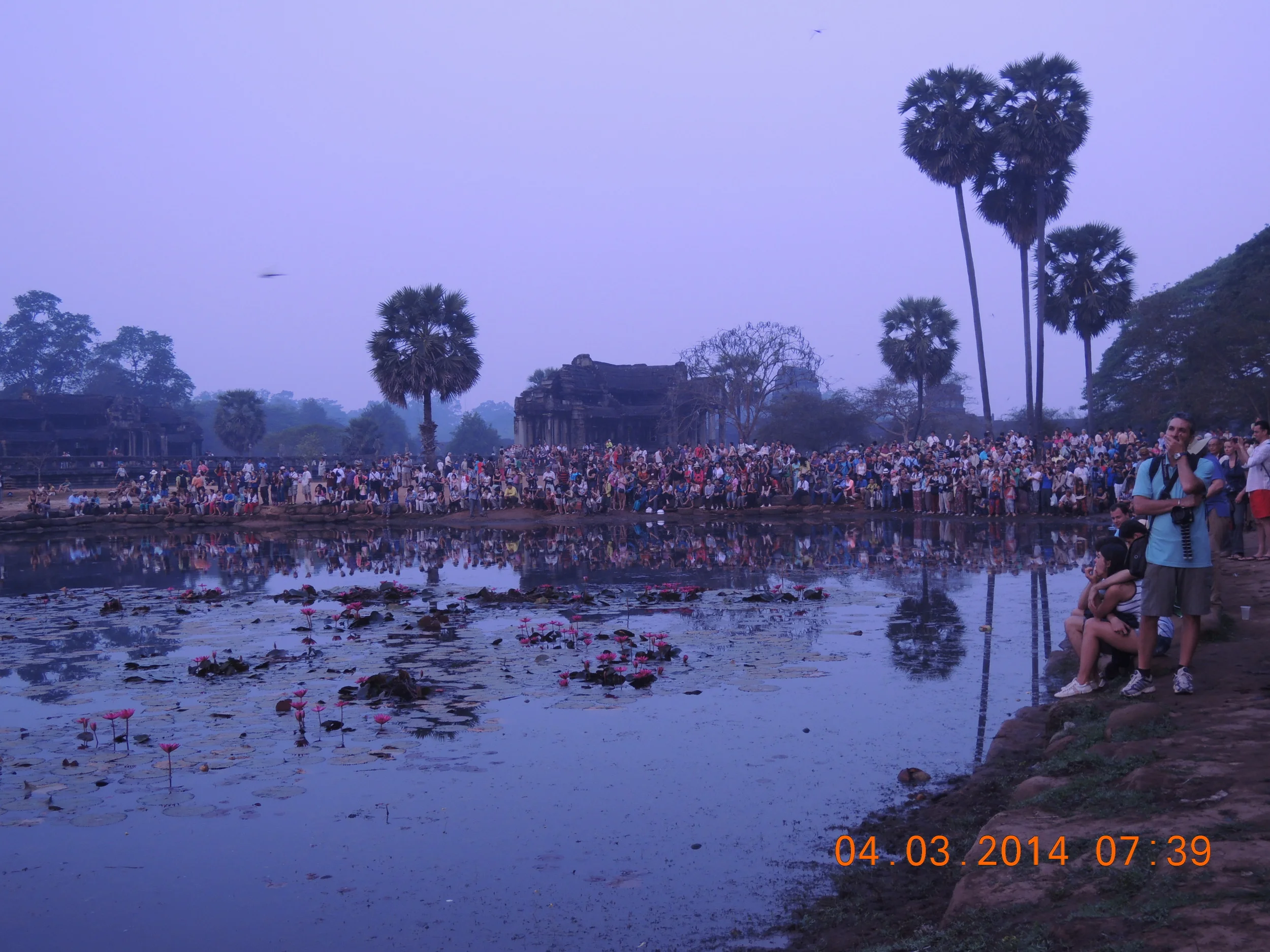
Angkor Wat, the dawn that wasn't.

The crowd waiting for the sunrise that never happened.

The crowd waiting for the sunrise that never happened.

Kheleur explains while I gaze.
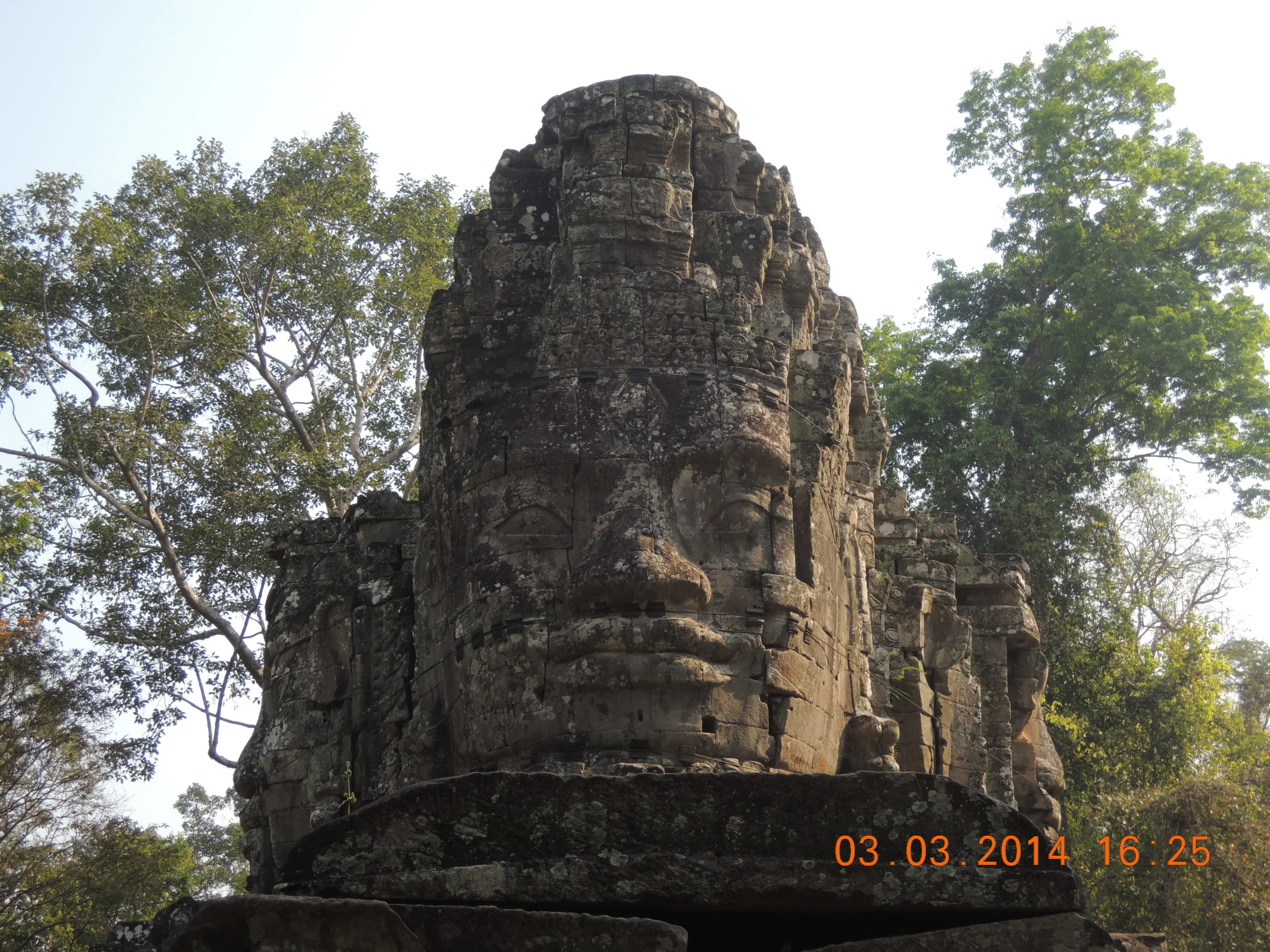
Kheleur explains while I gaze.

Buddahs pop up everywhere in the Angkor Zone.
Buddahs pop up everywhere in the Angkor Zone.

The Old Market is a busy smelly place.

The Old Market is a busy smelly place.

David having a gin and tonic at the end of our day in the Cambodian countryside.

David having a gin and tonic at the end of our day in the Cambodian countryside.

The Official Language

The official language of Singapore is English.  It’s surprising how many people don’t know that.  The signs and notices are English.  Government forms are in English.  Newspapers are in English. 

Because there are so many cultures, most Singaporeans speak two languages—the tongue of their heritage and English.  Because their English is heavily accented, I often ask the Singaporeans to speak slower and louder, explaining that I have difficulty hearing.  I thought this was a clever and tactful solution to a touchy problem until I was discussing the issue with a woman at last month’s readers’ group (The book was Wives and Daughters.  If ever you come across it, run!  Save yourself!) and one of the other women said she did the same thing.  So now we’ve got the Singaporeans thinking Americans have weak ears. 

When I first moved here the English-speaking ex-pats jokingly referred to Singaporean English as “Singlish”—a little too openly, as it turned out, because what seems humorous or charming to one group seems condescending and mean-spirited to another.  So these days, to say someone speaks Singlish is politically incorrect.  Also, the term Singlish implies that the local language is a mixture of English and Singaporean, but there simply isn’t such a thing.  And just because the accent is difficult to understand doesn’t mean the Singaporeans are speaking any language other than English.  The Singaporeans are well-educated with as sizeable a vocabulary and as sharp a grasp of grammar as people from any other English-speaking country.  I can be standing right next to two people who are talking to one another—and I’ll wonder, what language are they speaking?  And then a word will fly past—toaster, car, shops—and I’ll realize they’re speaking English. 

That’s not to say there aren’t a lot of other languages around.  The imported workers are from Indonesia, Malaysia, The Philippines, Bangladesh, Pakistan—oh, and so many others.  And these people speak whatever language they’ve brought with them; plus, in order to come here, they’re required to speak English.  Today I was walking up the hill from Orchard Road (David calls this the Hill of Death.  He’s made up a merry song about it.) when I passed two people who were speaking to one another in their own language.  As soon as they noticed my approach, they switched to English.  This has happened too many times for it to be a coincidence.  Often when I’m on the bus or in the checkout line at the grocery store, people will change from their language to mine without so much as a break in their flow of words.  This is a thoughtful gesture which allows me to listen in on the conversations of strangers, and I appreciate it.     

The sign on the construction across the street. 

The sign on the construction across the street. 

This is Oathman.  He understands what I say, but I hardly ever understand what he says.  

This is Oathman.  He understands what I say, but I hardly ever understand what he says.  

Chinatown

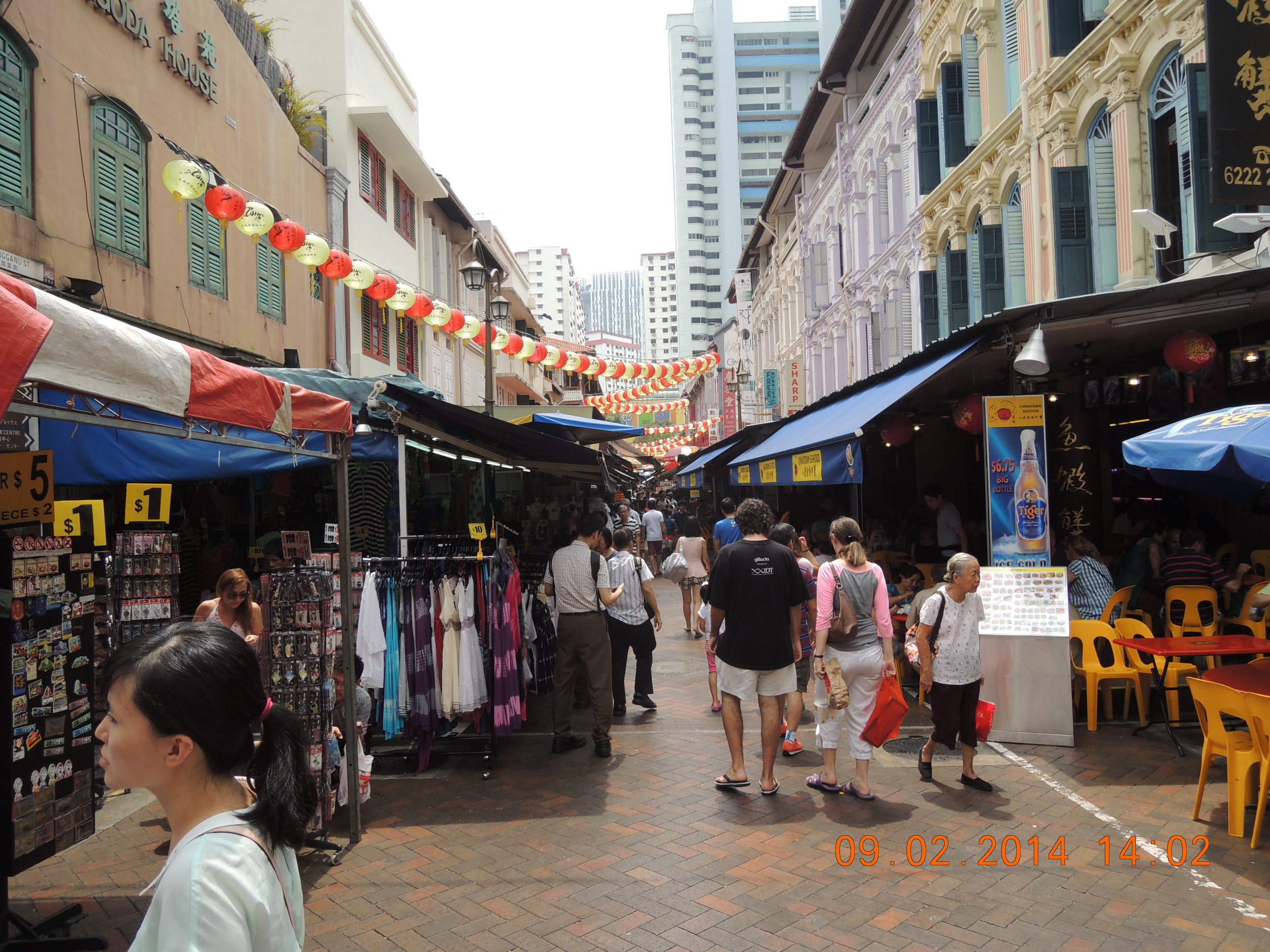
My favorite place to go in Singapore is Chinatown.  It’s a short walk, a short bus ride, then a short metro trip from my home.  Though some hours of the day are less crowded than others, even the quiet times are hopping in Chinatown.  It’s a great place to people-watch.  Tourists are always fun with their bewildered expressions and cameras cradled in their hands.  When a cruise ship is in town the people in its tour group wear matching stickers on their shirts.  Sometimes a school group will come through.  A field trip to Chinatown—how fun!  The kids wear backpacks and stumble over their long feet.  The vendors tend to be cynical—why should the woman sell me the fake antique teapot for ten dollars when someone’ll come along shortly who’ll pay the twenty-five she’s asking, though she and I both know she didn’t pay three bucks for it.  In Chinatown it’s all about profit. 

Chinatown has everything a Chinese person could need—and I find it fascinating to see what other cultures regard as necessity.  There’s a hawker center for an inexpensive meal, but be careful what you order because if you ask for pork you may get tripe, and fish stew could mean fish eyes floating in your bowl.  Also, there’s a wet market for fresh produce and meat.  The produce is often unfamiliar, but the woman behind the counter is happy to tell you what it is and how to prepare it.  The reason it’s called a wet market is because animals are slaughtered here, and fish are cleaned here, and at the end of the day the vendors hose the place down, washing the whole gooey mess down the drain in the center of the floor. 

Out on the streets what look like stalls turn out to be deep shops.  Red paper lanterns bop the taller customers on their heads as they pass beneath and between awnings.  Clothes stores offer inexpensive lightweight shirts and skirts from India, Thailand, Viet Nam, and China.  Tea shops are stacked from floor to ceiling and back to front with yellow, red, and green canisters.   Apothecaries sell Chinese remedies like Tiger Balm, Ma Huang Tang (cure for a wind cold), and white flower oil.  Handbags, jewelry, calligraphy brushes, Mahjong sets, pashminas, chopsticks, wooden combs—all are on display, along with more cheap souvenirs than a sane person would ever want.    

My favorite area is the fabric market.  Walk past the man who repairs shoes on the curb, beyond the juice stand, and up the escalator that never works.  Up here are two low-ceilinged hallways lined with shops that are stuffed with rolls of richly colored fabric.  Chest-high bolts fall from the shops, leaning on each other, and blocking the walkway.  A couple of shops specialize only in men’s shirt fabric.  Several hold only material for women’s formal wear—transparent or heavy silk, and lace.  The proprietors who sell cotton know me and I know them.  When they see me coming they rush out, calling me “Madam, come see our new, come see our new.”  They point out their latest goods, which are always Japanese and more expensive than any of the other cotton.  Though all the stalls have the same fabric because it all comes from the same places and it was all brought in on the same boat, I always spread the money around, carefully buying a meter from this one, a meter from that one, a meter from another one.  They all know when I’m starting a new quilt.

Welcome, Year of the Horse.  And horses are everywhere in Chinatown.  

Welcome, Year of the Horse.  And horses are everywhere in Chinatown.  

Doesn't this look like fun?  

Doesn't this look like fun?  

Here's a quilt I made from fabric I bought in Chinatown.  

Here's a quilt I made from fabric I bought in Chinatown.  

Live-ins

Off our kitchen is an open-air utility room.  On the right side of this room is a back door, the live-in’s entrance.  Opposite this door, left of the kitchen, is a tiny room that’s intended to house a live-in.  The live-in is usually a domestic helper, although one of the families in the building has a live-in male driver and also a live-in helper—and two children as well, so I’m curious how four adults and two kids share the same amount of space that sometimes makes David and me feel crowded.  How they manage in such close quarters is absolutely none of my business—but really, who wouldn’t want to know?

The live-in’s room is large enough for a single cot.  Beyond the room is a cramped bathroom with an undersized sink mounted in the corner, a toilet that’s half the size of the others in the flat, and a plastic nozzle hooked to the wall at waist-height—not a proper shower at all.  We use this bedroom and bathroom for storage.  I’ve never considered having a live-in because I prefer only the people who love me to have a close-up of my imperfections.  I drink too much, eat too much, play too much spider solitaire—why would I want an outsider watching me?  I’m not the only one who feels this way.  I have a friend who, when she’s going to play bridge, tells her helper that she’s going to a charity meeting.  “I want her to think I’m doing important things,” my friend says.  “I don’t want her to know I’m spending the entire afternoon playing a game.” 

Rumors about the live-ins abound in the ex-pat community.  The most common is how the ex-pat wife takes the kids back home for the summer, leaving her husband in the care of the domestic helper; and during the wife’s absence, the helper makes a move on the husband.  This is an oft-repeated story, intended as a warning among friends—and though I’ve met people who know people who know someone it’s happened to, I have yet to actually meet anyone whose marriage has been endangered in this way. 

Another tale that’s been making the rounds ever since I got here is the one about the vindictive cleaner.  In Singapore a live-in must have a sponsor—someone who provides a home and regular employment.  The live-in must not work for anyone but this sponsor and, likewise, it’s against the rules to hire someone whom you’re not sponsoring, which leads to the scary story of how, when an under-the-table cleaner was let go because the woman she was working for on a part-time basis found someone cheaper, the one who’d been let go turned her ex-employer in to the authorities—and no one wants to get on the wrong side of the Ministry of Manpower.  I’ve heard this account from four difference sources.  How much retelling is required before a story becomes urban legend? 

Another story that flows from mouth-to-ear and mouth-to-ear is the one about the live-in who’d been working here for five years, sending money back to the Philippines to support her husband and children.  When she went home for a visit, she discovered that her husband had dumped the kids with her parents and taken a mistress.  A sizeable portion of the live-in’s earnings had gone to support the mistress.  This story has a different slant in that the victim is the Filipina.  As far as I can see, there’s no reason why this teapot drama is so popular among the ex-pat women, except that they seem to find malicious satisfaction in telling it, which I find puzzling. 

Live-ins are a colorful and ubiquitous entity.  They’re in front and behind me in the grocery store line.  They’re up and down the street constantly, walking the dogs.  They take toddlers to the pre-school at the bottom of the hill and fetch them home again three hours later.  Some smile and some are surly.  Some like the people they work for and some don’t.  They all have people back home that they miss.  And they all need the money they earn working far from their families. 

This is Mary, the live-in from the seventeenth floor.  

This is Mary, the live-in from the seventeenth floor.  

This is the space that's intended for the live-in.

This is the space that's intended for the live-in.

Carrying the groceries up the hill from the grocery store.  

Carrying the groceries up the hill from the grocery store.  

On Sundays the domestic helpers meet their friends on Orchard Road.

On Sundays the domestic helpers meet their friends on Orchard Road.

This picture of me playing with Trip has nothing to do with the posting--but I thought it was funny that I'm squatting like the wiry street workers do when they're on break.  Can you squat like this?  

This picture of me playing with Trip has nothing to do with the posting--but I thought it was funny that I'm squatting like the wiry street workers do when they're on break.  Can you squat like this?