Mahjong in the Afternoon


I don’t care for games.  Board games, card games, word games, games that involve chasing or seeking—I don’t like any of them.  I tend to avoid competition in all its forms, probably due to a lack of self-confidence or a fear of failure, or some other unattractive flaw in my flaw-riddled psyche. 

So, if I don’t like games, why do I like Mahjong? 

Mahjong is a tile game involving skill, strategy, and luck.  A take-and-discard game, the point is to match the tiles on your rack to a specified grouping—a clear objective that, for some reason, makes me eager to hop out of bed on game days. 

Each game offers me a variety of challenges—discerning and pursuing the most likely hand, estimating my chances of getting a necessary tile, the flexibility to change direction once the hand I already committed to is out of play.  There are elaborate procedures for setting up, dealing, and winning.  For example, before we can actually commence, four walls from which to draw the tiles must be built.  The sides of my wall must match the end of my left neighbor’s wall on the outside, while abutting my neighbor-to-the-right’s wall on the inside, which forms a perfect square.  This tight construction is important because, traditionally, the closed wall keeps the evil spirits out.  I’ve known sticklers who wouldn’t distribute the tiles if there was a gap at a corner.  In play, the rules are complex, the action is strict and orderly, and expletives form word clouds above the table.  When I’m one away from Mahjong, I must announce this by saying the word “fishing”—and while it makes sense to warn the others that I’m fixing to tromp all over the hands they’ve come to love, the word itself feels jarring to me, incongruent with the other evocative designations of the game, like Guardian Dragons, Unique Wonder, and Confused Gates.

I sink intensely into every round, bonding with my tiles, absorbing the targeted combination into my soul like it’s the key to happiness.  I thrill each time I add a tile that’ll get me closer.  Ordinarily a passive person with an encouraging mien, when I play Majhong, I grow impatient, bossy, and vengeful.  I’ve been known to hold a weeks-long grudge against someone for holding on to a tile I needed.  If I lose I’m in a bad mood for several days.  If I win I’m giddy. 

And none of this explains why I enjoy Mahjong.  It’s fun, that’s why.  Learn to play it and you’ll see.  
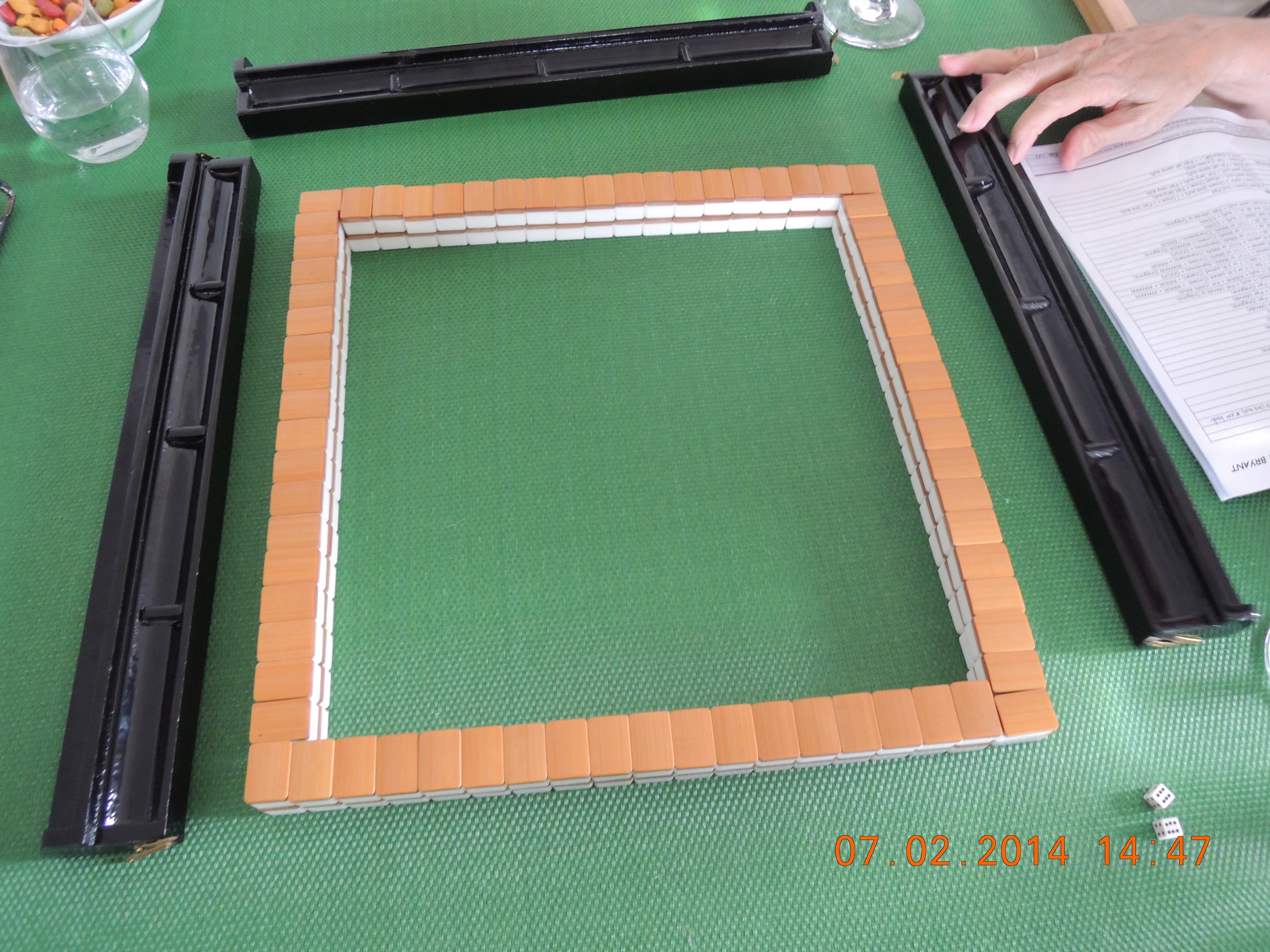
 This is our starting square.  


This is our starting square.  

Etta, Janine, and Judith, yesterday afternoon.  The winning hand, displayed, is mine.  
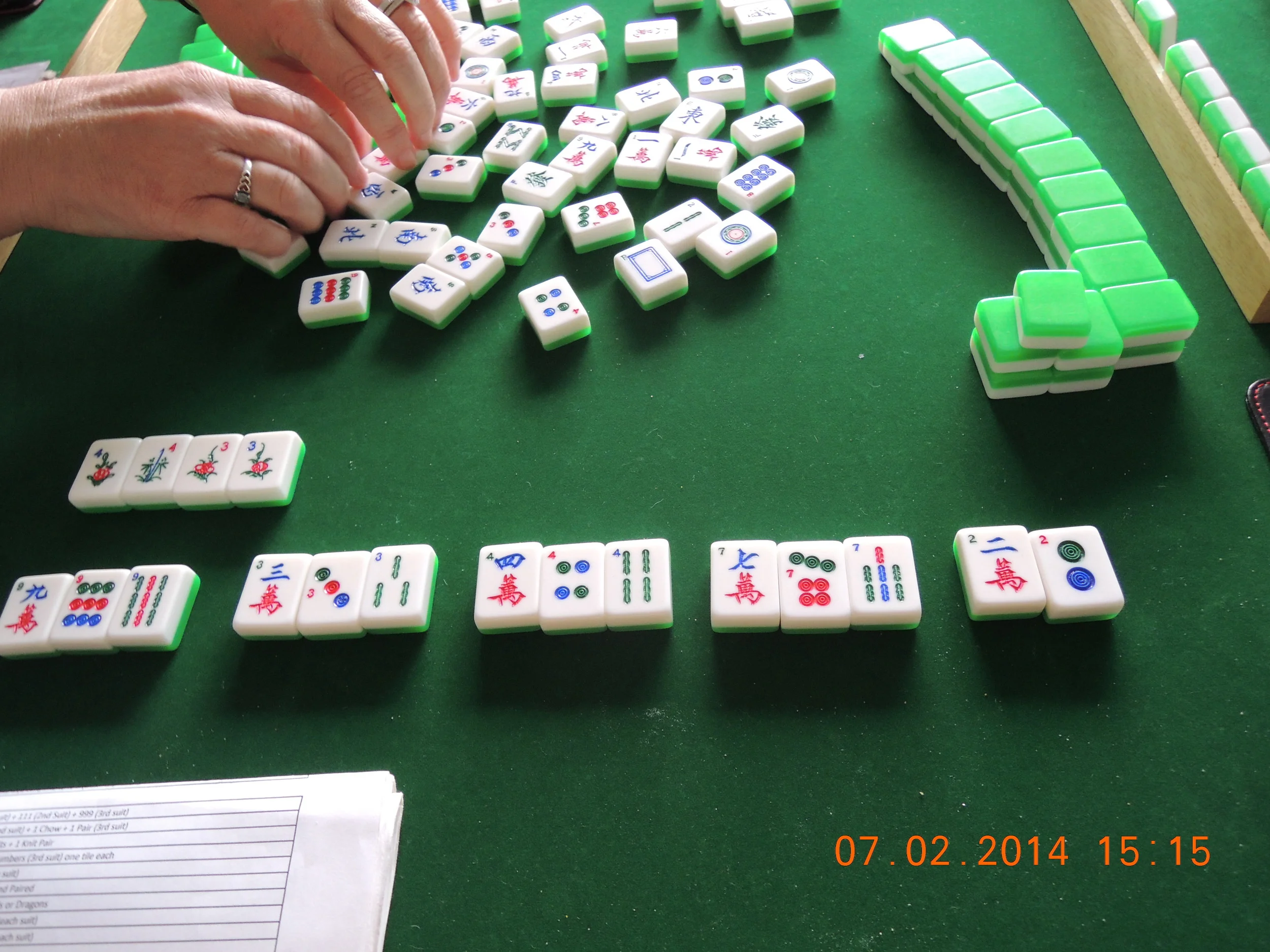
Etta, Janine, and Judith, yesterday afternoon.  The winning hand, displayed, is mine.  

Jane's winning hand, Triple Knitting

Jane's winning hand, Triple Knitting

Isa, Jane, Linda, and Helen--Thanks, Jane, for hosting
Isa, Jane, Linda, and Helen--Thanks, Jane, for hosting

Walking in Singapore

Here are some cultural generalizations that are irrefutable:  Egyptians are good-hearted and hard-working.  The English have a resentful way of looking at things.  Kuwaitis are stingy to the point of dishonesty.  Germans go crazy when they’re on holiday.  And the Singaporeans are unable to walk in a straight line. 

No matter what social strata, everybody here walks.  Well, except for the rich and the really rich, who employ drivers.  The public transit system is good at moving the populace from one place to another, but most people don’t live near a bus stop, and they don’t work across from the MRT.  So quite a bit of walking is involved. 

I walk a lot.  I don’t amble and I don’t stroll.  I lack the patience.  A quick-paced stride is the way I get from here to there and back again.  But, as there are a lot of other people in Singapore who also walk, the crowd dictates the pace and progress is often more wish than reality.  Which is why it makes no sense that people wander sideways instead of going straight.  For instance, I’m walking.  The woman next to me is also walking.  We’re heading in the same direction.  And before I know it, she’s sliding over, pressing into my space, placing her ankle across mine; then she's directly in front of me and she slows, inviting me to crash into her back.  Which I have done on occasion. 

Also, there’s the difficult act of passing.  Imagine a lull in foot traffic.  The sidewalk is medium-width, certainly broad enough for two people to walk side-by-side without brushing; and no one else is on it except for me and one other person, a man, who’s in front of me—and the man is moving slower than I am, and I’d like to get by, get ahead, get there already.  When my decision to pass is made, the guy is to the left, so I angle to pass on the right.  But as soon as I aim myself in that direction, he also shuffles right.  The same thing’ll happen again when I make an attempt at the left flank. 

Scoff, you might.  But I’m telling the full truth about this.  This happens every time I go a-walking.  Every time.  The Singaporeans don’t walk straight.  One of the world’s mysteries.   

Orchard Tower

In Orchard Tower young men and women with slippery voices ask me if I want to come into their shop for reflexology.  The shop is dark and a little creepy, so usually I just wave and pass on by.  Once I surprised them by accepting their invitation to come in and put my feet up.   It was a soft massage, a soothing rub that, while relaxing, was ineffectual.  The woman hunched over my feet seemed to be making things up as she went along—little circles around my heel, an up-and-down stroke between my toes; in general, a lack of commitment that was sad.  Reflexology calls for resolve.  It demands strength coming up from the toes, through the back, across the shoulders, and all the way to the tips of the fingers.  I’ve had reflexology treatments that dug into my arches so hard that I had to bite my lips to keep from bleating in pain.  A good reflexology session will teach you a thing or two about torture.  But in the end it’ll make your feet and lower limbs feel twenty years younger.  It will make your sleep heavier and your dreams fine and colorful.

Back to the people who hang out in Orchard Tower.  The building itself holds many shops—tailors, spas, massage parlors, travel agents, florists.  On the weekend these small businesses take a back seat to the bars, of which there are several.  The whole corner on Orchard and Claymore booms with music.  The air is heavy with smoke and belched beer.  On Saturdays and Sundays David and I often cut through the tower to get home from our errands on Orchard Road, though we could easily walk around, and I don’t know why we don’t, except to say that maybe the energy of the place reminds us of the time in our lives when we hung out in bars and smoked and rubbed our bodies against other bodies in dark corners. 

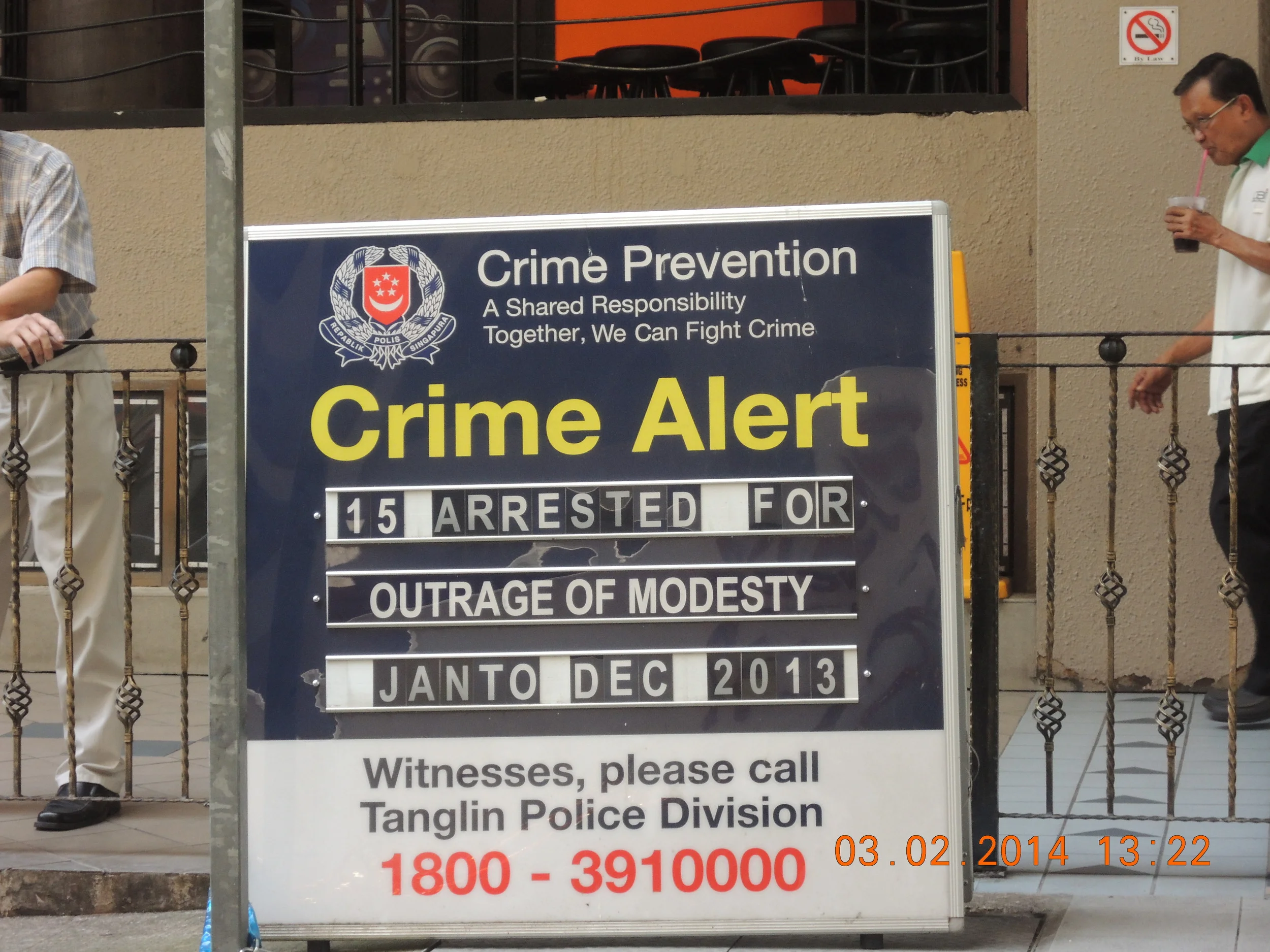
So, speaking of bodies in dark corners:  Three weeks ago someone who has a say in these matters decided to clean up Orchard Tower, which led to Monday morning declarations being posted outside the building.  These notices stated how many were arrested over the weekend, and what they were arrested for.  First weekend—Thirteen people, Outrage of Decency.   Next weekend—Nine people, Outrage of Decency.  Next weekend—Seven people, Outrage of Modesty. 

The numbers are going down, so it’s doing what it was meant to do.  This difference in the naming of the charge is confusing.  To outrage decency, or to outrage modesty—which is worse?  Another thing to be considered is that these people have nowhere else to go to do their groping.  They’re imported workers.  The men work in construction and the women work in homes or shops.  The domestic helpers stay in the homes of their sponsors.  The constructions workers live in shared and crowded apartments. 

Maybe Orchard Tower needs to start renting out rooms by the hour.  

Posted at the back of Orchard Tower--not in front because then everyone on Orchard Road would see.  

Posted at the back of Orchard Tower--not in front because then everyone on Orchard Road would see.  

This is the building from Orchard Road.  

This is the building from Orchard Road.